He is a PhD biologist who has published over 200 papers and worked as a grant reviewer for the NIH. Here he tells his story of transforming from militant atheism to faith and why science itself rejects materialism.
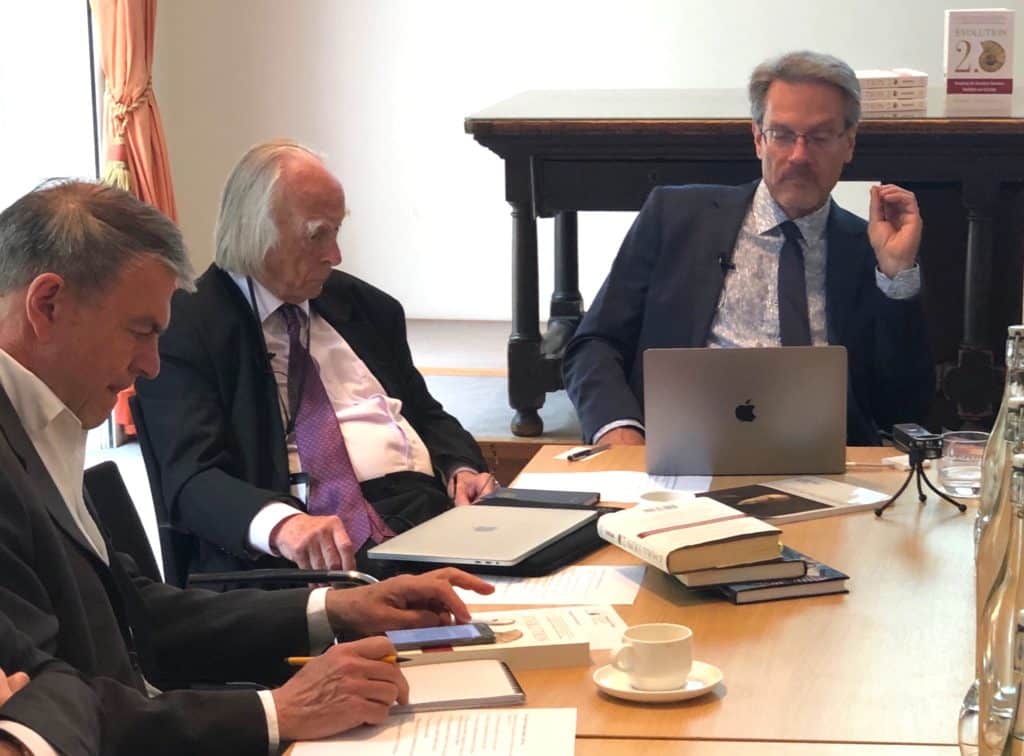
At the Royal Society in Great Britain 31 May 2019, Perry Marshall and investor Kevin Ham announced the $10 Million Evolution 2.0 Prize.
The meeting was hosted by Oxford Professor Denis Noble FRS CBE; and Oxford Professor Paul Flather, President of the Forum for Philosophy at the London School of Economics.
Where did life come from? Where did the genetic code come from? The Evolution 2.0 Prize incentivizes the first person who can discover how code can emerge from chemistry. Such a discovery will bridge the gap between physics and biology.
Origin of Information (“Abiogenesis”) is the crucial question in the Origin Of Life. It’s also central to evolutionary change. It is the most elemental scientific problem that can be precisely defined. A solution may be as revolutionary as Einstein’s theory of relativity or the development of the transistor.
Denis Noble, one of the judges for the Evolution 2.0 Prize, discusses in this interview why we can’t just put lipstick on a pig – why the public needs to be aware that evolutionary theory has undergone a revolution, and how this affects not only religious and philosophical discussions but policies and actions in medicine economics and politics.
This article has been republished with written permission from The Financial Times Ltd.
At the Royal Society in London: Financial Times Science Editor Clive Cookson; Denis Noble, Fellow of the Royal Society; and Perry Marshall at the Evolution 2.0 Prize announcement.
Wealthy investors are offering a $10m prize to the first scientific team that can create a genetic code from simple chemicals — reproducing the unknown process that led billions of years ago to DNA as the vehicle for transmitting information in life on Earth.
The Evolution 2.0 prize is an initiative by Perry Marshall, an online marketing entrepreneur based in Chicago. It will be judged by prominent scientists, including George Church, genetics professor at Harvard university, and Denis Noble, the Oxford university biologist who was the first to model the human heart on a computer.
“The biggest problems in science today are: how life got going in the first place and what is the origin of the genetic code,” said Professor Noble. “We want to know whether the way information is encoded in DNA is the result of chance or whether there are good chemical reasons why the code should be the way it is.”Read more »
Iconoclast, polymath, renegade and world-class chemist, Steve Benner has engineered a new breed of DNA with 8 nucleotide options instead of four. This exponentially increases its data capacity and it’s called Hachimoji DNA.
What are the implications of this?
In this podcast, Steve sounds off about the conflict between research and advocacy, and the great power of shattering paradigms and admitting what we don’t know.
There isn’t code in DNA. Those are just letters we give chemical interactions to be able to talk about them. There isn’t a code in DNA. That’s like saying there is a code in the rain/water cycle. Nonsense.
Nelson,
There’s a guy who often comments on this site, his name is Read more »
Frank Visser discovered Ken Wilber’s work in 1982 and contacted him in 1995 by fax, after which they became friends. Frank has written the first popular academic book on Wilber: “Ken Wilber: Thought as Passion” (SUNY 2003).In this conversation, we discuss Frank’s departure from Ken Wilber’s insistence that life itself and evolution are manifestations of the divine. We explore the question of how theology informs specific evolutionary theories. Does invoking God further science? Frank and Perry take a look at the nuances of Darwinism versus Design.
Michael Behe’s “Darwin Devolves” asks: Has Darwin solved the design problem in biology? Behe says absolutely not, and backs his position with detailed examples. Furthermore, nobody has really solved the famous problem of “irreducible complexity” that Behe described in “Darwin’s Black Box.” But Perry Marshall insists Behe has still omitted vital details and landmark experiments. Bill Cole works closely with Behe, so Perry and Bill discuss: Will Behe’s approach be effective in addressing the shortcomings of mainstream science?
Hoàng Bùi Đình { The ancients through experience and life experience went through generations of refinement to write the Bible and philosophies in different ... }
Fi Parker { This perfectly explains why living systems are different from physical ones. Physics follows mathematical rules because consciousness (teaspoons, rocks, electrons) ... }