


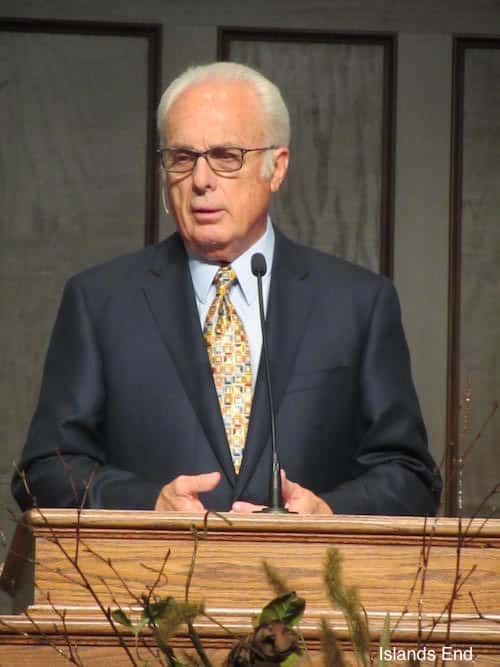
John MacArthur, ally of Young Earth Creation
I grew up in an ultra-conservative, 4 1/2 point Calvinist, expository Bible teaching church. When I was in high school, my church in Lincoln Nebraska brought in a special speaker, the Young Earth Creationist and Bible teacher John C. Whitcomb. He gave a series of talks about science and the Bible.
It was FASCINATING. Ten times more interesting than the usual Sunday Biblical exegesis. A six-part series, a multi-day, power packed tour de force of creation science.
Whitcomb delivered a scorching exposé of the fallacies of carbon dating; he described the worldwide flood; the Genesis account, the deterioration and de-evolution of the human genome; the tower of Babel.
He explained how Noah’s flood accounted for geological anomalies which secular scientists misconstrued as “millions of years;” and how the earth is actually 6,000 years old. He explained how we know that from the Biblical genealogies. I was captivated.
Whitcomb was a pivotal figure in the Young Earth Creation movement. He and his co-author Henry Morris created an entire field known as “Flood geology.” A weekend seminar similar to that one still appears at a church near you multiple times a year. My church growing up was very similar to John MacArthur’s. He’s pictured above.
When I was seven, I had a dinosaur book I wore out from total fascination. It described dinosaurs living 65 million years ago. My 2nd grade teacher taught me how to handle that:
“Just laugh at it.”
So I did.
Origins didn’t come up much in high school or college. Once I had a conversation about Jesus around the water cooler at work. I offered a pretty convincing case for the resurrection, and a co-worker admitted as much.
But he said, “There’s no way you’re going to convince me that all of humanity is the result of two naked people, an apple and a snake.” I didn’t have a comeback.
I professionally subscribed to a publication called Sensors Magazine. It struck me how technologies – especially sensors, from cameras to ultrasonics to devices most folks have never imagined – are greatly inspired by sensors in the human body and animal kingdom. As an engineer I intuitively sensed a tremendous level of design in nature.
I also knew there were a LOT of questions I couldn’t answer. I wasn’t exactly seeking opportunities to debate.
One day I heard up talk by astrophysicist Hugh Ross called “New Scientific Evidence for the God of the Bible” and it set my mind on fire. This guy explained how the Big Bang was first proposed by a Catholic priest in 1931, scorned for years, then reluctantly accepted in the mainstream. Why? Because evidence for a single discrete beginning 13.8 billion years ago had become overwhelming, despite secular bias against it.
He showed, verse by verse, how modern cosmology and the opening verses of Genesis match exceedingly well. All that was needed was a shift in perspective, a few very elegant assumptions.
So long as you assume a “day” is a period of time, and take the story as being told from an earthly vantage point (which is established in Genesis 1:2), it all fits – tit for tat. Ross described the extreme fine tuning required for gravity, the expansion rate of the big bang, forces, constants etc – physics facts Electrical Engineers are quite familiar with. Wow. That was a mind-blower.
Guess what – no conflict between mainstream cosmology and Genesis after all.
I sent Ross’s tape to a physics professor friend of mine. He wrote back with a rebuke: “David Hume dismantled the ‘design argument’ 200 years ago.”
His reply didn’t contain much actual substance, however. He did nothing to explain the fact that no plausible re-configuration of any of those interdependent constants would result in any kind of coherent universe. Nothing more than a hand-waving dismissal.
I plowed forward, happy to now have a general cosmology that matched the Biblical one – but on a much grander scale. Guess what, those dinosaurs really did live 65 million years ago and it’s not a problem.
The story I’ve told so far will make Old Earth Creationists quite happy – and Young Earth Creationists unhappy. The reason it makes YECs unhappy is… YEC is brittle. Any change to the story forces them to disassemble quite a number of theological shibboleths and re-assemble them.
Go down this road and you’ll soon find major Biblical engine parts scattered around on the shop floor. For awhile may not feel quite sure if they’re going to go back together.
This is anathema to a traditional evangelical. Especially where I came from. Our systematic theology was a vast spreadsheet of theological exact answers and precision-formed parts, carefully engineered and fine-tuned like a NASCAR drive train.
To a traditional evangelical, this comes down to an issue of authority. “Are you going to believe godless secular scientists? Or are you going to believe God’s word?” This is how Answers In Genesis frames the question. It’s either/or, black-and-white.
There’s little dance or interplay between science and theology. You take the plain sense literal reading of Genesis, you eschew those “liberals” who “compromise” God’s Holy Word.
Any apparent disagreement with science is obviously a science problem. Not a theology problem. Not an interpretation problem.
When I was in high school I had debates with my pal Pat, who belonged to a traditional strand of Church of Christ. COC interpreted not a few, but MANY things differently than my home team. I saw that as they rotated their theological Rubik’s cube, they matched some pieces much differently than we did. As I became familiar with other protestants and Catholics, I saw that the re-configurations of Christian theology can be almost endless.
The central pillars of Christianity are quite solid. It’s pretty hard to come up with anything much different from the Apostle’s Creed, for example, without butchering the Bible. But once you get to secondary and tertiary issues, there are many ways to work the puzzle.
I was a pastor’s kid. As Biblically educated as anybody’s likely to get short of seminary. And already by age 20 I viewed the 10-decimal precision and proclaimed certainty of reformed evangelical theology with a jaundiced eye.
I noticed that theologians fiddle with interpretations for their entire lives, and do clever sleight of hand with each other (with plenty of petty name calling, posturing, shaming and shunning) to win debates and protect egos. I knew too much about the Bible to crown one single, rigid, Ken Ham interpretation as king – or anybody else’s for that matter.
Don’t get me wrong, I embrace the inspiration and authority of the Bible. I believe in the lifelong pursuit of truth and discernment. But I believe the value and experience of twisting the Rubik’s cube itself is actually more important than the particular Rubik’s configuration your cube happens to land on today. Nuances of theology are squishy. That’s a fact.
I also think the capacity to dialogue with people who disagree with you, and still love them without losing your cool, is much closer to the “point” of Christianity than whatever doctrines we abstract from the stories and texts.
Also:
As an Electrical Engineer, I found some things in science are not squishy at all. Like the speed of light. It’s the “c” in Einstein’s “e=mc^2.” That “c” appears all over the place in physics. It’s in Maxwell’s equations, which define light’s essential behavior; “c” cements the relationship between electric fields and magnetism, and we can measure it with ten decimals of precision. 299,792,458 meters per second.
There is nothing remotely controversial about this in science. (Contrast this to Darwinism, for example, which has been plagued with endless problems and conflicting data for 150 years.)
The speed of light, so far as I know as an electrical engineer, is a constant in physics. Sure, light’s speed changes in a prism, but as a physical constant it does not budge. It doesn’t even shift with the speed of objects. As far as we can tell it’s an absolute barrier.
Q: If a star is 100 million light years away, when did that light leave the star?
A: 100 million years ago.
All kinds of YECs have tried to dodge that question and that answer. None have succeeded. If they were right, physics itself would be a complete mess. But it’s not. Physics works like a precision-built Swiss watch, thank you very much.
Therefore… in the alleged authority battle between science and the Bible… for me, speed of light won.
Once I began seriously considering this, I realized that if the Bible actually intended to say the universe is 6,000 years old, then it could not even be inspired by God.
The universe is old. Period.
But upon further study, I’m not convinced anything in the Bible contradicts that. Rather, YECs have been reading a young earth into scripture for 100 years.
Yes, you can explore whether the speed of light is changing, whether God made the universe to LOOK old even though it’s actually young. I invite you to research to your heart’s content. Personally I’ve been down those trails and I caution you that any of those positions will back you into a corner that you cannot get out of.
Our often-squishy theology needs to make room for verifiable facts. Like the speed of light.
Any honest apologist or thinking Christian surely has to admit that quality of evidence comes into play. The Bible is FULL of history-based truth claims (which is not the case with other religions, like Hinduism and Buddhism).
For example: the honest Christian should be able to say that IF someone really did produce the body of Jesus, if they proved that Jesus didn’t actually rise from the dead, then Christianity is therefore not true. And then we are truly “above all most to be pitied” as St. Paul said.
Is it not true that Christians criticize Mormons for believing in entire civilizations in South America that left nary a trace? For believing that American Indians are actually a lost tribe of Jews, even though DNA evidence contradicts this?
Is it not true that Christians criticize Jehovah’s Witnesses for predicting the end of the world multiple times, and being wrong?
So if Christianity is historical, shouldn’t it be falsifiable as well?
Why does YEC get a free pass in making up its own version of history, yet Mormonism doesn’t?
We should be willing to abandon Christianity if we find it’s not true. By the same token we can shout it from the rooftops if we find that it IS true. That’s the position the apostles took in the book of Acts.
And yes, we can and should use verifiable scientific facts to judge between competing theologies.
Oh, and by the way…. most people at this point would pile on a litany of other problems with YEC. Most articles like this one sport a list of 10 major problems or more.
I don’t need all those. I only need one. Speed of light. It’s exact, you can measure it in the comfort of your own home and you can do the math. Math doesn’t lie.
The other problems with YEC are more fuel for the fire.
We know the earth is old. If that’s true, what theological dominoes fall?
The first domino is the notion that there was no animal death before the fall. Nothing in the fossil record suggests a death-free world before man showed up.
THIS is the lynch pin of YEC. It’s not the word “Yom” (day) in Hebrew, it’s not something else. It’s the issue of death before the fall. Let me explain.
The central cornerstone of YEC is belief that 1) earth was a perfect paradise, 2) God could not make any world that was less than perfect and pristine, and 3) “Through one man sin entered the world, and death through sin” (Romans chapter five.) For YECs, that means ALL death, not just men, not just men’s spirits.
This holds YEC in place. It’s a theodicy (account of evil despite a perfect God) that many Christians are comfortable with. Throw that out and you have to start over with your theodicy. You’ll need a more complex picture of God.
If earth is old, if bears were eating salmon 50 million years ago, if alligators always had sharp incisors, then God fashioned an extremely inefficient universe where conflict was baked in from the word go.
Cancer and bacteria and weeds and parasites have been around as long as there have been plants and animals.
That, to the traditional Christian mind, is too much to stomach. (Though the same Christian seems to have no quibbles with various other cruelties, both in the past and future.)
My late colleague Michael Marshall asked, “Which is more dangerous? A world with pathogens like viruses and bacteria? Or a world where the 2nd most powerful being in the universe is a serial killer boiling with rage, salivating for an opportunity to devour everyone?”
Did you ever notice that in the Adam and Eve story, God doesn’t even warn them them about what’s coming, or who? He certainly doesn’t do what any normal parent would do.
Nevertheless God declared the world to be very good. Despite the fact that peril was built in to the picture before man ever showed up.
In Genesis 1:31, when God says “And God saw all that he had made and it was very good,” do you know what the Hebrew word for “Good” means in the original Hebrew?
It means “Good.”
It does not mean “Perfect.”
I can still label planet earth a “good” world. I cannot label it “perfect.” I don’t have to like all of it. I can still agree with God that it was good. Exuberant parents bring newborn babies into this good world with joy every single day.
The assertion that God would never make anything “imperfect” flies in the face of not only science, but Biblical theology. And good luck coming up with a coherent definition of “perfect” that aptly describes any created thing.
What did God say to Moses in Exodus 4? “Who gave human beings their mouths? Who makes them deaf or mute? Who gives them sight or makes them blind? Is it not I, the Lord? Now go; I will help you speak and will teach you what to say.”
This raises even more questions that I’m not going to answer in this article. Some of those are:
–Who was the first man? Who was Adam?
–Was Adam a Real Person?
–Was Noah’s flood global or local? How does known Middle Eastern history overlap with the Biblical story?
–Is “death” in the fall physical death, or something else? Does it apply to animals?
–How do you read Genesis 1 from an old-universe perspective?
–Was the Grand Canyon formed by the flood?
–What about evolution? Is evolution Biblical?
You can follow the links above for more on these questions. Meanwhile, basic facts of science which are now beyond reasonable doubt call YEC into question.
God wrote two books: the book of scripture, and the book of nature. I do not believe there is any conflict between the two. But our understanding of both will never cease evolving.
And that is why I am not a Young Earth Creationist.
Download The First 3 Chapters of Evolution 2.0 For Free, Here – https://evo2.org/evolution/Where Did Life And The Genetic Code Come From? Can The Answer Build Superior AI? The #1 Mystery In Science Now Has A $10 Million Prize. Learn More About It, Here – https://www.herox.com/evolution2.0
So you went to Indian Hills Community Church? I saw Whitcomb there when I was a student at Nebraska Wesleyan University. I was probably in the auditorium at the same time.
Small world.
You are overlooking a few realities;
The most established law (the second law of thermodynamics ) and universally accepted reality that the universe “started out” in a state on “minimum” entropy, when cosmic order, information and usable energy was at its premium or maximum state. This necessitates that the universe at that short span of time was of necessity fully formed and fully functional, that’s what a “minimum” entropy state represents, just as the genesis account of origins reports. the Scientific world also operates on the premise that the universe inflated to a gigantic size in less than a second. While it takes an enormous time for light to travel “through” space to distant parts of the universe, there is no such limit how fast space itself can rapidly inflate. Making the speed of light through space totally irrelevant. Thus, at the very beginning we have a fully formed universe in a state where cosmic order, information and usable energy is at its maximum, in a universe that rapidly inflated to a gigantic size right at the beginning, just as the Genesis account of creation states. You also need to know that there is no instrument know to science that DIRECTLY measured the age of anything. Meaning that all dating methods and systems operate entirely on “assumptions”. So, all you have to do to play the dating “assumptions” game is select which ages you prefer, thousands or millions of years, and select which dating assumptions you want to put in your bag of tricks. I decide to go with the Genesis account because it is impossible to “stretch” the genealogies from the creation of the universe and Adam to Christ over billions of years. A reality Hugh Ross has yet to discover.
I find it interesting that one takes a literal successive genealogical approach to estimate the age of the earth when there are 10 generations listed from Adam to Noah (pre-flood) and 10 generations from Shem to Abram (post-flood). Are the 2 sets of 10’s mere coincidence or highlights of genealogy using 10-digits (fingers) as memory device?
Moreover, by insisting a 6,000 to 10,000 year earth history, which places the flood at approximately 4,500 years ago, how would a YEC reconcile the fact that there are now billions of species that could not possibly fit on the Ark… which were not later created since God ceased his creative work after Day 6.
One of the major issues relevant to the debate between YE creationism, OE theistic evolution, and ID evolution is the definition of “kind.” Evolutionist, be they theistic or pagan, wrongly like to associate “kind” with “species” in order to discredit YEC and the great Noah flood. Truth be told, we don’t really know from the Bible what the distinction of “kind” is. I would think it lies more between “family and “genus” than “species” although these are all man speculated classifications. Of course there are millions of species that could not fit on Noah’s ark, but the Bible says two of every “sort’ or “kind.” When I first read Evolution 2.0, I went into it assuming Perry, professing to be a Christian, was supporting evolution within “kinds.” Very few if any YEC deny evolution within kind unless we wish to debate if evolution within kind is really the same as “adaptation.” (This also gets in to the semantics of micro and macro evolution. Secularists like to state that evolution is fact without making the distinction between micro which is a fact and macro which is not proven and discredit Creationist because they don’t believe in (macro) evolution.) After reading the debate between Perry and Stephen Meyer, it appeared to me as though Perry is associating macro with evolution of the species, not just kinds and that everything has evolved from a single God created and information implanted entity. I do not believe the position of everything evolving from one single entity, even if that entity was created by God can be in any way supported by the Bible no matter how you try to interpret Genesis 1 and 2 and Exodus 20:9-11 (which is another whole area of questionable interpretation.) If I understand correctly what Stephen is saying, I believe he is much closer to the Biblical truth in that God created the “kinds” on the different Biblically specified days or, if you want to believe, ages. I know “God of the gaps” is being accused here. And when it comes to origins and later miracles that defy natural explanations, what’s wrong with that? At some point unless you believe in pure naturalism and something out of nothing, you have to claim “God of the gaps.” If you believe God created that first entity, you are claiming “God of the gaps” to explain how the specified information got into that entity. You have to claim “God of the gaps” for water into wine, for the virgin birth, for the resurrection, etc. But, back to the problem of the proliferation of species, Evolution 2.0 makes a very convincing case for very directed rapid speciation—within “kinds.”
We also don’t know whether “after their kinds” is a rigid rule or a general principle.
The only people that use the ‘God of The Gaps’ phrase are the ones opposing God. For the most part, this is the atheist. I have never heard this phrase come from a believer in a scientific discussion. It is an atheistic defeater, utilized to capture ignorance on the part of the believer – to explain something science has yet to discover.
Only the opposition to God ever uses it, (i.e. the atheist.) It is NEVER claimed by the believer in any scientific argument.
Science claims to know what? 4% of the known universe? These tend to be the ones espousing multiverses, too. This diminishes that 4% right down to obscurity. Anyone believing that science is mostly right, at this point in time, is pompous, arrogant, AND denying scientific history. They will laugh at us (what we think we know,) 1000 years from now, as surely as we laugh at what our ancestors thought they knew 1000 years ago!
Science is always making discoveries. With every new discovery comes the knowledge that we (Science) don’t know much about the new discovery. This confirms there is always more to discover, and with every discovery, there is a new universe of knowledge which unfolds FROM that discovery. As scientific knowledge grows, the database of POTENTIAL knowledge necessarily grows exponentially.
Science continually discovers it knows LESS than it previously thought it knew. This is THE scientific model – – of Science itself.
Well said. (Although Christians also resist God of Gaps arguments, I being one.) Use your last name from now on, your opinions ought to be properly signed.
No one can convince me that all of humanity is the result of two naked people (created, of course, by a male in his image and to boot, a woman from the man’s rib), a wily serpent planted in a garden, and a tree with forbidden fruit to start the whole ball rolling. If it was true, it was all rigged from the git-go.
Tara, modern-day research tells us that the first humans were from the same geographical area recorded in the Biblical record. Just the facts. Again, doesn’t matter what you believe. It is what it is, and all of us have to deal with it.
Jose, with due respect, that is not a fact. There are thousands of sources that contradict biblical “records,” which are not records at all. The book of Genesis is one tantalizing tale of many written in a big book around 700 BCE that caught on. Adam and Eve are names in a story and the earth itself has been proven to be around four billion years old. It is as if the Bible is the only book worth reading and yes, the bible is one of the great classic. That includes the Mahabharata, the Bhagavad Gita, Siddhartha, and myriad story books held as sacred as Christians hold the Bible do, and whose authors “recorded” differing and equally unscientific versions of how the world began. The Bible is not a behavioral manual by a deity, it is all beautifully written as fiction with virtually all of it taking place in a single geographic location, Israel, Jordan and Palestine. We didn’t have to be told by some male deity that man created for political and control motives that killing, lying, stealing, cheating on your spouse, et al, are morally wrong.
It will do no further for me to belabor the subject further with people who refuse to burst out of their biblical bubble.
Throughout life I have read tons and tons of differing views including this blog which has mini-books by contributors who seem to be vieing with each other to get their pointsacross. All I will do is suggest some scientific articles that may shed light on genetics that aren’t biblical or combative so try checking these out:
1) biologos.com (I found this by googling Does Genetics Point to a Single Primal Couple? and coincidentally that was the title. This tells where in Africa (not in the biblical area as you say, and also how and why genetics does not point to one couple.) Much less in a lush garden…
2) Wikipedia.org /wiki/homo_sapiens_idaltu (which includes a human time line as well as interesting and scientific discoveries).
3) http://www.biblicalnonsense.com/chapter6.html (titled: 101 Reasons Why Noah’s Story Doesn’t Float” is written in an unabashedly non-scholarly and ironic but not disrespectful style using common sense. The article’s many subheadings are convenient for lay persons. Check out the subheadings Animals, then contemplate how impossible a task it would be for a man, a woman, and three sons to be competent seagoing zookeepers in Genesis Chapter 6.
I know: The final “shut up” answer of ultra-conservative Christians is “Well, God did it this way Because He Could.” So have the last word, Jose. I respect you as a person but not your frightening religion.
Tara, first of all I don’t have a religion. I don’t need you lecturing me with the idea that Christianity is a religious thing. My faith has nothing to do with any religion. And, just to clarify your attempt to differentiate the holy books of our modern day culture: the Bible is the only book that speaks of our universe coming into existence outside of space and time. This universe is not an eternal entity. Just need to clarify that with you before anything else.
Jose Lopez, for another perspective relating to the Hebrew text and context of Genesis 1, I would encourage and challenge you to read “As It Is Written” by Kenneth Gentry, Jr., h.D.
Also another book to read is “In the Beginning… We Misunderstood” by Miller & Soden (Kregel Publications). It’s hypothesis is since the ancient Hebrew people Moses was writing to were pre-scientific, i.e., physics and cosmology, then, Genesis shouldn’t be read as a science text (though it may contain some science facts).
Tara Stuart, concerning genetics, I would encourage and challenge you to read “Replacing Darwin: The New Origin of Species” by Nathaniel Jeanson, B.S. in Molecular Biology and Bioinformatics and PhD in Cell and Developmental Biology. Perry Marshall, you also may find this book of interest.
Tara,
Please do not let me interrupt your discussion with Jose, but if I may, I would like to interject a comment from a perspective that may be unfamiliar to you. Even if it does not interest you, maybe someone else will appreciate it. Whether you ever burst out of your anti-biblical bubble or not, what I say here might provide food for thought.
Focus is good, so instead of trying to address all of the “scientific articles” you recommended, I would like to concentrate on the one you described as “written in an unabashedly non-scholarly and ironic but not disrespectful style using common sense.” I assume it was written by Dr. Jason Long.
We can agree that the Genesis account of the Flood is “highly questionable,” but Long’s attempt to convince us that it “doesn’t float” is actually full of holes. He only imagines that he is “thoroughly demonstrating why the Bible is not the holy word of any deity.” To keep the length of this comment reasonable, I will focus on just a few points where his reasoning goes against common sense. I am convinced that his main conclusion is incorrect in spite of some points that are well taken. If you want me to focus on some other point in particular that ought to change my mind, please call it to my attention.
Negatives are notoriously difficult to prove, but the article “101 Reasons Why Noah’s Story Doesn’t Float” is a valiant attempt to prove one anyway without appreciating the difficulty, probably on the safe assumption that many readers will either feel more comfortable with an existing conviction or else be persuaded to accept Long’s conclusion without independent use of common sense.
Long repeats over and over a pattern that fits his purpose. Take some detail of the story not specified in Genesis, fill in missing information with a guess, point out how improbable or unworkable it is, and conclude that “Noah’s story doesn’t float.” Let’s take a case in point.
“To this day, no one has ever been able to assemble a seaworthy boat the size and best possible composition of the ark … Experts in the field agree on the long established three-hundred-foot limit for a wooden vessel, yet the ark extends 50% beyond this repeatedly verified limitation. In addition, researchers carried out their attempts to break the three-hundred-foot barrier under tranquil weather, not conditions indicative of the apocalyptic downpour depicted in Genesis.”
Genesis covers few details of ark design. Not even the thickness of the hull is given, let alone the thickness or arrangement of interior walls, the means for holding the ark together, or the properties of the type of wood used in its construction, but Long evidently guesses that his experts, when they ran experiments to find a length limit, actually tested a design close enough to the design dictated by God to Noah. Where are the modern experiments documented, so we can consider what designs were tested? Long assumes that a cubit is 18 inches long, but can we really be sure that it was no longer and no shorter according to the convention that Noah followed? I don’t think we can. The conversion factor seems to be an educated guess too. Do we really know how “apocalyptic” the downpour depicted in Genesis was? No. Long guesses that it must have been too heavy for the ark to stand it. Is it common sense to conclude that his guesses and overall conclusion must be correct? Isn’t a measure of skepticism reasonably justified?
I think this is like a man concluding that his lost eyeglasses must not be in his house, because he already looked everywhere he often puts them but failed to find them. Based on common sense, we should agree that he might not have looked hard enough. How do we know that Long looked hard enough for workable solutions to the problems he covered? Can anyone in our day possibly know enough about actual details to be sure that his judgment about the plausibility of the Flood story in Genesis holds water?
The careful reader should be on the lookout for cases where Long distorts a detail that *is* given in Genesis. For example, he says, “… [Noah] would need to select a grain and species strong enough to prevent separation between the ark’s joints during its hazardous journey. For reasons that should be painfully obvious by now, I doubt this mysterious ‘gopher wood’ was selected using such advanced analytical thinking.” According to Gen. 6:14, Noah did not need to select a species of wood, because God told him what kind to use. What rational basis does Long have for his doubt? Does he suppose that God is incapable of analytical thinking, so he might carelessly specify the wrong kind of wood? To a believer, that is nonsense. To someone who thinks like Long, it may not matter whether it makes sense or not. Maybe it is only the dramatic effect that counts.
One key issue is the expected date of the Flood of Noah according to biblical chronology. Long reveals what he thinks it is when he says, “Records of flourishing civilizations in China, Egypt, Babylon, and Mesopotamia exist straight through the flood era of 2500-2000 BCE.” These dates should not be particularly surprising, because I dare say the majority of Bible scholars would agree that they seem to be about right. But what if they are off by a thousand years? Looking for Flood evidence with a date so far from the correct date would almost guarantee failure, but Long evidently neglected to consider this possibility. Dr. Gerald E. Aardsma has proposed a reasonable biblical chronology with a Flood date at about 3520 B.C. and found plenty of evidence to confirm the historicity of a flood consistent with a reasonable interpretation of the Genesis account. This is no place to go into excruciating detail, but here is a link to his website.
http://www.biblicalchronologist.org/
Note especially the fourth book in the top banner, the one on aging, available as a free PDF download. It explains how Aardsma discovered an experimental vitamin through his study of life span information in Genesis and his theory of the Flood. His theory explains where most of the water came from and where it went after the Flood, a possibility that Long failed to consider.
I admit that Aardsma’s ideas are not well known or well vetted. His ideas could eventually require adjustment or even replacement, but if his ideas must be rejected, it does not logically follow that no other Flood theory can possibly hold water. A rational skeptic ought to avoid falling for the argument-from-ignorance fallacy. I recommend that Flood skeptics consider Aardsma’s Flood theory with a relatively specific Flood date and good reasons to believe that it is accurate, which makes it especially remarkable.
Thank you for your interesting discourse meant to contradict and it was impressive. Religious people are impossible to argue with; they worship something that was meant only as a fantastic tale. I am being labeled as someone who is only wrong, directly opposed to a belief you hold. But the bible, like many smaller books, is rife with both monstrous and lovely tales.
For example, if you are a believer in only the bible being inspired by a god, the old testament will answer your questions by showing that is mostly fiction. To name a few, read the gory Leviticus. How can a loving god order these things d one t o people?
The old testament encouraged polygamy and slavery and a god of wanton murder. If you believe in 7 24-hour days, then how can anyone swallow a tale that “Adam” lived hundreds of years and Methuselah lived 969 years, and Samson killed thousands with the jawbone of an ass? The other religions have equally implausible tales. The new testament has a less active god, who lets a man be crucified. Paul admonishes slaves to obey their masters…..ad nauseam.
I won’t waste 3 pages to rationalize or argue your very determined writings. It is all very well written, just to support nonsense. The main point is that all of your sources are written by mere humans like us, not gods.
Tara, I think there’s a common misconception about the character of God. Yes, He’s a loving God. But, He never claimed to be somekind of a teddy bear. Yes, He sent His Son Jesus to His death. You may be missing His purpose in don’t that. Everything He does has purpose. He’s not just ordering the death of people. Last I remember, without physical death, it’ll be difficult to experience eternal life. The whole basis of Jesus dying on that cross was to atone our sinful natures. He didn’t have to. He chose to because that was the way to Him determined by Him. That’s the Christian faith. Without the blood atonement, the Christian faith is dead.
Tom, this is an open conversation. I’m going to back up for a minute, and I may have already repeated what I’m going to say. The church has an ongoing debate between young earth and old earth creationism. One side is saying no science because God’s powerful, and He created our planet in a nanosecond without any respect to the laws of nature (sometimes known as the space-time laws) which Scripture says He created, and which, by the way, have not changed. The other side is saying yes to science because we can see it thru our telescopes, which couldn’t have happened in a nanosecond because it took time to shape our formless and void planet. I don’t think any of that matters to Tara, and many others, no matter how magical or scientific it seems to be. Looking at the overall picture, my position is that this debate is an English language issue, as you and I both know the Scriptures were not recorded in English. We must comprehend God’s point of view before we decide what interpretation to pursue, which smacks us in the face from the first two verses in the first chapter of Genesis. There isn’t one Scripture that tells us how much time passed, or what happened, in between verses one and two. Common sense will tell us it wasn’t a twenty-four hour period of time. Astronomers have an easy analysis of why a twenty-four hour period is absurd. A “true child of God” will tell you that God’s point of view leaps off the pages in the first chapter of Genesis. While young earthers will lead us to believe that God didn’t need science. He’s a powerful magician who held up a gigantic flashlight upon the earth because He hadn’t created the sun, moon, or stars until the fourth day. It’s no wonder why culture laughs at Christians when they hear these young earthers preaching these twenty-four hour interpretations to their congregations. It’s a shame, and a dangerous virus that is infiltrating the minds of our young people, maybe including our own children. It’s also no wonder why kids are leaving their faith, and maybe why people, such as Tara, doubt the Christian faith. While Perry and I may not always agree on every detail, it’s quite clear Tara and Tom, that God is a scientist because the Anthropic Principle shows us how He’s holding it all together. Can we also say miraculously?
Jose Lopez, there is no valid reason from the text of Genesis to assume that any time took place between 1:1 and 1:2; that doesn’t mean the Old Earth/Young Earth debate is solved, but the “gap” theory just isn’t a good answer. The grammar of the phrase “and the Earth was…” (והארץ היתה) is identical to many other places in Scripture that communicate a past tense state of being. In Biblical Hebrew, if I want to communicate the idea of “becoming” the preposition ל is required.
Mike, the Biblical interpretation of the days of creation being long periods of time has nothing to do with the gap theory. That’s a common theory that atheists and some scientists use. Not sure which is most disturbing : the young earth camp, or the fact that you think my world view lies in the hands of a gap theory. Tara, my interpretation of God’s Scriptures has nothing to do with any gap theory. We’ll leave that humorous idea to our world class atheists.
Jose Lopez,
You said “There isn’t one Scripture that tells us how much time passed, or what happened, in between verses one and two. Common sense will tell us it wasn’t a twenty-four hour period of time.”
The suggestion that there is an indeterminate gap of time between verse 1 and verse 2 is BY DEFINITION a “gap” theory. Placing a gap between verse 1 and verse 2, as you have suggested, isn’t the only version of a “gap” theory but is the most popular version of the “gap” theory. It is a creative idea but it isn’t linguistically supported by the Hebrew text.
What is humorous is that you proposed a version of the “gap” theory but don’t seem to recognize that is what you proposed. If you reject a “gap” theory, then you must reject, by definition, any proposed gap of time between verses 1 and 2.
I’m going to assume that you know that Biblical Hebrew consisted of about three thousand words excluding names. The word Yom, translated day in English, has four literal definitions. Again, Mike, this is an English language issue and not a gap theory debate.
Yes, I read biblical Hebrew fluently. While the language does have a limited vocabulary, it is a bit bigger than you have suggested.
Since the Hebrew word יום does not appear in the first two verses of Genesis, questions about the interpretation of those two verses are not dependent on any definition of יום
In regards to the meaning of the word יום, I can give you many examples where the word does not mean a literal 24 hour day. Zach. 14:7 is one such example and another is 2 Chr. 21:19. In the latter example the Hebrew text says “two days,” but every English translation correctly renders this as “two years.”
Another issues in trying to understand a Genesis timeline is understanding the genealogies. Here is an article I wrote a while back on Genesis genealogies.
http://hamilim.netronix.com/2016/07/20/please-dont-create-unnecessary-division-among-believers-over-gods-creation/
Mike, can you elaborate on genealogies ?
Jose Lopez,
Thanks for making me feel welcome to participate in your conversation. If Tara has dropped out, I hope it is not my fault. She may have a comment waiting for moderation, but I see nothing of hers here later than the one where she suggested checking out the “101 Reasons” article that interested me. It was dated January 23.
Thanks for summarizing your perspective on the ongoing debate among Christians regarding the proper interpretation of Genesis. From my own perspective, there are more than just the two sides, or maybe you would say that the two sides are each divided into factions.
You call one side “young earth,” the other “old earth,” but I would rather not encourage the use of this terminology, because words mean things. The earth cannot really be young if nothing in all of creation is older than the earth, which is what I believe, and I suspect that most creationists who take Genesis literally as straightforward history agree. It is the other side that considers the earth to be young, billions of years younger than the oldest galaxies and the universe as a whole.
As far as I know, no one on my side “is saying no science.” It is just that we insist on a clear distinction between science and history. Science is a tool for investigating and understanding nature and the laws of nature through use of the scientific method, which involves interpreting evidence and the results of experiments under the no-miracle presupposition, sometimes called methodological naturalism. We embrace science in this context. It has been extremely useful in developing our modern technology. This contrasts sharply with history, a search for the truth about what took place in the unobserved past. Historians, as opposed to scientists, rely mostly on documents and testimony deemed credible, not a study of physical evidence, although this could be helpful in cases where relevant archaeological evidence has been uncovered. We do believe that God worked miracles of creation, but the laws of nature were instituted by God as well, and created objects have been subject to those laws ever since, with the possible exception of rare times when a later miracle was performed.
You suggested that we believe God “created our planet in a nanosecond,” but I have never heard of such a claim before. You must be exaggerating. We believe God took six days to finish his work on everything made in the beginning, but we have no basis for saying how long it took God to make anything during his work on a given day, except to insist that it must have been less than 24 hours. This means that a nanosecond qualifies, but the actual time could have been much longer. We are not told how long exactly.
Evolutionists on the other side agree about science with respect to the context I specified above, but they like to blur the distinction between science and history, considering their work on writing a tentative, speculative, history of our origins to be quite scientific. They may claim that they see history through our telescopes, but this is merely a convenient distortion of what really goes on. No star has a date tag on it, let alone a history lesson. Observations are made through probes, telescopes, and other instruments, and this is the way investigators amass raw data, but before a history can be written, someone has to interpret collected data based on certain assumptions that may or may not be true. As you might expect, one of their key assumptions is that no miracle or supernatural intervention was ever involved. They may consider their conclusions to be facts, but this is really just a comfortable illusion, unless “facts” are supposed to change every time a conclusion has to be updated as more is learned.
Within the evolutionist camp, there are both atheists and Christians. People belonging to the latter faction may consider themselves to be creationists too, because they believe that God created by using the process of evolution. Marshall Perry may belong to new faction that believes the traditional evolutionists are wrong about the importance of chance in the process, insisting that living things direct their own evolution, perhaps by using designs endowed by God. I don’t know whether he has tried to extend this concept to stellar evolution. Maybe I will find out when his book arrives, maybe tomorrow. One thing everyone in this camp seems to have in common is the idea that secular histories of our origins should be considered a higher authority than Genesis, so if there is a conflict, one must either reject Genesis as myth or legend or reinterpret it to harmonize with the “scientific” history as it currently stands. Either way, evolutionists understand that further adjustments or refinements may be necessary at any time, because the scientific approach requires this flexibility.
Within the camp that treats Genesis as the highest authority, there are also factions, but maybe not so well known. I suppose I belong to a fringe faction that is interested in the work of Dr. Gerald E. Aardsma, who has proposed ideas not widely known or discussed. Here is his website.
http://www.biblicalchronologist.org/
Is the debate in this camp just about English translations of the original Hebrew? I agree that there are disagreements about the proper interpretation of some Hebrew words, especially the word for day (*yom*), but I think there is much more than this behind the differences of opinion.
On the proper interpretation of the first two verses in Genesis, I agree with Mike Tisdell. You and he both seem to reject the gap theory, and I certainly do too. I like this article that explains how the first three verses in Genesis fit into the narrative structure of the account:
https://creation.com/genesis-13-undermines-gap-theory
I think Mike correctly put his finger on the reason for the confusion about whether you were advocating for a gap between those first two verses. Since you do not defend the gap theory now, I assume you are really more interested in some form of a day-age theory. It might help to clarify exactly where you stand. You already have plenty of options, and you could invent a new one, of course.
In the meantime, I wonder whether your position has room for a finished creation that was later cursed (two separate episodes where God intervened miraculously). I think the entire evolutionist camp rejects this idea, imagining that the creative process of evolution has continued without interruption from the beginning, and there was never any curse like the one reported in Genesis 3 along the way. If you like this uninterrupted evolution idea, I would also like to know whether you see stories about clouds of dust and gas becoming stars, where planets and even living organisms eventually evolved, as a violation of the second law of thermodynamics. Is this a problem for you?
Actually, can you clarify about cursed after the creation?
Tom Godfrey,
The article on Gen. 13 was pretty good until it came to its conclusion i.e. “The main problem with the gap theory.” At this point the article shifted to a theory about physical death that has several significant issues, not the least is its apparent contradiction with Gen. 2:16-17 , “You may surely eat of every tree of the garden, but of the tree of the knowledge of good and evil you shall not eat, FOR IN THE DAY THAT YOU EAT OF IT YOU SHALL SURELY DIE.”
Christian thinkers since the very beginning of the church have recognized that if this is speaking of “physical death” then it raises serious interpretive issues. Some in the early church resolved this problem by noting that Adam did not live 1,000 years and decided that each day of Creation was 1,000 years long. Other, like Augustine, held the most common view today i.e. that this was specifically an issue of Spiritual death. Augustine argued that if man had been permitted to remain in the garden that he would have been able to live forever in a physical, perishable body by continually partaking of the fruit from the tree of life. He did not see a man’s or an animal’s body as inherently eternal. Ref. The City of God, book 13, Augustine
FYI – The articles claim that GAP theories first originated in the 1800’s is wrong. Some GAP theories were around centuries before that time i.e. long before the 1700’s and the advent of modern scientific theories of origins. One GAP theory that significantly predates the 1700’s places the GAP between Day 5 and Day 6, it was proposed by a Jewish thinker who noted that there was no article on any “day” until the 6th day.
Also, the idea that creation was instantaneous, was I believe first proposed by Augustine. It is not a new theory. Note: I am not defending it, just noting that it has been around for a very long time.
Mike Tisdell
I have never heard “day-age, spiritual death ONLY due to Adam’s sin” proponents give a convincing argument as to why Christ needed to die physically. It seems the debate between death as physical versus death as spiritual has polarized the issue of death from sin and the curse as though it were one or the other. I believe there are many strong implications that it was BOTH spiritual and definitely physical. If death was only spiritual, why did Christ have to be beaten and tortured physically and experience physical death to pay the penalty for sin? Why could He have not just died a spiritual death? Why is the essence of the sacrament of communion so about the physical elements representing the physical blood and body of the physical death of Christ? He died a physical death and was resurrected in a new physical body that we could have eternal life in a new physical body.
As to the issue of “in the day that thou eatest thereof thou shalt surely die,” I believe day as it is used here in respect to physical death can be interpreted in much the same way as if I would say to a kidnapper who holds my family hostage, “the day you harm my family, you’re a dead man.” That does not necessarily mean that within the 24 hour period after my family is harmed that the perpetrator would be brought to justice. But the surety of the effect is confirmed the day of the cause. Also I think from the very outset, God, knowing that man would fall, shows His longsuffering mercy, delays the physical death penalty and substitutes animal sacrifices, physical animal death, as a substitute for physical human death?
Also, what is spiritual in the curse itself in which God said, “for dust thou art, and unto dust shalt thou return?”
Mike Tisdell,
When I submitted my comment for Jose, I had not seen your January 27 reply to him time stamped at 4:09 pm, probably because of a moderation delay. Anyway, thanks for the link to the very interesting article with a rebuttal to an equally interesting chapter posted at the Answers in Genesis website. Thanks, too, for bringing up the topic of Genesis genealogies. Naturally, neither one of those articles covers this topic exhaustively.
The (anonymous?) author of the HaMilim.Netronix article wrote, “Unfortunately the goal of some ‘creation ministries’ has not been to prove that their answers to these questions are the best answers, but rather to prove that they are the only answers.” I suspect that this represents a guess, not a statement of fact. Actual goals may be difficult to know for sure, whether the ministry has publically stated a goal or not, because there might be a hidden agenda. I guess that the author guessed wrong in any case where a different answer from the preferred answer is both acknowledged and rejected. Larry Pierce and Ken Ham certainly did make it clear in their AiG chapter that they consider their answer to the question in their chapter title (no) to be better than the alternative answer that they tried to refute (yes).
But I digress. The Genesis genealogies may well be much more important than casual readers realize. As Pierce and Ham said, “… even these so-called dull passages contain vital truth that can be trusted.” Their importance and trustworthiness hit me like a pound of bricks when I read Dr. Aardsma’s latest book. It is all about a proposed cure for aging. His discovery of an experimental vitamin relied heavily on an analysis of life span data in those Genesis genealogies and on his Flood theory. By the way, he agrees with the answer preferred by Pierce and Ham but came to his conclusion earlier. For years, he investigated questions about biblical chronology and the reason for a dramatic drop in life spans at about the time of the Flood, which he figures happened around 3520 B.C., based on his study of Genesis and chronological information in the Bible as well as physical evidence. His Flood theory and evidence for it are covered in an earlier, much larger book, but you can get his new book on aging as a free PDF download through his website. Click on the fourth book in the top banner. See also the options further to the right up there.
http://www.biblicalchronologist.org/
Tom Godfrey,
The article that I provided was not “anonymous,” it was written by me and attributed to me at the very bottom of the article.
The article shows several places where the claims made in the AiG article are demonstratively and objectively false. Let’s take one example from the article:
In AiG’s article, they tell us that “Nowhere in the Old Testament is the Hebrew word for begat (yalad) used in any other way than to mean a single-generation (e.g., father/son or mother/daughter) relationship.”
However, in Ruth 4:17 were are told that “A son has been born to Naomi.” This son, we know from the narrative, was the direct descendant of Ruth and Boaz. Not only is there a generational gap, there wasn’t even a direct biological relationship between Naomi and Ruth and only a distant relationship between Naomi and Boaz. And just so so that it is clear that ‘yalad’ is used in this text, here is the Hebrew for the phrase ‘a son was born [yalad] to Naomi’
יֻלַּד־בֵּ֖ן לְנָעֳמִ֑י (Ruth 4:17 BHS)
Tom, I have missed something in your response. Keep in mind that there are many gaps in the Biblical genealogies. They’re not intended to justify the YEC interpretation of a 6,000 year old earth, or universe.
Mike Tisdell,
Thanks for your February 1 comment on my January 29 reply to Jose, in particular my reference to an article by Phil Robinson on the “gap theory” regarding the proper interpretation of the Genesis account of creation.
Before I get into the meat of your comment, I would like to defend the claim in the first sentence of the Robinson article: “The gap theory has come in different forms since its conception in the early 1800s.” I appreciate your letting me know about older gap theories, in particular the one that posits a gap between Day 5 and Day 6. However, I think Robinson was referring to just the one “gap theory” that posits a gap between verses 1 and 2, and he wrote about “its conception in the early 1800s” without claiming “that GAP theories [plural] first originated in the 1800’s.” I think he used the word conception in its mental activity sense, not its biological sense. In other words, I think he was talking about the particular gap theory that was adopted and became popular at that time in response to pressure to accommodate allegedly long ages of geological history.
It is encouraging to me that we agree on so much of the thrust of that article, evidently practically all of it except for the last section. Since you know Hebrew, you should recognize the translation issues behind the English word surely in the Gen. 2:16-17 passage. The challenge is to capture the meaning of infinitive absolute phrases in the original. The phrase mot tamut (מ֥וֹת תָּמֽוּת) was given an alternate translation in the KJV long ago, but there might not be any terse translation into English that is quite faithful to the original.
You may also have noticed an interesting contrast in the conversation between Eve and the serpent, especially Gen. 3:2-4. The command to Adam that is recorded in 2:17 was given before Eve was even created, so the verb forms there are second person singular. Eve must have known about the command, somehow, perhaps indirectly through Adam or directly from God, but she must have received it in a form not reported in Genesis. When she quoted the command for the serpent, she used t’mutun (תְּמֻתֽוּן), a simpler form of the verb in the command that God had given to Adam alone. This leads to speculation that someone, either Adam or Eve, misquoted God. When the serpent contradicted her, he reverted back to that earlier form with the infinitive absolute, lo mot t’mutun (לֹֽא־מ֖וֹת תְּמֻתֽוּן), translated into English (KJV and NIV) to include the adverb surely), except that both Eve and the serpent used second person plural, supposedly to include both Adam and Eve.
I have a lot more to say about this issue that I already said in a recent conversation with Ken Koskinen on another one of Perry Marshall’s blogs.
https://evo2.org/facing-genesis/comment-page-2/#comments
Please search for Christian salvation to find the part where we began to discuss the proper interpretation of death in the passage of interest. In brief, I think it refers to a kind of immediate spiritual death coupled with an immediate beginning to a slow process of physical death that culminated in a final return to the dust hundreds of years later. It will save us time if you tell me where we agree or disagree. We can pick up from there.
Tom Godfrey
The claim made by Robinson is not defensible. Hugo De S Victore in his book De Sacramentis Christianae Fidei argues for the possibility of a gap between Ge. 1:1 and 1:2 (1:1, chapter 6). He lived in the 10th-11th century.
http://www.documentacatholicaomnia.eu/04z/z_1096-1141__Hugo_De_S_Victore__De_Sacramentis_Christianae_Fidei__MLT.pdf.html
Tom Godfrey,
Yes there is a frequently noted response between Eve’s response and God’s command, and also between the serpents response and God’s command. However, the infinitive-imperfect constructions do translate well into as emphatic (and while there are other places where the emphatic is not communicated well into English, in this passage the translations reflect well the original text.
Note: In this text, the infinitive-imperfect construction is also used with God command to eat freely from all the [other] trees in the garden i.e. אכל תאכל (this is also not in Eve’s or the Serpent’s response).
Regarding the 2nd person plural, you are correct that doesn’t get communicated well into Modern English; however, it is actually communicated in the KJV English (the problem is that people no longer understand the English 2nd person plural even when they read it in 17th century English). 17th century English readers would have not missed it.
Note, there is a typo I cannot correct. First sentence should read: “Yes, there are frequently noted differences between God’s command and Eve’s response”
Jose Lopez,
If you ever miss one of my responses, it may be because of slow moderation. Such delays are entirely beyond our control, of course, but life goes on, and it is not always possible to respond immediately to every comment anyway. We should be thankful to Perry Marshall for allowing us to participate in polite discussions here, even though he strongly disagrees with some of the opinions expressed. Some of mine are cases in point.
You wanted me (January 30 at 9:26 pm) to clarify what I meant by “cursed after the creation.” I assume you referred to my earlier comment (January 29 at 10:05 pm) for you, especially the first sentence in the last paragraph of that comment. I was referring to the curses that God pronounced in Genesis 3, especially the curse on the ground in verse 17. The text is not crystal clear about the extent of this curse, but it could have been much wider than the particular fields that Adam was destined to farm. I am probably not alone in assuming that it could have included all ground throughout the universe, with Rom. 8:21 perhaps being a New Testament reference to the same curse. Gen. 5:29 seems to be a much clearer reference to it. If you are still confused, please ask me a more specific question. Otherwise, I am still interested in your answer to my question for you at the end of that paragraph.
You said in a later comment (February 1 at 9:24 pm), “Keep in mind that there are many gaps in the Biblical genealogies. They’re not intended to justify the YEC interpretation of a 6,000 year old earth, or universe.” Maybe you really meant to claim many gaps in some biblical genealogies. If you intended to include the genealogies in Genesis 5 and 11, please explain why you believe those genealogies have gaps, and if they were not intended to support an accurate chronology that stretched back to the Flood and even all of the way back to Creation, then why do you suppose the age of each patriarch at the birth of the next patriarch in the line is included? Notice that this information is not a feature of every genealogy. See, for example, the ones in Genesis 10 and Ruth 4:18-22. If you are still convinced that even the genealogies with life spans have gaps, maybe spanning thousands of years, then you must be mystified by the success Dr. Aardsma has had in using that information. If you have no idea what I mean, please see my earlier comment (January 31 at 9:35 am) for Mike Tisdell and take a look at the book on aging (available as a free PDF download).
Tara,
Thanks for your response, which I assume explains why you do not want to continue the discussion you started with Jose. I hope it was not my fault. You know, it really is possible to argue with religious people. It is even possible to have a rational discussion with us in an atmosphere of mutual respect, but in this case, all sides need to be rational and willing to continue to participate. We are all free to drop out at any time for any reason.
Your claim that religious people worship “a fantastic tale” is a straw man. Who worships a tale? Idol worshipers may indeed worship things, but at least some of us worship the Creator of the universe, also known as God. Who has labeled you as “only wrong”? You are free to oppose any belief I hold without therefore necessarily being wrong about everything, and I hope the feeling is mutual. If you decide to continue participating, then whenever we agree, let’s admit it and move the discussion forward.
You claimed that the Bible is “rife with both monstrous and lovely tales.” You ought to realize that your adjectives are entirely subjective, not really suitable topics for rational debate. You are entitled to your opinion, of course. I have no way to prove that mine is better. I think the more important question anyway is whether those tales are true or not. It may not be possible to know for sure about what happened in antiquity, so we do the best we can to evaluate claims based on what we know and believe.
When we do this, it is important to avoid setting up straw men, like asking whether “Samson killed thousands with the jawbone of an ass” when the actual number claimed was exactly one thousand (Judges 15:16), and even this much lower number may have been rounded. Would even 800 mean killed be too fantastic to believe? I think a lot depends on how much we know about Samson and his strength and stamina. If we actually know very little through secular sources, we pretty much have to rely on the text received, our imagination, and respect for the trustworthiness of the author. Some issues probably do boil down to just differences of opinion with no hope of making progress toward agreement through arguments based on little more than pure speculation.
I said in my previous comment for you that focus is good, and I picked a topic involving ideas and physical evidence that I thought we could discuss profitably and not merely express our personal opinions. You evidently want to drop out of a discussion of that topic (Noah’s Ark) without agreeing on a rational resolution, and that is okay. You should realize, however, that you leave me with the working hypothesis that you really have no good case against my position, so maybe dropping out is just an easy way to dodge the issue without losing face. No problem. If you prefer another topic, go ahead and pick one that you think may interest me, but please let it be just one that you can defend with confidence. Focus is good. We could always move along to another topic later.
Well said, Tom. Let me just add that there are many Christians who are intelligent thinkers. Most of us don’t just go out with “blind Faith”. Tara, I believe God created in six, long periods of time. I believe He created this universe out of nothing, including time, space, and matter. His laws are commonly known as the space time theorems. Those laws began and have not changed since the Big Bang. I believe in purposeful, numerous miracles through time. The Bible is the inspired Word of God. I believe in the Father, Son, and the Holy Spirit, and Jesus Christ died, by choice, for every human being on this planet that He created. And, if you acknowledge Him, He’ll give you eternal life. Finally, He’ll create again better known as His eighth day.
Mike Tisdell,
It is frustrating that this blog offers no way to correct a mistake after a comment has been posted. I once asked the moderator about adding edit and delete features, and Perry Marshall told me, “We can’t make those changes without making things needlessly complex.” So there you have it. Thanks for making your correction the hard way.
On the claim made by Robinson, I actually looked up De Sacramentis Christianae Fidei and found the chapter of interest (pp. 190-92 in the book, pp. 13-14 in the PDF copy), but I only skimmed over the Latin text. I suppose it would be interesting to delve into a gap theory considered that long ago, but frankly, I think you missed the point of my defense of Robinson’s claim. You believe it is “not defensible” simply because you can find cases where people were writing about some form of gap theory long before 1800. I am not so sure that Robinson intended to claim that no gap theory had ever been proposed before 1800. I think he was talking about the particular gap theory that was adopted and became popular “in the early 1800s” in response to pressure to accommodate allegedly long ages of geological history. In other words, I understand Robinson’s mention of “its conception” to refer to the wide adoption of a particular gap theory, not necessarily to the first appearance of any gap theory.
You seem to be happy with translations like the KJV “thou shalt surely die” for Gen. 2:I7, where the longer construction might be assumed to add emphasis only, but at least the KJV center reference column offers an alternative translation, “dying thou shalt die,” which suggests that there might be a period of dying involved that would ultimately end in death. I am glad you noticed אָכֹ֥ל תֹּאכֵֽל in Gen. 2:16, where the same construction is used, but the translation does not include the word surely here. It is translated “thou mayest freely eat” (KJV) or, perhaps more literally, “eating thou shalt eat” (center reference column in the KJV). I think the important idea here must be that Adam had permission to eat during a period of time of unspecified length. God was not giving him permission to eat just once at some future time (with emphasis added). I think we should interpret in a similar way God’s warning to Adam about dying if he disobeyed the command not to eat the fruit of a certain tree. Based on this analysis, God was not necessarily saying that Adam would drop dead as soon as he took a bite. Adam might be eating or dying for hundreds of years. What do you think?
Tom Godfrey,
There is not a single Hebrew scholar that would support the idea that “dying thou shalt die” might “suggests that there might be a period of dying involved that would ultimately end in death.” The inclusion of the infinitive in this Hebrew construction does not indicate a continuing action! This is an excellent example of the kind of bad hermeneutics that arise when people, who cannot read the biblical languages, make wrong assumptions about the meaning of words in the original languages. The KJV’s note simply describes the literal construction, it doesn’t attempt to apply the meaning you have ascribed to that grammatical construction.
Tom Godfrey,
In order to defend Robinson, you are now asking us to ignore what he actually said and try and discern what intended to say????
Can’t we just acknowledge that he was wrong?
Mike Tisdell,
I am not asking anyone to ignore anything. I was hoping that you would pay at least as close attention to what Robinson actually wrote as I did and discern what he meant. We evidently came to different conclusions. You think he meant that no gap theory had ever been proposed before about 1800 and conclude that he was wrong about this, right? I think he meant that the particular gap theory that was adopted and became popular “in the early 1800s” (in response to pressure to accommodate allegedly long ages of geological history) has come in different forms since then. Do you see a significant difference in our interpretations? If you do, you should understand why I do not simply agree with you that he was wrong. I am not disputing your claim that older gap theories existed, but frankly, your complaint is a point that I do not find very interesting.
Is it reasonable to expect me to believe that you checked or polled every single Hebrew scholar in less than 12 hours? Could you (or would you) do this if you had 12 months to conduct your survey? I know, this is just a case of exaggeration for dramatic effect, right? You really meant to say that you are a Hebrew scholar, and you do not support my idea, right? No problem.
But now let’s be serious. You emphatically said, “The inclusion of the infinitive in this Hebrew construction does not indicate a continuing action!” I think this ruling may be convenient for anyone who interprets Gen. 2:17 to mean that God warned Adam that he would drop dead the same day if he ate the fruit. If you just gave me a general rule of Hebrew grammar, then I think it ought to apply to Gen. 2:16 as well. If not, why not? If we assume that your ruling applies there too, did God actually authorize Adam to eat just once? After he finished eating once, that was it? No more eating allowed until new permission was granted? Or did it mean that he could continue the action of eating as often as he pleased and for as long as he lived? If so, does your rule have an exception to cover this case? If you wanted to indicate the same kind of continuing action of dying as you have for the continuing action of eating in Gen. 2:16, what would the corrected Hebrew wording be in Gen. 2:17?
I don’t understand why you think any translation might simply describe a literal construction. Any translation is supposed to convey a message in a target language as close as possible to the message as understood by the translators who read the source text. This is actually an art, and two or more alternate wordings in the target language might be proposed to address a translation difficulty. I think this must be how we got those KJV notes. To me, “dying thou shalt die” does indeed suggest “continuing action” of dying finally ending in death, while “to die thou shalt die” or “to eat thou shalt eat” does not. What do these alternatives suggest to you? The amplified wording I proposed is obviously far too heavy to be appropriate in a smooth translation.
One needs to be careful not to allow English intuitions about infinitive usage to cloud an interpretation of their usage in a different language, and likewise for the usage of any verbal in different languages. We see a clear contrast between dying (a gerund or participle implying continuing or repeated action) and to die (an infinitive with no such connotation), but another language might prefer an infinitive where we would prefer a gerund. For example, we say “No smoking!” in English but “¡No fumar!” (with an infinitive, literally, “Not to smoke!”) in Spanish in exactly the same context.
Tom Godfrey,
I didn’t come to the understanding I presented in 12 hours, I have been studying Hebrew for over 30 years. The reality is that some propositions are so preposterous that you DO NOT need to survey every scholar to come to the conclusion that the idea is wrong. If someone claimed that our Sun was a frozen mass, I would not need to survey every astrophysicist to come to the conclusion that no astrophysicist would support such a claim, because the claim itself would exclude the one making it from credible scholarship. I will provide references from three of the most influential volumes on Hebrew Grammar and Syntax below (two which specifically use the verse in question as an example) to demonstrate what is understood by Hebrew scholars. If you really want to continue to argue the absurd, then provide a single reference from a reputable scholar that supports the proposition you have made. Without a solid reference from a respected Hebrew journal or reference grammar), I will not entertain further discussion on this point.
Hebrew Grammar, Gesenius, 113, n
The infinitive absolute used before the verb to strengthen the verbal idea, i.e. to emphasize in this way either the certainty (especially in the case of threats) or the forcibleness and completeness of an occurrence. In English, such an infinitive is mostly expressed by a corresponding adverb, but sometimes merely by putting greater stress on the verb; e.g. Gn 2:17 מות תמות thou shalt surely die, cf. 18:10, 18, 22:17, 28:22, 1 S 9:6 (cometh surely to pass); 24:21, Am 5:5, 7:17, Hb 2:3, Zc 11:17; with the infinitive strengthened by אך; Gn 44:28 (but 27:30 and Jacob was yet scarce gone out, &c.); Gn 43:3′ העד העד בנו he did solemnly protest unto us; 1 S 20:6 נשאל נשאלDavid earnestly asked leave of me; Jos 17:13, Ju 1:28 > והוריש לא הורישוand did not utterly drive them out; especially typical instances are Am 9:8 I will destroy it from off the face of the earth אפס כי לא השמיד אשמיד וג’saving that I will not utterly destroy, &c.; Jer 30:11 and will in no wise leave thee unpunished; cf. further Gn 20:18, 1 K 3:26, Jo 1:7, Jb 13:5.
An Introduction to Biblical Hebrew Syntax, Bruce K. Waltke, M. O’Conner, 35.3.1 Absolute Complement
The precise nuance of intensification must be discovered from the broader context; it can usually be rendered into English by an intensifying adverb appropriate to the clause (e.g., ‘certainly, really’). The potential species of emphasis are too diverse to classify; it is more important to grasp the contextual meaning of the infinitive absolute.26 Riekert makes the point well: “Although the emphasis on the verb is brought about ‘in various ways’ … , it is not different kinds of uses. It is rather a differentiation caused by being used in a richly diversified field of contextual situations.”
Affirmation is the most straightforward role for an infinitive absolute (## 1–5); sometimes the particle אך is added for emphasis (# 6); the infinitive generally stands in prepositive position. The affirmation may form a strong contrast to what precedes (## 7–8) or follows (# 9), or infinitives may be used in both members of a pair (# 10).29 The contrast may involve a concession qualifying what follows (## 11–12) or precedes (# 13).
1. מות תמותYou will surely die.
Gen 2:17
2. שׁוב אשׁוב אליך I will surely return to you.
Gen 18:10
3. כי־ברך אברכךI will surely bless you.
Gen 22:17
4. כל אשׁר־ידבר בוא יבוא All that he says will surely happen.
1 Sam 9:6
5. והמלח לא המלחת והחתל לא חתלתTo be sure, you were not rubbed with salt or wrapped in cloth (Pual perf. + Hophal inf. abs.).
Ezek 16:4
6. אך נגוף נגף הוא לפנינו כמלחמה הראשׁנהSurely he is fleeing before us.
Judg 20:39
7. לא כי־קנו אקנה מאותךNo, I insist on paying you (for it).
2 Sam 24:24 manuscripts
A Biblical Hebrew Reference Grammar, 2nd Edition, Christo H.J. vand der Merwe, Jacobus A. Naude, Jan H. Kroeze, 20.2.2.2 Semantic-pragmatic functions
(1) Confirms the factuality of an event
This typically happens in contexts where a speaker is of the opinion that the factuality of an event or state of affairs is not certain or not beyond any doubt.
The construction is used to confirm, or express the conviction of speakers, that something will or must happen — or not happen – in the future.
ואברהם היו יהיה לגוי גדול ועצום (Gen. 18:18 BHS)
כי ידעתי אחרי מותי כי־השׁחת תשׁחתון (Deut. 31:29 BHS)
סקול יסקל השׁור (Exod. 21:28 BHS)
(2) Specify the extreme mode of an event
In contexts where the factuality of an event is either discourse active, assumed, or not contested, the intensity or extreme nature of an event is specified.
כי אמרו אך נגוף נגף הוא לפנינו כמלחמה הראשׁנה (Jdg. 20:39 BHS)
ותתפלל על־יהוה ובכה תבכה (1 Sam. 1:10 BHS)
Tom Godfrey
Phil Robinson said:
“The gap theory has come in different forms SINCE ITS CONCEPTION IN THE EARLY 1800’S. It was a response to the long geological ages that were coming to the forefront, from a naturalistic worldview of the earth’s geological history, in the late 1700s.”
https://creation.com/genesis-13-undermines-gap-theory
Robinson tells us not only when he believe the idea was conceived, but also what he believe was the cause for its “conception.” Neither claim is accurate; the idea is documented many centuries BEFORE his proposed “conception” and the events which he supposes were the cause for this theory.
Yes, you are now asking us to ignore WHAT HE ACTUALLY SAID, and want us to accept what YOU BELIEVE he intended to say instead!
Tom Godfrey,
And just to be clear, your proposition is that the grammatical construction inf. absolute + imperfect used in Ge. 2:17 was intended to convey that idea that the man’s death would begin in the day he ate the fruit and continue over a long period of time. It is your claim that the inf. absolute was added to communicate that the action would not be immediate.
This is what I expect you to demonstrate in a reputable Hebrew reference grammar or journal.
Just clarifying that the most important aspect of the fruit situation is spiritual death.
Mike Tisdell,
Thanks for your three replies today. I want to respond to all of them in this one comment.
First, you said, “Yes, you are now asking us to ignore WHAT HE ACTUALLY SAID, and want us to accept what YOU BELIEVE he intended to say instead!” You are imagining this. If you really believe it, I challenge you to quote me exactly. I say again, as I said the last time, I am not asking anyone to ignore anything. What Robinson actually said is not in dispute. Now you and I have both quoted what he said. I did this first and without all-caps for emphasis. You interpret “its conception” one way. I interpret it another way, as I explained yesterday. What more can I say? Let’s move on.
You also said, “And just to be clear, your proposition is that the grammatical construction inf. absolute + imperfect used in Ge. 2:17 was intended to convey that idea that the man’s death would begin in the day he ate the fruit and continue over a long period of time. It is your claim that the inf. absolute was added to communicate that the action would not be immediate.” This is another case where it would be helpful if you quoted me exactly instead of restating what I said in a form that is harder for me to defend. This is how you set up a straw man. Let’s discuss this rationally.
For the benefit of people jumping in right here, this is what I actually wrote (February 8, 2018 at 10:52 pm): “You seem to be happy with translations like the KJV ‘thou shalt surely die’ for Gen. 2:I7, where the longer construction might be assumed to add emphasis only, but at least the KJV center reference column offers an alternative translation, ‘dying thou shalt die,’ which suggests that there might be a period of dying involved that would ultimately end in death.” Please see the original comment for the full context. The paragraph ended with a question for you, Mike, “What do you think?” Do you detect any difference in tone and substance between what I actually wrote about an alternative translation and what you said my “claim” or “proposition” is? Did I overlook another statement of my own that is more like your “just to be clear” summary?
Yesterday you wrote, “There is not a single Hebrew scholar that would support the idea that ‘dying thou shalt die’ might ‘suggests that there might be a period of dying involved that would ultimately end in death.’” Negative claims like this are notoriously difficult to prove. Maybe I should not have teased you about it. Thanks for admitting that you were really just giving me guidance based on your own vast knowledge of Hebrew grammar and selected authorities, without actually knowing whether every single Hebrew scholar supports my idea about what “dying thou shalt die” suggests. Does every one of them even know English well enough to judge this particular English translation from Hebrew?
Thanks, too, for looking up so many great references for me that cover infinitive absolute usage in Hebrew. One of them noted, “Affirmation is the most straightforward role for an infinitive absolute.” It seems to me that this role is not necessarily inconsistent or incompatible with the concept of continuing action. Can you explain why you ignored all of my questions about Gen. 2:16? Does this verse not have the construction of interest? Do any of your references mention it? Is the idea of continuing action in Gen. 2:16 really as “absurd” as claiming “that our Sun was a frozen mass”?
Tom, what are you referring to when you said, “does every one of then even know English”?
Tom Godfrey,
I didn’t change what you said, I only slightly restated what you said using terms that would be found in books or papers on Hebrew grammar and syntax. This is how the Hebrew grammatical structure for the phrase “מות תמות” is defined in English. Note, what I said wasn’t very different from what you said in your first reply to me:
“he reverted back to that earlier form with the infinitive absolute, lo mot t’mutun (לֹֽא־מ֖וֹת תְּמֻתֽוּן), translated into English (KJV and NIV) to include the adverb surely)”
And in the link you provided, you specifically refer to the “same Hebrew construction”:
“The same Hebrew construction appears with a different verb in Gen. 2:16 — “eating thou shalt eat,” meaning that Adam had permission to eat not only at the time of the command but also in the future. I conclude from this that the proper interpretation of mot tamut is God’s warning to Adam that a violation of the command would initiate a period of his dying that could extend into the future, just like the eating.”
But I will leave you with this option, if you can find a peer reviewed paper or book on Hebrew grammar and Syntax that uses different grammatical terms for this “same Hebrew construction” then feel free to provide that reference. I know that other words are used for these terms in papers published in peer reviewed journals in German and Hebrew, so if your paper uses עתיד instead of imperfect, I am fine with it, just so long as it is in a recognized peer reviewed journal, or a respected book on Hebrew grammar and Syntax similar to the references I provided you.
As for the other verse, common sense should get you to a reasonable answer, but I will discuss it with you when you either provide a reputable reference from a Hebrew scholar that supports the grammar case you have proposed, or you acknowledge that Hebrew scholarship doesn’t support your claim.
Jose Lopez,
Thanks for your interest in the discussion of Hebrew grammar and the proper interpretation of Gen. 2:17. When I wrote “every one of them,” I was referring to all Hebrew scholars, regardless of their native language. I assume that not all of them are native speakers of English. Some of them may know very little English. I don’t know who qualifies for membership in the group, let alone what their native languages are. I studied Hebrew back in 1974. Do I qualify? I asked Mike about this because he seemed so sure that not a single Hebrew scholar would support my idea about what a certain English translation suggests. Maybe I should have assumed that he meant none of those scholars would support my idea if they knew English well and if they also knew what my idea is, but frankly, I suspect he was actually talking about something else, namely general usage of infinitive absolute constructions in Hebrew, not a reasonable interpretation of a particular English translation (“dying thou shalt die”) proposed by Hebrew scholars long ago. (I don’t know how long ago, but it’s in my great-great-grandfather’s Bible.) In an earlier note (February 3, 2018 at 9:42 am), Mike called it the infinitive-imperfect construction.
Tom, my position is that Biblical interpretation can only include full “inerrant” respect to its original language: this purpose being Hebrew. I’m assuming you’re keeping in mind that the Hebraic Scriptures consisted of, at most, about three thousand words not including names and places, keeping in mind these words have multiple meanings. The question is how did God use His words. So, this is an English language issue.
Jose Lopez,
You have twice made this ridiculous claim about there being only 3000 words in biblical Hebrew. The reality is that both HALOT and BDAG list over 10,000 words. Additionally, each Hebrew verb can be constructed into 7 different forms, with each Hebrew root communicating meanings that is communicated by multiple English words. On average, Hebrew roots are used in about 4 different constructions. That means that you can add almost 12,000 words to the working OT Hebrew vocabulary i.e. 22,000 and not 3,000. While still a very small vocabulary, it is not nearly as small as you keep proposing.
Here is an example of a word that appears in all 7 constructions:
אכל
Qal – to eat
Niphal – to be eaten
Piel – to devour
Pual – to be devoured
Hiphal – to feed
Hophal – to be fed
Hitpiel – to digest.
Additionally, this verb adopts new meaning depending on the context i.e. when the object is not food i.e. wood and/or the subject is fire, it means “to burn”
In an English dictionary, that would be 8 separate lexical entries, but in a Hebrew dictionary, it is one. In the written text, prefixes, infixes, and suffixes clearly indicate which construction is intended i.e. they don’t appear in the text as the “same word.”
אכלתי ארוחת בוקר I ate breakfast
האכלתי בבני ארוחת בוקר I fed my son breakfast
איכלתי את ארוחת בוקר שלי I devoured my breakfast
ביתי נאכל לאדמה אתמול בלילה My house burned to the ground last night.
Mike, I’m not speaking of the English language.
Tom Godfrey,
I didn’t realize you were so confused about what constitutes Hebrew scholarship. Let’s make it simple. I will consider any article published in a PEER REVIEWED ACADEMIC JOURNAL ON BIBLICAL HEBREW that discusses the grammar proposal you have made, or ANY TEXT BOOK ON BIBLICAL HEBREW GRAMMAR AND SYNTAX USED IN ANY MAJOR UNIVERSITY.
And to be clear, the issue I have rejected is your claim that by including the infinitive absolute, the meaning changes to allow for a continuing process of dying.
In your example from the KJV “dying (infinitive absolute), you will die (imperfect)”
I have already provided you with three references (from the work of five of the top Hebrew scholars in the world), two which explicitly use this verse in their examples, that do not support such a claim. You continue to advance the idea that there might be some scholar somewhere that supports your proposal, but you have not yet provided a single reference from a scholarly source that demonstrates that any scholar supports your position. The argument is about as compelling as the claim that some scientist somewhere believes the earth is flat.
And the “Some of them may know very little English” response is a straw man; I have already noted that in previous response and said I would welcome papers from non-English scholars. There is a wealth that comes from Hebrew University in Jerusalem, if you would like to check there. BTW – Gesenius’ grammar (one of the sources I cited) was original published in German.