


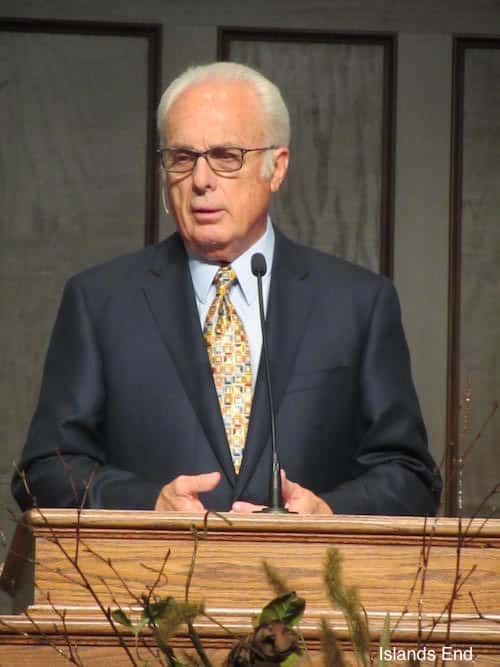
John MacArthur, ally of Young Earth Creation
I grew up in an ultra-conservative, 4 1/2 point Calvinist, expository Bible teaching church. When I was in high school, my church in Lincoln Nebraska brought in a special speaker, the Young Earth Creationist and Bible teacher John C. Whitcomb. He gave a series of talks about science and the Bible.
It was FASCINATING. Ten times more interesting than the usual Sunday Biblical exegesis. A six-part series, a multi-day, power packed tour de force of creation science.
Whitcomb delivered a scorching exposé of the fallacies of carbon dating; he described the worldwide flood; the Genesis account, the deterioration and de-evolution of the human genome; the tower of Babel.
He explained how Noah’s flood accounted for geological anomalies which secular scientists misconstrued as “millions of years;” and how the earth is actually 6,000 years old. He explained how we know that from the Biblical genealogies. I was captivated.
Whitcomb was a pivotal figure in the Young Earth Creation movement. He and his co-author Henry Morris created an entire field known as “Flood geology.” A weekend seminar similar to that one still appears at a church near you multiple times a year. My church growing up was very similar to John MacArthur’s. He’s pictured above.
When I was seven, I had a dinosaur book I wore out from total fascination. It described dinosaurs living 65 million years ago. My 2nd grade teacher taught me how to handle that:
“Just laugh at it.”
So I did.
Origins didn’t come up much in high school or college. Once I had a conversation about Jesus around the water cooler at work. I offered a pretty convincing case for the resurrection, and a co-worker admitted as much.
But he said, “There’s no way you’re going to convince me that all of humanity is the result of two naked people, an apple and a snake.” I didn’t have a comeback.
I professionally subscribed to a publication called Sensors Magazine. It struck me how technologies – especially sensors, from cameras to ultrasonics to devices most folks have never imagined – are greatly inspired by sensors in the human body and animal kingdom. As an engineer I intuitively sensed a tremendous level of design in nature.
I also knew there were a LOT of questions I couldn’t answer. I wasn’t exactly seeking opportunities to debate.
One day I heard up talk by astrophysicist Hugh Ross called “New Scientific Evidence for the God of the Bible” and it set my mind on fire. This guy explained how the Big Bang was first proposed by a Catholic priest in 1931, scorned for years, then reluctantly accepted in the mainstream. Why? Because evidence for a single discrete beginning 13.8 billion years ago had become overwhelming, despite secular bias against it.
He showed, verse by verse, how modern cosmology and the opening verses of Genesis match exceedingly well. All that was needed was a shift in perspective, a few very elegant assumptions.
So long as you assume a “day” is a period of time, and take the story as being told from an earthly vantage point (which is established in Genesis 1:2), it all fits – tit for tat. Ross described the extreme fine tuning required for gravity, the expansion rate of the big bang, forces, constants etc – physics facts Electrical Engineers are quite familiar with. Wow. That was a mind-blower.
Guess what – no conflict between mainstream cosmology and Genesis after all.
I sent Ross’s tape to a physics professor friend of mine. He wrote back with a rebuke: “David Hume dismantled the ‘design argument’ 200 years ago.”
His reply didn’t contain much actual substance, however. He did nothing to explain the fact that no plausible re-configuration of any of those interdependent constants would result in any kind of coherent universe. Nothing more than a hand-waving dismissal.
I plowed forward, happy to now have a general cosmology that matched the Biblical one – but on a much grander scale. Guess what, those dinosaurs really did live 65 million years ago and it’s not a problem.
The story I’ve told so far will make Old Earth Creationists quite happy – and Young Earth Creationists unhappy. The reason it makes YECs unhappy is… YEC is brittle. Any change to the story forces them to disassemble quite a number of theological shibboleths and re-assemble them.
Go down this road and you’ll soon find major Biblical engine parts scattered around on the shop floor. For awhile may not feel quite sure if they’re going to go back together.
This is anathema to a traditional evangelical. Especially where I came from. Our systematic theology was a vast spreadsheet of theological exact answers and precision-formed parts, carefully engineered and fine-tuned like a NASCAR drive train.
To a traditional evangelical, this comes down to an issue of authority. “Are you going to believe godless secular scientists? Or are you going to believe God’s word?” This is how Answers In Genesis frames the question. It’s either/or, black-and-white.
There’s little dance or interplay between science and theology. You take the plain sense literal reading of Genesis, you eschew those “liberals” who “compromise” God’s Holy Word.
Any apparent disagreement with science is obviously a science problem. Not a theology problem. Not an interpretation problem.
When I was in high school I had debates with my pal Pat, who belonged to a traditional strand of Church of Christ. COC interpreted not a few, but MANY things differently than my home team. I saw that as they rotated their theological Rubik’s cube, they matched some pieces much differently than we did. As I became familiar with other protestants and Catholics, I saw that the re-configurations of Christian theology can be almost endless.
The central pillars of Christianity are quite solid. It’s pretty hard to come up with anything much different from the Apostle’s Creed, for example, without butchering the Bible. But once you get to secondary and tertiary issues, there are many ways to work the puzzle.
I was a pastor’s kid. As Biblically educated as anybody’s likely to get short of seminary. And already by age 20 I viewed the 10-decimal precision and proclaimed certainty of reformed evangelical theology with a jaundiced eye.
I noticed that theologians fiddle with interpretations for their entire lives, and do clever sleight of hand with each other (with plenty of petty name calling, posturing, shaming and shunning) to win debates and protect egos. I knew too much about the Bible to crown one single, rigid, Ken Ham interpretation as king – or anybody else’s for that matter.
Don’t get me wrong, I embrace the inspiration and authority of the Bible. I believe in the lifelong pursuit of truth and discernment. But I believe the value and experience of twisting the Rubik’s cube itself is actually more important than the particular Rubik’s configuration your cube happens to land on today. Nuances of theology are squishy. That’s a fact.
I also think the capacity to dialogue with people who disagree with you, and still love them without losing your cool, is much closer to the “point” of Christianity than whatever doctrines we abstract from the stories and texts.
Also:
As an Electrical Engineer, I found some things in science are not squishy at all. Like the speed of light. It’s the “c” in Einstein’s “e=mc^2.” That “c” appears all over the place in physics. It’s in Maxwell’s equations, which define light’s essential behavior; “c” cements the relationship between electric fields and magnetism, and we can measure it with ten decimals of precision. 299,792,458 meters per second.
There is nothing remotely controversial about this in science. (Contrast this to Darwinism, for example, which has been plagued with endless problems and conflicting data for 150 years.)
The speed of light, so far as I know as an electrical engineer, is a constant in physics. Sure, light’s speed changes in a prism, but as a physical constant it does not budge. It doesn’t even shift with the speed of objects. As far as we can tell it’s an absolute barrier.
Q: If a star is 100 million light years away, when did that light leave the star?
A: 100 million years ago.
All kinds of YECs have tried to dodge that question and that answer. None have succeeded. If they were right, physics itself would be a complete mess. But it’s not. Physics works like a precision-built Swiss watch, thank you very much.
Therefore… in the alleged authority battle between science and the Bible… for me, speed of light won.
Once I began seriously considering this, I realized that if the Bible actually intended to say the universe is 6,000 years old, then it could not even be inspired by God.
The universe is old. Period.
But upon further study, I’m not convinced anything in the Bible contradicts that. Rather, YECs have been reading a young earth into scripture for 100 years.
Yes, you can explore whether the speed of light is changing, whether God made the universe to LOOK old even though it’s actually young. I invite you to research to your heart’s content. Personally I’ve been down those trails and I caution you that any of those positions will back you into a corner that you cannot get out of.
Our often-squishy theology needs to make room for verifiable facts. Like the speed of light.
Any honest apologist or thinking Christian surely has to admit that quality of evidence comes into play. The Bible is FULL of history-based truth claims (which is not the case with other religions, like Hinduism and Buddhism).
For example: the honest Christian should be able to say that IF someone really did produce the body of Jesus, if they proved that Jesus didn’t actually rise from the dead, then Christianity is therefore not true. And then we are truly “above all most to be pitied” as St. Paul said.
Is it not true that Christians criticize Mormons for believing in entire civilizations in South America that left nary a trace? For believing that American Indians are actually a lost tribe of Jews, even though DNA evidence contradicts this?
Is it not true that Christians criticize Jehovah’s Witnesses for predicting the end of the world multiple times, and being wrong?
So if Christianity is historical, shouldn’t it be falsifiable as well?
Why does YEC get a free pass in making up its own version of history, yet Mormonism doesn’t?
We should be willing to abandon Christianity if we find it’s not true. By the same token we can shout it from the rooftops if we find that it IS true. That’s the position the apostles took in the book of Acts.
And yes, we can and should use verifiable scientific facts to judge between competing theologies.
Oh, and by the way…. most people at this point would pile on a litany of other problems with YEC. Most articles like this one sport a list of 10 major problems or more.
I don’t need all those. I only need one. Speed of light. It’s exact, you can measure it in the comfort of your own home and you can do the math. Math doesn’t lie.
The other problems with YEC are more fuel for the fire.
We know the earth is old. If that’s true, what theological dominoes fall?
The first domino is the notion that there was no animal death before the fall. Nothing in the fossil record suggests a death-free world before man showed up.
THIS is the lynch pin of YEC. It’s not the word “Yom” (day) in Hebrew, it’s not something else. It’s the issue of death before the fall. Let me explain.
The central cornerstone of YEC is belief that 1) earth was a perfect paradise, 2) God could not make any world that was less than perfect and pristine, and 3) “Through one man sin entered the world, and death through sin” (Romans chapter five.) For YECs, that means ALL death, not just men, not just men’s spirits.
This holds YEC in place. It’s a theodicy (account of evil despite a perfect God) that many Christians are comfortable with. Throw that out and you have to start over with your theodicy. You’ll need a more complex picture of God.
If earth is old, if bears were eating salmon 50 million years ago, if alligators always had sharp incisors, then God fashioned an extremely inefficient universe where conflict was baked in from the word go.
Cancer and bacteria and weeds and parasites have been around as long as there have been plants and animals.
That, to the traditional Christian mind, is too much to stomach. (Though the same Christian seems to have no quibbles with various other cruelties, both in the past and future.)
My late colleague Michael Marshall asked, “Which is more dangerous? A world with pathogens like viruses and bacteria? Or a world where the 2nd most powerful being in the universe is a serial killer boiling with rage, salivating for an opportunity to devour everyone?”
Did you ever notice that in the Adam and Eve story, God doesn’t even warn them them about what’s coming, or who? He certainly doesn’t do what any normal parent would do.
Nevertheless God declared the world to be very good. Despite the fact that peril was built in to the picture before man ever showed up.
In Genesis 1:31, when God says “And God saw all that he had made and it was very good,” do you know what the Hebrew word for “Good” means in the original Hebrew?
It means “Good.”
It does not mean “Perfect.”
I can still label planet earth a “good” world. I cannot label it “perfect.” I don’t have to like all of it. I can still agree with God that it was good. Exuberant parents bring newborn babies into this good world with joy every single day.
The assertion that God would never make anything “imperfect” flies in the face of not only science, but Biblical theology. And good luck coming up with a coherent definition of “perfect” that aptly describes any created thing.
What did God say to Moses in Exodus 4? “Who gave human beings their mouths? Who makes them deaf or mute? Who gives them sight or makes them blind? Is it not I, the Lord? Now go; I will help you speak and will teach you what to say.”
This raises even more questions that I’m not going to answer in this article. Some of those are:
–Who was the first man? Who was Adam?
–Was Adam a Real Person?
–Was Noah’s flood global or local? How does known Middle Eastern history overlap with the Biblical story?
–Is “death” in the fall physical death, or something else? Does it apply to animals?
–How do you read Genesis 1 from an old-universe perspective?
–Was the Grand Canyon formed by the flood?
–What about evolution? Is evolution Biblical?
You can follow the links above for more on these questions. Meanwhile, basic facts of science which are now beyond reasonable doubt call YEC into question.
God wrote two books: the book of scripture, and the book of nature. I do not believe there is any conflict between the two. But our understanding of both will never cease evolving.
And that is why I am not a Young Earth Creationist.
Download The First 3 Chapters of Evolution 2.0 For Free, Here – https://evo2.org/evolution/Where Did Life And The Genetic Code Come From? Can The Answer Build Superior AI? The #1 Mystery In Science Now Has A $10 Million Prize. Learn More About It, Here – https://www.herox.com/evolution2.0
How old was Adam when God created him? How old were the animals, the plants, the birds, the oceans, the stars, etc? They were fully formed and fully existing, so how aged were they? We do not know. But, if you start with the presupposition that there is a Divine Creator (God), then there is no reason to believe that God could not create a planet/universe 6,000 years ago that was 5 Billion Years old when He created it. Both the Bible and Science can be true. Just a thought.
That’s just fine if you’re OK with 99.9% of earth’s history being an illusion fabricated by God, and God therefore being a trickster.
Did Adam have scars on his knees from falling off his Bicycle back when he was (never) 9 years old?
Perry,
We may well guess that Adam never rode a bicycle, even after he was created, but the fact that Genesis mentions no scars, navel, bicycle, or any other such things that Adam might have had cannot serve as proof that he did not have them. We don’t know what he had unless we are told, though we are free to guess, of course.
To get back to Conn Mobley’s question, it seems obvious to me that the age of Adam at the moment of creation should be zero, even though he might have *appeared* to be an adult whose age we would have guessed to be 20 years or more. Since Genesis does not provide this detail, we can only speculate about how old he might have looked. His ability to name lots of animals and his early interest in Eve should serve as nice clues.
How much of earth’s history is an illusion? For those of us who believe Genesis, none of what God let us know about it is an illusion. It is just the aftermath of miracles, which cannot be used legitimately to invent a different story to account for the same results with natural processes alone—without the impact of the miracles that really took place. Those of you who do not believe that the Genesis account is about natural processes, not miracles, prefer to speculate that the earth has billions of years of history, none of which you believe is an illusion. For you, it makes sense to have scientists study physical evidence and propose stories that might account for our origins, but these stories are therefore necessarily tentative. New evidence can come to light at any time and upset the apple cart.
I remember having a discussion about origins once where it came to light that skeptics or freethinkers are not necessarily convinced that the universe had a beginning, as Genesis claims. There might be many “universes” out there somewhere, whether we can detect them or not, and the whole lot of them might actually be eternal, expanding and contracting endlessly. Well, who knows? If you are convinced that Genesis matches the history of earth as proposed by Hugh Ross, what will you do if “modern science” eventually decides that his idea was only an illusion, and the universe is actually eternal? Scientific ideas about cosmology evolve. Will there ever be any reason for confidence that we are finally ready to teach the true history of earth, if we reject what Genesis teaches?
Tom,
Thanks for your thoughtful reply to this. I’ll get to your other as I’m able.
“What will you do if modern science eventually decides… the universe is actually eternal?”
Well first of all you seem to be assuming that I’m just “going by modern science” as though it’s a fad.
If you study my evolution work I take very nuanced views based on what you can observe and deduce, regardless of whether the majority of biologists agree with them. I take each fact one by one. On some items i 100% agree with the consensus. On others I sharply disagree.
John Hands’ book Cosmosapiens expresses admirable skepticism about many aspects of modern physics. There are others who have been skeptical of big bang cosmology whom I’ve found much less persuasive, but he wins my admiration for his thoroughness and his lack of black and white thinking. Many big bang skeptics come across more like conspiracy theorists than discerning evaluators of detailed data.
I know eternal universe was the consensus view for a very long time in science and that the big bang gained supporters slowly despite resembling the Judeo Christian account. In fact the slowness was because of its consonance with Genesis 1:1.
There are some nuances about this you’re not considering:
-Jesus raised from the dead but his body still bore signs of what he had been through. This is not an insignificant clue about Christian epistemology and the relationship between this world and the next. That miracle did not completely erase history.
-The universe and the earth have a HIGHLY HIGHLY HIGHLY detailed history of billions of years – which you can dissect and subdivide to your hearts content and continue to find artifacts – both in the night sky and in the geological record. This goes far beyond anything like “scars on Adam’s knees.”
=The Young Earth view is fraught with problems, starting with the speed of light but including literally every major scientific discipline that is concerned with earth’s history: Geology, paleontology, physics, chemistry, biology, genetics, etc etc etc. Ken Ham and friends have literally invented their own version of science and use a very elaborate Christian theology (much of which they have invented as well) to hold it in place. Along with a good dose of legalism, fundamentalism and guilt.
I think that it is telling that aside from some Muslims and perhaps a smattering of Jews, NO other group, scientific, religious or otherwise, embraces young earth. In this sense it is highly analogous to the Mormons with their teaching that the American Indians are actually a lost tribe of Jews (modern genetics doesn’t support this in the slightest, and the LDS church even admits this) or that South America was once home to the Nephites and the Lamanites and the Jaredites. ONLY Mormons believe this. Nobody else.
I’m with Augustine in believing that God wrote two books, scripture and nature, and that they are not in disagreement. YEC has more problems, frankly, than the Mormons. The issue is not the Bible, the issue is YEC interpretation.
Please keep in mind that the New and Old Testaments, overall, have admirable credibility as historical documents, even in secular circles. (Unlike the book of Mormon). That is my point in bringing up these other factors. So when part of the Bible has ZERO credibility as a historical document, I question the interpretation. The Hugh Ross style interpretation matches what we know fairly well.
The Swiss theologian Karl Barth used the word saga to describe scripture passages that are not myth and not legend, but that also are not bare historical facts. Saga refers to real historical events, which are expressed in poetic terms because human language is incapable of adequately expressing acts of God.
Finally it’s interesting to observe that most YECs are cessationists with respect to modern miracles. I find this highly odd, since YEC itself is an insistence on miracles, yet I find it as hard to convince some evangelical Christians that real miracles occur today as convincing many atheists of the same fact. They’ll accept MASSIVE miracles 6000 years ago and zero miracles today.
I think that since their theology doesn’t allow them modern miracles, they have to cling to ancient ones.
I personally have seen many modern miracles with my own eyes: http://www.coffeehousetheology.com/miracles
This invokes a further question of “how do you PROVE a miracle”? Simple answer: If no one was there to see it, I don’t see how it’s possible to ever prove it happened. But people were there to see Jesus before and after the resurrection and people were there before and after the deaf people you see on my page.
Perry,
Thank you for thoughtfully considering my questions too. My question about what you would do if mainstream scientists ever agree on an eternal universe story was not to accuse you or to imply I assume that you just go with the latest fad. It was an honest question raised by your claim, “A modern *literal* interpretation of Genesis 1 matches modern cosmology, geology and the fossil record… exactly.” If the latest fad ever fails to match your interpretation of Genesis 1, one or the other has to give. Which one, if any, will you then say must be true?
I think I am beginning to grasp your idea. You want the Bible, including Genesis 1, to appeal even to the group of people that you labeled “secularists.” (I have this desire too, by the way.) Please correct me if I have misunderstood, but your general approach seems to be to interpret “God” as a literary equivalent of “nature” or “Time/Chance/Evolution” or maybe “Chance/Evolution/Eternal-Multiverse.” For example, you would suggest interpreting “And God said, ‘Let there be light’” (Gen. 1:3a) not as a command from an almighty supernatural being but rather as an observation meaning something like, “And it was ordained by the laws of nature that light should come into existence,” and so on. If I or some other kooky creationist points out an order of events inconsistent with a mainstream teaching, you evidently do not see this as a problem. After all, you can tell skeptics that they are reading just the guesses of ignorant shepherds speculating about origins, not an inerrant revelation from someone who personally witnessed miracles of creation, so we should be impressed by how much the ancient author got right, not by those few discrepancies. Just ignore them and move on, right? Maybe this approach actually works. You be the judge.
Well, okay, this gets you through Genesis 1, but now what about Genesis 2? Recall that our Lord quoted parts of both chapters in Matt. 19:4, as though they were considered at the time to be harmonious accounts of creation. How do you extend your approach when a secularist reaches Gen. 2:18 and wonders why it should be reported there that Adam was alone? Reading further, we read that beasts of the field and birds of the air were with Adam, and we should understand why they could not dispel his loneliness, but won’t secularist readers wonder where his parents and other relatives were? And what about the rest of the hominin population that was supposed to be evolving at the same time? Adam should have been able to solve his problem just by traveling around to find a wife, right? But this was not the solution as reported in our text. How is the secularist supposed to make sense of Gen. 2:21-24, the last verse of which was quoted by Jesus Christ? None of this is a problem for those of us who believe that the Creator used miracles to make the universe (Heb. 1:2) as well as Adam and Eve “in the beginning” (Matt. 19:4). What else does the Bible say about creation that is a problem for us?
I like your question about how one might prove a miracle, and if your short answer is that it can’t be done, I applaud you. So how can anyone ever come to believe that a miracle took place? I would say it would be because of either personal experience or testimony deemed credible. The proof could not be the result of a study of physical evidence (after the fact) based on a presupposition that natural laws and processes must explain everything.
At the risk of encouraging a digression into ad hominem arguments, I wonder whether Ken Ham (or anyone who agrees with him) would disagree with anything in these lyrics (sung by George Beverly Shea). Could *you* join him in singing all of those words wholeheartedly?
https://www.youtube.com/watch?v=-MvGd9UWSWM
I turn now to what seems to be your main point, anchored by you claim, “The universe and the earth have a HIGHLY HIGHLY HIGHLY detailed history of billions of years – which you can dissect and subdivide to your hearts content and continue to find artifacts – both in the night sky and in the geological record.” If Adam was created in one 24-hour day and would have appeared to us as a grown man, would he also have had “a HIGHLY HIGHLY HIGHLY detailed history” of many years of life? Suppose a scientist measured the length of his bones and studied his teeth, genitalia, maybe even his DNA, and so on. All of this information, if available, could have been used to form an opinion about his age and life history, but would any of it have reflected his real history? My answer is no. What is your opinion?
Nevertheless, I take your challenge seriously. Did you know that the numbers of the years of the kings of Judah and Israel as recorded in the Old Testament were once considered by scholars to be hopelessly inconsistent and probably fictional? In spite of this, many believers continued accepting the Old Testament as the inerrant word of God. However, childlike faith in its trustworthiness, including the accuracy of those numbers, was eventually supported through the work of Edwin R. Thiele. You can read about it here.
https://en.wikipedia.org/wiki/The_Mysterious_Numbers_of_the_Hebrew_Kings
But what about the historicity of Genesis? The problem with Thiele’s work is that it took us back to only about 931 BC and stopped there. People interested in the biblical chronology of earlier years had just as much trouble matching up with chronologies derived from secular sources. I am convinced that a breakthrough occurred in this field again around 25 years ago. You may not have heard of Gerald E. Aardsma either, mainly because his focus, with a few exceptions, has been on research, not on popularizing his ideas. Here is his website.
http://www.biblicalchronologist.org/
Without delving into details, Aardsma believes that his biblical chronology, which goes all the way back to creation in 5176±26 BC, is consistent with secular chronologies at every point, all the way back. I have found his evidence for the Flood of Noah to be especially impressive, not to mention great evidence for the Exodus as well. It is true that his claims have not been well vetted, and I admit that they could be overturned or require significant adjustments when specialists finally decide to take his work seriously. You may be interested to know that he disagrees with Ken Ham and many other creationists about the nature of the Flood, and he disagrees with me too about the nature of the rainbow covenant, but this is all beside my point. The bottom line is that no believer has good cause to be embarrassed by any historical claim made in Genesis. It may well all be quite true in light of what is known for sure. I believe the Bible is all true but walk by faith as a small child.
There is one leftover problem that Aardsma has also covered in his work. He freely admits that physical evidence suggests a history that could be extended back into what he calls proleptic time, periods apparently dated before his date of creation. He calls this “virtual history.” You may disagree with his analysis, of course, but think about it. Could anything of interest be created *ex nihilo* without a virtual history? If it were possible for God to have created Adam appearing to have an age of zero, how could we describe such a human being? We could ask a similar question about a star or a starfish. It doesn’t matter. Ask it about the universe. Does this mean that God must be a trickster? Not at all. It just means that he works miracles of creation, and a virtual history is therefore an inescapable consequence. We should not be fooled by the length, nature, or complexity of any virtual history. We might be surprised by it, but we can know the truth through testimony as revealed by God.
Both the Bible and the book of nature are trustworthy, but they do not necessarily cover the same material. One gives us the true story of our origins, by revelation, while the other can be studied with confidence to learn about the laws of nature outside of miracles through observations and repeatable experiments. If the latter book is used incorrectly to piece together a speculative, alternative story of our origins based on a no-miracle presupposition when in fact the origin of the universe and of life on earth was miraculous, we do not have to be fooled. What do you think?
If the latest fad ever fails to match your interpretation of Genesis 1, one or the other has to give. Which one, if any, will you then say must be true?
Answer:
I hold to the Biblical worldview. And as a pastor’s son and as someone who has studied theology for years, there are many ways to read Genesis.
So for example Genesis 1 says there was a beginning – that time itself had a beginning.
I do hold to that. The opposite view (which is out there now by the way) would take a LOT of convincing for me to buy it. The eternal universe idea after all is plagued with scientific problems.
And had I lived in 1850 when the eternal universe was in vogue, I probably would have believed the Bible. In any case I would not be able to not ask questions.
Now to be fair, early in my quest I determined: If the Bible really intends to say the earth is 6000 literal years old then it simply is not the Word of God.
(Science is way too clear on this fact. Speed of light.)
My personal epistemology leaves room for the Bible not being true – if it is not truthful. We judge the tree by its fruit. Jesus said you shall know the truth and the truth shall set you free.
If there is no way for Christians to ever NOT believe in Jesus, then it’s just blind immature faith. Christianity is however historical and evidence based. Jesus provided evidence and proof via miracles. He never asked anyone to believe him on Blind Faith.
So if Jesus did not rise from the dead and you could absolutely prove he was still dead, I would stop being a Christian.
And to a much lesser degree I believe that if you can’t find a way to understand Genesis in a way that squares with observable facts, then Genesis has a real problem.
This is why I’ve brought up archaeology. Some archaeologists have more confidence in the Bible as a historical document and some have less, but they all agree it tells reasonably accurate history much of the time. I expect no different level of accuracy from Genesis.
The good news is, it’s only an issue of interpretation. There really is no problem with Genesis.
For example, you would suggest interpreting “And God said, ‘Let there be light’” (Gen. 1:3a) not as a command from an almighty supernatural being but rather as an observation meaning something like, “And it was ordained by the laws of nature that light should come into existence,” and so on.
When God said “let the waters separate from the land” etc. I have no way of knowing whether it was an interruption of existing processes or whether it was baked in from the beginning. In a sense I don’t care very much because I’ve seen enough miracles with my own two eyes that I don’t need a miracle on Day 3 of Genesis 1 to be one particular way.
Well, okay, this gets you through Genesis 1, but now what about Genesis 2? None of this is a problem for those of us who believe that the Creator used miracles to make the universe (Heb. 1:2) as well as Adam and Eve “in the beginning” (Matt. 19:4). What else does the Bible say about creation that is a problem for us?
I interpret these as spiritual events, man and woman receiving soul and spirit; not the literal creation of their bodies. I cover this in the Appendix of Evolution 2.0.
And I don’t see any of this as being a problem. The only time it’s a problem is if you read it with such a rigid view that you can’t imagine reading it any other way.
Suppose a scientist measured the length of his bones and studied his teeth, genitalia, maybe even his DNA, and so on. All of this information, if available, could have been used to form an opinion about his age and life history, but would any of it have reflected his real history? My answer is no. What is your opinion?
Nevertheless, I take your challenge seriously. Did you know that the numbers of the years of the kings of Judah and Israel as recorded in the Old Testament were once considered by scholars to be hopelessly inconsistent and probably fictional? In spite of this, many believers continued accepting the Old Testament as the inerrant word of God. However, childlike faith in its trustworthiness, including the accuracy of those numbers, was eventually supported through the work of Edwin R. Thiele. You can read about it here.
https://en.wikipedia.org/wiki/The_Mysterious_Numbers_of_the_Hebrew_Kings
I understand that, and I know that the Bible continues to vindicate itself in archaeology.
But this example is trifling compared to the massive problems of trying to explain away 13 billion years of observable historical and astronomical record. There is no comparison.
But what about the historicity of Genesis? The problem with Thiele’s work is that it took us back to only about 931 BC and stopped there. People interested in the biblical chronology of earlier years had just as much trouble matching up with chronologies derived from secular sources. I am convinced that a breakthrough occurred in this field again around 25 years ago. You may not have heard of Gerald E. Aardsma either, mainly because his focus, with a few exceptions, has been on research, not on popularizing his ideas. Here is his website.
http://www.biblicalchronologist.org/
Without delving into details, Aardsma believes that his biblical chronology, which goes all the way back to creation in 5176±26 BC, is consistent with secular chronologies at every point, all the way back. I have found his evidence for the Flood of Noah to be especially impressive, not to mention great evidence for the Exodus as well. It is true that his claims have not been well vetted, and I admit that they could be overturned or require significant adjustments when specialists finally decide to take his work seriously. You may be interested to know that he disagrees with Ken Ham and many other creationists about the nature of the Flood, and he disagrees with me too about the nature of the rainbow covenant, but this is all beside my point. The bottom line is that no believer has good cause to be embarrassed by any historical claim made in Genesis. It may well all be quite true in light of what is known for sure. I believe the Bible is all true but walk by faith as a small child.
That’s all fine but the earth is not 6,000 years old. The star you see that’s 100 million light years away is necessarily over 100 million years old. What do you expect a non-Christian to think – that God made it 6000 years ago with 100 million years of fake history? Do you really expect intelligent people to believe that?
There is one leftover problem that Aardsma has also covered in his work. He freely admits that physical evidence suggests a history that could be extended back into what he calls proleptic time, periods apparently dated before his date of creation. He calls this “virtual history.” You may disagree with his analysis, of course, but think about it. Could anything of interest be created *ex nihilo* without a virtual history?
Absolutely. An infinitely compressed point of energy could come into being 13.8 billion years ago with no trace of history whatsoever. Not only that, you can’t even examine anything before 10^-43 seconds after the event. Study the Big Bang. Scientists agree it’s impossible to look back beyond it.
If it were possible for God to have created Adam appearing to have an age of zero, how could we describe such a human being? We could ask a similar question about a star or a starfish. It doesn’t matter. Ask it about the universe. Does this mean that God must be a trickster? Not at all.
If God makes stars 6,000 years ago with 100 million years of detailed apparent history that is not real, then yes, God is a trickster. This is not the God I find anywhere else in the Bible, by the way. I see no other precedent any other similar thing in scripture. Do you?
This is no minor problem with YEC. It is a major problem.
If you wish to take this on childlike faith I respect you personally for that. But don’t call it science because it’s dishonest. And I mean that. It is tantamount to lying. And this is why atheists have so little respect for Ken Ham. I believe Ken Ham has done great damage to the the reputation of Christianity.
It just means that he works miracles of creation, and a virtual history is therefore an inescapable consequence. We should not be fooled by the length, nature, or complexity of any virtual history. We might be surprised by it, but we can know the truth through testimony as revealed by God.
Why are you OK explaining away Genesis 1-3 with virtual history? Would you be OK explaining away problems with archaeology by claiming “virtual history”? Or do you study the archaeology MORE in order to eventually resolve the problem? From what I understand for a long time Jericho’s walls were in dispute and now they have found them (movie “Patterns of Evidence). Would you have preferred that they resolve the apparent contradiction with virtual history?
Is the idea of “Virtual history” even Biblical at all? Is there scriptural precedent for it? Or is it a story a guy made up to make the data fit?
Both the Bible and the book of nature are trustworthy, but they do not necessarily cover the same material. One gives us the true story of our origins, by revelation, while the other can be studied with confidence to learn about the laws of nature outside of miracles through observations and repeatable experiments. If the latter book is used incorrectly to piece together a speculative, alternative story of our origins based on a no-miracle presupposition when in fact the origin of the universe and of life on earth was miraculous, we do not have to be fooled. What do you think?
I do not perceive that paleontology, geology, astronomy and physics are primarily speculative. They are 70-99% empirical. What is speculative is speaking of things like “virtual history” and proclaiming that we may never be able to understand.
I feel you ought to raise your expectations of both Bible and nature.
As I say in Evolution 2.0: “Darwinists underestimate nature. Creationists underestimate God.”
Perry, in considering the 6 days of labor and the continued 7th day of rest as in Exodus, I wanted to reconcile that with Genesis according to your interpretation of Genesis. If I understand you correctly, you believe in miracles and that comes, among other things, in the form of God creating the information that he put into the basic entity or entities (cells) from which many species “intelligently” evolve. That led me to try to put flesh on your interpretation of reconciling science, chronology and the scriptures. So here goes:
DAY 1 – 13.8 billion – God created the universe
4.6 billion – Earth / Solar System came into being. Atmosphere changes from dark to cloudy.
Day and might appear.
DAY 2 – 3.5 billion – God creates a single celled entity with the encoded information for it to reproduce.
600 million – God creates the cells of each kind of fish with the encoded information to
reproduce and evolve into species within their “kind.”
God creates the cells of each kind of bird with the encoded information
to reproduce and evolve into species within their “kind.”
God creates the cells of each kind of land animal with the encoded
information to reproduce and evolve into species within their “kind.”
DAY 3 – 470 million – God forms land and sea.
God creates plant cells encoded with the information to reproduce and evolve into many
species within their “kind.”
DAY 4 – ? – God clears the atmosphere.
DAY 5 – ? – God ?
23 million – Human ancestors evolved.
DAY 6 – 200 thousand – God made a male hominoid a spiritual being (Adam).
God gave something of Adam’s being to a female hominoid (Eve).
DAY 7 – sometime after 200 thousand – God ceased from creating and forming and now rests.
The same author who wrote “day” in Genesis wrote “day” in Exodus 20:11 and 31:17. Using the context of Genesis 1, the passages in Exodus would be interpreted as: SINCE God created the heavens and the earth in six periods of very varied time lengths ranging from billions of years to hundreds of thousands of years and then restED (whoops, Moses must have made a mistake—should be restS) for an undetermined period of years, man should do his work in an explicit period of 24 hour days for 6 days and then rest from his work for 24 hours.
It does not seem to reconcile with me. Also I wish to point out again an argument from my paper: The 7th day was unique from all the other days. There was not a beginning of creative work and an end of creative work as on the other days. Though there is no morning (ending) declared neither is there an evening (start) declared. If this were the beginning of a continuing day-age, it could be argued that consistency with the other days would suggest that the author would have declared that there was an evening (a start to the 7th day) but would not have declared a morning (ending).
Bill,
In my opinion the variability of the length of days hardly creates any kind of problem for the command in Exodus to rest on the 7th day. It’s only a problem if you want it to be.
When on the other hand re-interpreting and vandalizing huge swaths of modern science in order to cram 13 billion years of history into 6000 years, creates massive contradictions and makes a complete mess of physics and astronomy – which otherwise seem to work quite well for the most part.
I find the former approach to be far more palatable. And I like this video:
http://evo2.org/bible-science-reconciled/
You will have to decide for yourself. But I as an electrical engineer who understands things like the speed of light very well cannot go with your interpretation. Your brittle interpretation to be quite frank causes hundreds of thousands of Christians to lose their faith unnecessarily. I would not dream of asking a scientifically literate non-Christian to run science through a blender just for the sake of avoiding what you feel is a strained interpretation of Exodus.
I respectfully submit that it’s time for new wineskins.
Perry, first, as I hope you have read previously, I do understand that the starlight and deep time issues are major in the YE OE debate and scientifically stand in the way of the YE interpretation. However, I see those two issues as the only real scientific issues that are a problem for the YE interpretation. The other issues of the debate can be interpreted from the evidences according to what position one holds. Since I do see the major scientific problem with young earth and major theological problems with OE interpretations, I have posed a literal interpretation of God having created the universe in Genesis 1:1 as a separate creative act and then beginning in 1:2 started the six 24 hour day special creation which is about preparing earth for life and then creating life. This interpretation would resolve the starlight and deep time issues of YE as well as the theological problems with OE. My interpretation is not as brittle as you would suggest. I have been honestly trying to evaluate the two positions. I did find the video (slide show) you suggested quite interesting, but it and my trying to understand your timeline and how it fits with scripture has raised more questions. I have come to realize that though the interpretation of the word “day” is one of the key factors in the debate, there is another word and a phrase that is being interpreted differently by the two positions that are crucial keys. That word is “made” and the phrase is “let there be.” YE interprets “made” and “let there be” as creating something out of nothing or forming something out of already existing elements. OE interprets “made” and “let there be” as making something already created or evolved to appear or become visible. Day 4–God MADE the sun, moon, stars. OE says God made the already existing sun, moon, and stars to appear. Day 5—God (actually in this instance, CREATED) made great whales, and every living creature that moves and every winged fowl. OE says the living creatures already evolved were made to appear (not sure to who they would appear at this point.) Day 6—God MADE the beast of the earth…..and cattle…..and everything that creepiest upon the earth. OE says the animals already evolved were made to appear. This raises a number of questions which also have implications for the Exodus passages. If God was making things appear that were already in existence and developing over a continuum, how long would that take and why would there be a distinction of days or periods at all? How long would it take God to just clear the clouds so the already existing sun, moon, and stars would become visible? Why would there even be a need to separate that into a long period of time from the plants already evolved which God made to appear? How long would it take God to make already existing animals to appear and then breathe spiritual life into an already existing animal? And if God created everything on day one and then just made already existing or evolving entities appear on days 2 through 6, what does God rest from on this seventh day? What did God really do on the five distinct periods that He rested from? Along another line, OE proponents argue vehemently that evening and morning are beginnings and endings of long periods of time. So, if the third period of time had an ending, then no more new plant life would develop. If the fifth period had a distinct beginning and end no more fish or birds would develop. If the sixth period had a distinct beginning and ending, God’s creative work ended. If the seventh period is still a period of rest from creative miracles, what do you do with the virgin birth and the resurrection of Christ? Again though, if everything was created the first period and then life evolved and things were just made to appear in the other periods, what do the distinct periods really represent?
Tom,
One additional comment.
I need you to really really really think about this “virtual history” thing.
If it’s true, it means there are millions of fossils of millions of animals that never existed at all. That we have the bodies of animals that APPEAR to have been born, and lived, and died, and eaten plants, and have half digested stuff in their stomachs – YET THE EVENTS THEMSELVES NEVER HAPPENED, they are only part of “virtual history.”
Please notice that suddenly you have to draw a dotted line in the past and say “everything before this is virtual history and everything after is real history.”
Is that the most probable, best interpretation of scripture, in order to maintain a young earth (or the appearance of)?
Is THAT what God expects us to believe with childlike faith?
Or does YEC simply force people to do bad exegesis?
You really need to think about this, sir.
And by the way this is no minor issue. It’s not salvation but some YEC people almost elevate it to that level. By being patient with me and talking this through, the problems are coming to light and becoming more apparent. Please understand, this is exactly the sort of thing that *some* Christians are expecting non-Christians to accept. People like Ken Ham condemn the world for not believing this. Personally I don’t blame non Christians who love science for having very low opinions of us. In a limited sense I also don’t even blame intelligent Christians for leaving the faith. Many Christians think they have NO CHOICE but to embrace a young earth because they THINK Christianity falls apart otherwise.
Personally I would never ask anybody to believe this – much less a highly educated highly intelligent leader in our society.
Now again that’s me. You get to decide whatever you want to believe. But have you fully considered the true implications of the disparity between YEC science and empirical science?
Perry,
It may be premature to digress into archaeology right now, but I should point out that Aardsma has much to say about Jericho and Ai. He has no need to relegate to virtual history anything that is reliably dated as less than 7,000 years old. I admit that the Bible does not mention virtual history as such. This is a concept that we get for free if we believe in miracles. Does the Bible talk about presuppositions? We are allowed to consider concepts not explicitly discussed in the Bible, right?
“An infinitely compressed point of energy” does not strike me as interesting. How many of those would fit in my pocket? What can we possibly even *know* about such a point? It is purely theoretical. Please try again to think of something *interesting* that could have been created *ex nihilo* yet without a virtual history. Genesis should give you plenty of ideas.
It is quite easy to eliminate virtual history from consideration. Simply adopt the no-miracle presupposition of what one might call “empirical science” or, in this case, more accurately *forensic* science. This brings us back to the kind of interpretation of Genesis 1 that I described in my previous comment. Did I hit the nail on the head there or not? If I did, I think you have a real problem when you get to the next chapter, as I explained, not to mention the inconsistencies that you had to ignore in chapter 1. What can the mention of flesh and bones in Gen. 2:23 possibly have to do with receiving a soul and a spirit? I don’t get it.
With Genesis reinterpreted to fit the worldview of the secularist, who needs it? A timeline like the one Ross proposed can be drawn up without any input from Genesis at all. Even though we ought to consider tentative whatever we learn through forensic science, which is always subject to revision, what gives when Genesis appears to be inconsistent with evidence now in hand? Genesis gives, or it is reinterpreted yet again, perhaps as “spiritual event,” right? In the meantime, with the foundation in ruins, the whole theological structure built upon it crumbles and falls to the ground. As far as those who go along with this program are concerned, the Enemy has won. Did God really say, … ? You fill in the blanks.
Let’s knock down the straw man claim that virtual history “means there are millions of fossils of millions of animals that never existed at all.” Let’s not mince words and admit that we are talking about *trillions* of fossils at least, but they are all quite real, and the animals to which they bear witness certainly have existed more or less in their present form for thousands of years. They are like the iron-rich core of the earth, which is also quite real, even though it has also lain so well hidden during most of the time of its existence that humanity had to wait until relatively recently for scientists to discover it. The only thing virtual about those animals (and the core of the earth) is their *history* as imagined in light of the no-miracles presupposition.
Let’s do some more thinking about the “virtual history” thing and go back to Adam, this time with the no-miracle presupposition rejected instead. What if he really was created *as an adult* on Day 6 as claimed, and it was a day like one in an ordinary work week, again as claimed? Can virtual history still be avoided? Would *Adam* appear to have been born? If not, how would you describe him? Would he have had half-digested stuff in *his* stomach? Unless God created him well starved and extremely thirsty, going for a drink, gathering delicious berries that never actually grew in real time, and chewing and eating them would all have been imaginary events that took place only in what Aardsma calls virtual history.
Those few examples only scratch the surface. We can imagine countless other events of the same nature, if Adam was made in only one day from the dust of the ground. The same goes for the dust too. How long did it take God to weather Genesis rock to form the soils where seed-bearing plants had taken root three days earlier? What other virtual history would have been suggested by the content of those soils? Have I talked about anything here that should be difficult for “a highly educated highly intelligent leader in our society” to believe with childlike faith?
Right, we all get to decide what we believe. One big decision we eventually have to face is whether we believe that creation was miraculous or can somehow be explained naturally under the no-miracle presupposition. If you still prefer the latter alternative, I would be interested to know what you have to say about the first law of thermodynamics.
To be honest, I ought to repudiate my use of the term “forensic science” in previous comments, because the term evidently implies investigation of a crime or some legal issue. The kinds of investigations I had in mind obviously have no such angle. I was talking about investigations to develop a tentatively proposed story of our origins instead, but my underlying point should not be missed. Secularists engaged in this kind of investigation, regardless of the proper label for it, uniformly adopt a no-miracle presupposition and a no-supernatural-agent presupposition. People who claim to believe that Genesis offers a true account of origins need to decide whether they will join the secularists in adopting these two presuppositions or not. It matters.
Perry,
It has evidently been well over two weeks since any new posts have appeared here. I assume you have been on vacation or otherwise indisposed. I hope it is not because of illness or anything tragic.
Anyway, you probably would be interested to know about at least two notable creationists who have recently given your ideas serious consideration. I just received the spring 2016 issue of the *Creation Research Society Quarterly* (Vol. 52, No. 4), which is a special issue on genetics. The lead article mentions your work rather prominently. It is titled, “The challenge of Mount Improbable: A special issue of CRSQ,” and it is written by Kevin Anderson and Jean Lightner. I recommend reading the whole article, if not the entire issue, but here are the closing two paragraphs (p. 247) as a fair use sample and an invitation to comment.
“All of this genetic data is consistent with a recent origin of humans, lack of universal common descent, and overall failure of Darwinism to climb Mount Improbable. This mountain has not, and cannot, be climbed by mutation, transposition, or even limited preprogrammed systems. Evolutionists frequently offer examples of skids down the mountain (e.g., most mutations) or start at a higher point on the mountain by using modular systems (e.g., evolution 2.0), but none are able to account for scaling even small sectors of the mountain. Ascension of Mount Improbable requires the direct action of a creator. This occurred once (Genesis 1) and has not been repeated.
“All the articles in this special issue provide a valid and dynamic description of the genetic basis of a creation model. Genetic data not known just a few years ago add to the failure of common descent and the vibrant explanatory power of biblical creation. There is clearly *not* a lack of genetic evidence for creation. Critics are generally either ignorant of this evidence or simply unwilling to grasp its significance.”
Tom,
Is there any way you can send me a copy? Happy to pay for it.
Thanks for your patience on the other posts. A few questions:
1) Hypothetically, if you somehow were to find out through some kind of absolute indisputable evidence that evolution is true, would this undermine the Bible? Would it cause you to not be a Christian?
2) If you were to believe evolution is true, would you be compromising God’s word?
Perry,
Thanks for your interest in the CRSQ article. You might try getting the issue through the CRS website.
https://www.creationresearch.org/index.php/component/k2/item/137
If this proves to be frustrating, I think you could get it instead with a letter that specifies the issue you want (Vol. 52, Number 4). According to the order blank for past issues at the back of this issue, the cost would be $7.00 for a nonmember plus 20% ($1.40) for postage for a U.S. address. Your check or money order should be made payable to the Creation Research Society, and your order should be mailed to the Creation Research Society, 6801 N. Highway 89, Chino Valley, AZ 86323.
Now on to your questions.
1) There was a time in my walk with the Lord that I believed that evolution was true, that God had somehow used it to bring everything into existence, more or less as I was taught in school, and yet I am confident that I was a Christian the whole time. I even became a member in training of Wycliffe Bible Translators before I changed my mind about this. I dare say there are other Christians in the same boat today. Of course, whether I really was (or am now) a true member of the family of God or not is not for me to settle. God is the final judge, not I or any other human judge. I can report only my own conviction about this. I walk by faith. In any case, my belief in evolution was certainly not based on any “kind of absolute indisputable evidence that evolution is true.” I just trusted what scientists were teaching. We can still agree that evolution *is* true if we are talking about evolution that can actually be observed. I assume you are asking me about molecules-to-man evolution, which has not been observed. Frankly, I doubt that “absolute indisputable evidence” for this kind of evolution is even possible, and anyone who claims to be able to provide it is fooling himself, but maybe you can convince me otherwise. If man really did evolve from dust or dead chemicals during billions of years of evolution, I now understand that this would be inconsistent with the story of our origin in the Bible, but I have not always understood this. In a recent open letter, Henry M. Morris III wrote, “If God lied to us in Genesis, then the rest of Scripture is totally untrustworthy.” I agree with him, and yet, I dare say that many evolutionists believe that the creation narrative in Genesis, especially the part about the creation of Eve, is either a lie, a myth, a legend, or some other kind of totally misleading account.
2) If I were to believe that molecules-to-man evolution is true, therefore, I would be *rejecting* God’s word as I understand it now, though not as I misunderstood it earlier in my life. I hesitate to say that this belief would *compromise* God’s word, because it says what it says regardless of what I or anyone else believes about evolution.
So long as you assume a “day” is a period of time, and take the story as being told from an earthly vantage point (which is established in Genesis 1:2), it all fits – tit for tat.
My friend, I am responding to your post because I fear you have taken Dr Ross’ inducement, you have begun to abandon a trust in and an ability to understand the Bible.
I am not writing this post to argue with you about the points of YEC vs OEC, I am concerned your hermeneutic is not sustainable and that it will lead to other misinterpretations.
What you said in this one sentence should not be said as a Christian. It is my belief you have allowed external beliefs and allowed them to dismiss the truth of God’s Word here in Genesis 1. If you want to debate what “day” means in Genesis 1 on the merits of Biblical interpretation, then we can do so, but you likely know the YEC argument. Day in context with morning, evening and number always means an ordinary day, Genesis 1 should not be different because we do not understand it entirely.
The only way to be an OEC is to reinterpret the days of Genesis 1 to be as you say, “So long as you assume a “day” is a period of time.” My friend this is dangerous, let me encourage you to reconsider your position.
Hey Tommy. All seven days were long periods of time. As a matter of fact, we’re still in the seventh day.
I’ve never seen anyone interpret Genesis 1 correctly. If you want to be consistent with 20th century science you have to read up on the blockworld concept that comes from special relativity. When God creates the heavens and the Earth He creates everything across all of space AND TIME.
So, for example, when God creates plants on the third “day” He creates every plant that ever existed (but still exists) in the past, every plant that exists now and every plant that ever will exist (and already does exist) in the future. It’s the same for animals and people. In the blockworld it is our consciousness moving through the blockworld that gives us the impression that the past is gone, only the present exists and the future is not out there yet. Hardly anyone even knows about the blockworld however a very nice source is Brian Greene’s book The Fabric of the Cosmos: Space, Time and the Texture of Reality, especially see chapter 5, especially page 139 of the paperback edition. I just self-published a book on Amazon called The Haunted Mansion: Basic Christianity for Modern People that shows the importance of the blockworld concept in understanding the Bible. I’ve just sent you a copy to your Oak Park address.
You miss the point. It was the church (among others) that taught the Ptolemaic system for hundreds of years. Yet it was science that corrected a bad theology. YEC can’t accuse OEC of using science to interpret the Bible if they reject geocentricity.
Perry,
After having dropped out of this discussion for a few months, waiting for my two August 25, 2016, comments to pass moderation, I was drawn back here again today, after I finished listening to your Podcast 635, which features you in an interview on “Join up Dots with David Ralph.” It showed up on Facebook. I feel as though I know you much better now.
I am also waiting for a follow-up to my September 13, 2016, comment, which did pass moderation but was left hanging without a response from anyone. Were you ever able to get a copy of the *Creation Research Society Quarterly* (Vol. 52, No. 4) issue that had a prominent mention of your work? If so, do you have any comment on that?
I would like to return to the speed of light issue, which seems to be a major issue here. In a separate discussion on Facebook, this article came up:
https://www.quora.com/How-can-it-be-understood-that-the-universe-is-93-billion-light-years-across-and-yet-only-13-8-billion-years-old-1
Note especially this paragraph in the article:
“So, the diameter of 93 billion light years [for the observable universe] is, at most, a theoretical estimate of the current distance of all the matter that we can NOW see, even if the light we see is 13.8 billion years old (as in the case for the CMB images).”
Let’s consider the following Q&A where I suppose the first two answers could be from a mainstream scientist working under the no-miracle presupposition:
Q1: If astronomers determine that a star is 100 million light years away, how old is the universe?
A1: It must be at least 100 million years old, based on this measurement alone, but astronomers have determined that the universe is actually about 13.8 billion years old.
Q2: If astronomers determine that the edge of the observable universe is 46.5 billion light years away, how old is the universe?
A2: The universe is actually only about 13.8 billion years old. The discrepancy is due to the natural expansion of space.
Do you have any problem with those answers? If so, please explain. I suppose a creationist familiar with the work of Gerald Aardsma and free of the no-miracle presupposition might answer both questions the same way:
A1-2: In spite of conclusions about the distance, the universe is actually about 7,000 years old, based on a study of biblical chronology. The discrepancy could be due to divine intervention in the beginning, perhaps a miraculous expansion of space. This allowed Adam to enjoy the stars even on his first night out, when they were already beginning to serve the purposes for which God designed them.
If A2 is acceptable, is there any sound reason why A1-2 should not be acceptable as well? Of course, whoever gave those first two answers could protest that it would take a miracle for the A1-2 answer to be correct, because the math does not work out right. Well, yes, I suppose it would, but since we are free to think outside of the no-miracle box, why should the speed of light issue be a problem for any creationist? I am not questioning the explanation for the discrepancy given in A2, assuming that the no-miracle presupposition is granted.
By the same token, I claim that creationists are under no obligation to explain how God performs his miracles or how the same effects could have been achieved through natural processes alone. As someone who agrees with me that God can perform miracles and is even doing this in our time too, you should also agree with me about this claim at least.
Actually the answer to Q1 isn’t as simple as you made it to be. The diameter of the universe is different than the age of the universe. We measure the age by looking at the red shift of the earliest lights from stars and galaxies.
For an old creation view you ought to read Dr John Lennox’s book, The Seven Days that Divided the World.
Elephant in a room.
Bunch of puzzle masters trying to solve one Rubik’s cube to prove that the one on their side of the cube is the easiest part to solve.
A day could be thousand of years, and a thousand of it could be a day for God. That is the speed of light in God’s perspective.
It’s not a scriptural scapegoat for people who are gullible, naive or could not understand science that much.
Simple faith is what God requires.
Perry,
Over the years, I have written Facebook notes that have generated a lot of discussion with my atheist nephews, and this evening I just added a new one with the title, “What About Perry Marshall’s Evolution 2.0?” The word count is around 3,300, so it is surely too long to post here and probably considered off-topic besides, but I would still be interested in your feedback and corrections if I have misrepresented any of your ideas. It is not a review of your book. Here is a link to it.
https://www.facebook.com/notes/1572788699401320
If you have access issues, let me know your ideas for a better way to let you review the note. I really don’t expect you to let this short comment pass moderation. This was just the easiest way for me to contact you.
Tom,
I will get to your several comments in moderation (they’re detailed and complicated) – my apologies that it’s been so long.
I can’t access this article, I get an error message.
Perry,
Take your time on replying to old comments. The link to my Facebook note works for me, so it must be a permission issue (friends of friends). I have the same note as a Word document. How do you recommend getting it to you?
You can post it here.
What About Perry Marshall’s Evolution 2.0?
People who have graciously commented on my notes about evolution should already know that I believe the account of creation in Genesis and that I interpret it to mean that nothing in all of creation is older than the earth. I believe that Genesis 1 describes miraculous acts of creation performed by God in a period of only six ordinary days, and that the seventh day of rest ended a week of ordinary length only a few thousand years ago. Many outstanding scientists and Christians disagree with this view and reject it as totally unscientific. For them, the universe was supposed to have popped into existence in the Big Bang about 13.8 billion years ago. The earth is believed to be relatively young in comparison, having formed only about 4.5 billion years ago and now swarming with life forms that gradually evolved over the past 3.5 billion years, even humans that descended from ape-like creatures much more recently. One could call the people who believe such things *young-earth evolutionists*, but this term has mysteriously never caught on.
Those two views of history can be considered mutually exclusive, with no middle ground, pitting atheists against Bible-thumping fundamentalists in an ugly ideological struggle. There are, however, some Christians who agree with atheists about the age of the earth and what happened in the course of evolution but disagree with them about God, believed to be somehow involved in the process. I dare not come down too hard on these Christians, since I used to live in their camp myself. Hugh Ross may be one of their most famous proponents. Because of ads that recently appeared on Facebook, I have become interested in the ideas of someone else who may be on his way to eclipsing Ross.
Perry Marshall wrote *Evolution 2.0: Breaking the Deadlock Between Darwin and Design*, published by BenBella Books in September 2015. While he criticizes Ken Ham, honors Darwin as a great scientist, and agrees with atheist scientists about the general outline of natural history, Marshall is no atheist. After earning a degree in electrical engineering, he went on to a highly successful career as a marketing strategist, author, and entrepreneur.
https://en.wikipedia.org/wiki/Perry_Marshall
His career credentials may suggest that he is poorly qualified to pose as an authority on either creation or evolution, but I personally suspect that he is much more qualified than I am in this arena. Of course, it does not follow logically that he must therefore be right whenever we disagree. By the same token, authorities he criticizes are not necessarily right simply because of their greater fame or more impressive credentials. Big ideas deserve to be considered by anyone interested in the topic, but to what extent should we agree with them? Should atheists or Christians in general agree with Marshall? Everyone gets to decide for himself regardless. My goal here is to encourage a rational consideration of his ideas in an atmosphere of mutual respect. I am not reviewing Marshall’s book. My focus here is on ideas he made available to me free of charge. If I misunderstood his ideas or missed something important about them, I am open to correction. I certainly could be wrong.
Darwin is best known for his theory of evolution, but he also popularized an unstated but underlying core idea: Let scientists rewrite Genesis. This idea has lasted and even triumphed in spite of people, including Marshall, who have elaborated the original theory. To be clear, any version of Genesis rewritten by a scientist and based on a study of physical evidence alone must vary dramatically from the original, so much so that it would be quite out of place in the Bible. Do not look for stories about personalities, like Adam, Eve, Cain, Abel, Abraham, Jacob, Rachel, Joseph, or anyone else, and be surprised if you find anything about a worldwide flood. Expect it to focus instead on natural history and the things mentioned in Genesis 1, the bedrock of our faith.
Scientists can rewrite whatever they please, of course, but the normal work of a scientist is to study, describe, and understand nature, including the laws of nature and natural phenomena. This involves making hypotheses, testing them by running repeatable experiments, and presupposing that no miracles or supernatural intervention belongs in a scientific explanation of anything. At any time, a scientist can take off his scientist hat and put on a clown hat, an artist hat, or any other kind, even a historian hat. History is all about what happened in the past. It could be events like the beginning of the universe or of life on earth. Those events cannot be repeated or even observed in their full context, leaving only testimony and a study of physical traces that can be interpreted to form the basis for a story.
Scientists can write stories with their historian hat on that satisfy curiosity and even have a great influence on ideology, but what other practical value do they have? This endeavor is dramatically different from what most scientists normally do. Their work with a scientist hat on is the kind that leads to useful medical or technological advances. By doing this work well, scientists have earned great respect and appreciation.
Nevertheless, Christians may reach out to scientists wearing a historian hat to gain a second opinion about origins, hopefully, either confirming or correcting what Genesis has to say. Why might one do this? Could it be an inner voice asking the old satanic question, “Did God really say, …?” (Gen. 3:1) This curiosity might be rationalized as respect for God’s other book, the “book of nature,” and the idea that all truth is God’s truth. What can there be to fear? What these people fail to realize is that atheist scientists interested in origins and evolution retain their no-miracle presupposition. Is this a problem? Think about what this means. Genesis portrays God as a highly active Agent, so it runs afoul of the no-miracle presupposition immediately in the first verse, before the “book of nature” has even been cracked open. Any account that appeals to miracles of God has to be rejected as unscientific regardless of the physical evidence available for study.
The idea that questions about our origins can be answered by “God did it” has been dismissed as antiscience. If this answer is accepted, what is the point in having scientists investigate the matter? The other side of this coin is that the answer, “Time/Chance/Evolution did it,” as believed because of the no-miracle presupposition, implies that Genesis must not provide a scientifically acceptable account of origins. All that is left is a perhaps pointless search for a plausible theory about how Time/Chance/Evolution *might* have done it. Whatever story is proposed could be widely accepted for a time, only to be rejected or updated as more is learned, so true believers never have anything solid to stand on. What a scientist concludes and teaches the public to believe is necessarily tentative. It’s the nature of science.
The subtitle of Marshall’s book mentions a “Deadlock Between Darwin and Design,” evidently a metaphorical reference to Genesis and stories written by atheist scientists wearing their historian hat. I believe this deadlock can be easily broken simply by rejecting the no-miracle presupposition. This discards Darwin’s core idea of accepting a Genesis substitute written by atheists. If the question before us is whether God or Time/Chance/Evolution created the universe and life on earth, then the presupposition certainly has to go. To avoid circular reasoning or begging the question, we cannot logically allow a presupposition to appear in the conclusion too. I see no problem with ending the deadlock this simpler way. Nothing about the “God did it” answer to a question about origins interferes with the work of any scientist wearing his scientist hat.
So how does Marshall answer the big question? Was it God or Time/Chance/Evolution? He clearly rejects Time/Chance/Evolution, because he believes that a whole “tree of life” evolved as very clever cells improved their own genetic code. You can hear him explain this in his own words here (especially at 48:38 – 51:35 in this video clip):
http://www.inspiredinsider.com/perry-marshall-evolution-2-0-interview
This evidently does not drive him to conclude that “God did it” must be the only alternative. I think he wants to keep God as a possible answer while introducing Time/Intelligence/Evolution or Time/Information/Evolution as a viable new alternative that could be acceptable at least to atheists (55:34 – 58:44 in the same video clip). The God answer could be hard to sell to them, even if the only thing God did was trigger the Big Bang, because after all, this might let “a Divine Foot in the door.” If God could start the Big Bang, what should he be unable to do?
http://hyperphysics.phy-astr.gsu.edu/Nave-html/Faithpathh/lewontin.html
I applaud Marshall for recognizing that chance mutations do not explain life, but let’ move on now to two more of his claims: “Darwinists Underestimate Nature. Creationists Underestimate God.” (http://evo2.org/not-young-earth-creationist/comment-page-3/#comments at the bottom of his August 23, 2016, 10:43 p.m. comment addressed to me)
I believe he says that Darwinists underestimate nature because they fail to agree with him that living cells can engineer their own evolution. Darwinists prefer to believe that chance, random mutations, and natural selection work the magic, even though this idea ought to be rejected as too far-fetched. As I see it, neither he nor they underestimate nature. They all believe it did everything that Genesis says God did in the beginning, and that is quite a feat! *How* they figure nature did it is entirely beside the point. What else can Time/Chance/Evolution possibly do to top that miracle?
Well, do creationists underestimate God? I believe Marshall’s affirmative answer is based on his idea that we should be more impressed if God created the seed of everything, including the “tree of life,” with the power to evolve over billions of years into the world and universe as it is observed today, all without any further divine intervention, as though the traditional Genesis story describes another way to get the same result that is too easy. He offers the following thought experiment to explain. Consider the Windows operating system, which has been under development for years by Bill Gates and Microsoft developers. Wouldn’t it be much more impressive if they had created Windows years ago, and no one had to do anything more with it after that, because it kept developing its own new and better versions? (To listen to Marshall explaining this himself, refer to 53:03 – 55:33 in the same video clip referenced above.) I have to agree that it would be more impressive, but so what?
In my view, it is silly to imagine that some miracle of God must be more difficult for him than another. Jesus walked on water (John 6:16-20), and he raised Lazarus from the dead (John 11:1-43). Which was the harder miracle for God to perform? Speculation is pointless. With God, nothing is impossible. If creationists believe this, how can we possibly be underestimating God? He can do whatever he wants to do any way he wants to do it. We certainly have no business doubting what God said he did simply because we presume to know a better or more impressive way.
Marshall has called attention to the work of scientists wearing their scientist hat that may nevertheless feed speculation by people working on a “scientific” substitute for Genesis while respecting their customary no-miracle presupposition. Consider this example:
http://evo2.org/cooperation/#comments
Should this work cast doubt on Genesis? If scientists could create life and observe it evolving naturally, would this prove that God did not create life in the beginning? No! An analogy may help explain why. Suppose skeptics heard that Jesus had miraculously fed a multitude (John 6:1-15), met one of the disciples leaving the scene, examined the food in his basket of leftovers, and discovered that the fish was identical to the kind commonly caught in the Sea of Galilee, the bread just like what the local folks commonly baked. Should the skeptic conclude that there was nothing miraculous about the food in the basket after all? If its origin really was miraculous, as claimed by many eyewitnesses, would it be reasonable for him to accuse God of being a trickster for fooling him into concluding that the food in the basket must be nothing more than the entirely natural result of imaginary past events and well-understood processes? Perish the thought.
My analogy is certainly not perfect, but it illustrates a general principle that holds without exception. Whenever a miracle impacts physical traces of an event, any plan to figure out what actually happened through a study of those traces alone is doomed from the start. If it suggests a story at all, it is guaranteed to suggest one that is untrue or highly misleading. In a case like this, the only way the truth can possibly be known is through divine revelation, personal experience, or acceptance of testimony deemed to be credible. This principle applies even to a search for the truth about our origins. If a skeptic insists that every alleged miracle must be an illusion at best, then whenever he investigates a miracle claim that happens to be true, he has to remain mystified or believe a story that is actually false. A New Testament example of his dilemma is found in John 9, which tells how Pharisees investigated the healing of a man who had been blind from birth.
Darwin’s core idea must still have great appeal to many in our day, and Marshall is a case in point. In the same comment to me referenced above, he also talked about distant starlight and “the massive problems of trying to explain away 13 billion years of observable historical and astronomical record.” I am still waiting for him to explain why belief in a miraculous creation of stars only a few thousand years ago creates “massive problems” while scientists have no problem at all using the accepted natural expansion of space to explain away a missing 32.7 billion years of history (the difference between the currently proposed age of the universe and the number of years it is supposed to take light to reach the current edge of the observable universe, which is claimed to be 46.5 billion light years away).
https://www.quora.com/How-can-it-be-understood-that-the-universe-is-93-billion-light-years-across-and-yet-only-13-8-billion-years-old-1
It is really the same principle at work. If we study the aftermath of any miracle, even the creation of stars, and then try to explain this evidence in terms of purely natural, well-understood processes under the no-miracle presupposition, we are bound to get it wrong.
Nevertheless, this analysis might still leave one mad at God for trickery, so let’s drill down a little farther. When did people begin to believe that the stars are proof that the universe is billions of years old? This article may provide a rough answer:
https://en.wikipedia.org/wiki/Age_of_the_universe#History
It seems obvious that if God meant to trick scientists with astronomical evidence, the trick had no effect on them for most of human history. Notice that Darwin’s core idea became popular before starlight became an issue or any of the radiometric dating techniques were invented. Doubts about the accuracy of Genesis arose well before astronomers might have felt they were being tricked by God. One might protest that God should have known that some scientists would eventually feel tricked and should have arranged for them to observe only evidence suggesting that stars can be no more than a few thousand years old.
Not counting supernovas, practically all of the stars we can see with the naked eye are in this category, but still, what about those celestial objects seen in telescopes? Gazillions of them are supposed to be millions of light years away. It would have been simple for God to leave all of them out of his creation, right? The problem with this line of reasoning is that Adam might have had to wait ten years after creation to see his very first star, not counting the sun. By the time he was 100 years old, his star count would still be only in the dozens.
https://www.reddit.com/r/askscience/comments/20eyvg/what_is_the_average_distance_of_the_stars_that_we/
We can assume that God wanted the stars he made to serve their designed purpose in a timelier manner, and as for modern astronomers, I suspect he wanted them to be impressed by his power to create. Those inclined to doubt his word regardless of the evidence could still be fooled by foolishly sticking to their no-miracle presupposition, but this would be their fault, not his. In general, anyone who believes testimony to a miracle is under no obligation to explain how the same effect could have been achieved through purely natural means, without supernatural intervention.
Are believers guilty of circular reasoning? Do we presuppose that the Bible is true, study nature, and then conclude that it is true as claimed? There are, after all, many scientists and science educators, like Ken Ham and Jason Lisle, dedicated to investigating and publicizing evidence considered consistent with Genesis, but I still answer no to both questions. I dare say that most people who believe the Bible never made a careful study of physical evidence that forced them to conclude that Genesis tells the true story of our origins. For us, it is instead a matter of believing testimony deemed credible, in this case, the Bible as a whole. We may have a host of presuppositions too, but no real argument is involved. We walk by faith. I argue that even the atheists do this too, but their faith is in their own trusted experts.
A “creation scientist” simply points skeptics to evidence that they have conveniently disregarded, challenging them to face unacknowledged weaknesses in their arguments for philosophical naturalism. The same physical evidence lies in plain sight, open to inspection by all, and the conclusions people draw is highly dependent on their interpretation of it. Take for example, the discovery of soft tissue in biological specimens claimed to be millions of years old.
http://creation.com/dinosaur-soft-tissue
http://creation.com/ostrich-osaurus-discovery
A creationist sees this evidence and interprets it as supportive of the idea that those creatures were alive only a few thousand years ago. An evolutionist sees the very same evidence and concludes that there must be some not-yet-understood way to preserve those tissues for millions of years. They do not dare entertain the idea that creationists might be right, because after all, the evidence for deep time is just too overwhelming and incontrovertible to dismiss without a fight, right?
Well, as Marshall probably realizes, any argument, no matter how weak it is, can appear to be incontrovertible if only the problems with it can be dismissed as pseudoscience or simply ignored. What could be easier? He is a rising star in the universe of people interested in origins, so it may be embarrassing for him to walk his ideas back at this point. On the other hand, he has already shown that he can buck the system and think outside the box, so I have hope that he will be brave enough to do this whenever it is reasonable to do so, regardless of ego issues, in the interest of intellectual honesty. I suppose time will tell.
In the meantime, my recommendation to everyone is to answer “Yes!” with confidence whenever the question comes to mind, “Did God really say …?” If you have any faith at all in the trustworthiness of Genesis, you can guess the ultimate source of this question and realize how important it is to cast out any doubt about what God has said (James 1:5-8).
Thank you for your comments.
Tom Godfrey: I would be very interested in your reaction to a paper which I wrote concerning the issues around YE and OE and a different perspective on the creation timeline which addresses the starlight issue. The link is:
http://www.christianinformationministries.com/wp-content/uploads/2016/12/Creation-Model-by-Bill-Furman-1.pdf
Tom Godfrey: I would be very interested in your reaction to a paper which I wrote concerning the issues around YE and OE and a different perspective on the creation timeline which addresses the starlight issue. The link is:
http://www.christianinformationministries.com/wp-content/uploads/2016/12/Creation-Model-by-Bill-Furman-1.pdf
This is the best explanation I have heard yet and closely follows what I have come to believe. The science/scripture debate should be conducted under the following principle, “The God who wrote the Bible and the God who created the universe are one and the same, and He cannot be mistaken nor can He lie. Therefore the facts and observations of science (not necessarily the theories), properly understood, can never be in conflict with the words of scripture, properly interpreted.” This paper does a fine job of creating this harmony.
Bill Furman: I tried to read your article, but I had trouble with your link. I even simplified it to see whether I could at least get to the home page. McAfee WebAdvisor pops up a message that says, “Whoa! Are you sure you want to go there? http://www.christianinformationministries.com/ may be risky to visit.” Do you have any other way for me to review your paper?
Tom Godfrey: Sorry, don’t know why you are having problems with the link. Because of the length of the paper, I am going to break down the paper into 2 postings here while eliminating some of the introduction and my background. The first posting will be discussion of the issues that I have with YE and OE. This contains some reasons and support for why I have proposed my position. The second posting will contain my proposal of a simple, very literal interpretation that I believe does not conflict with science or the Bible.
Tom Godfrey: Issues with YE and OE
OE vs YE and aging
Between the OE and the YE position, there are a number of scientific issues that can be debated and resolved either way by interpretation of evidences. Much of the speculation about age of earth and the geological layers is assumed by circular reasoning. There is no evidence that indicates without a shadow of a doubt the age of the universe or of the earth. All aging, when it comes to origins, is speculation which can be derived by different interpretations of the data.
There is much controversy over the accuracy of the dating methods. Rocks that are known to be less than 100 years old give readings of being thousands of years old. The geological columns and the present face of the earth can be interpreted as validly by the flood as they can by long ages. The so called “Cambrian Explosion,” the massive burial grounds of fossils and their inconsistencies in the geological columns would be much better explained by a cataclysmic event such as the great flood.
YE Issues
However, there is one major scientific problem that has never been adequately explained by the YEP—we see light from stars that are millions of light years away. All OEP point this out as a major reason to reject the YE position and most YEP recognize and admit this as a major issue that is not yet scientifically explainable beyond a shadow of doubt.
I agree with Perry Marshall in “Evolution 2.0” that star light millions of light years away is present scientific observation (empirical) and cannot be interpreted any other way. We know today that light travels at 186,282 miles per second and some stars are a million light years away no matter when they were created. Physics says that the light from these stars are a million years old. Based upon that fact, he believes the universe cannot be around 6000 years old and, with him, that ends the conversation. However, for me, that does not end the conversation mainly because I see many problems with the OE position.
If you take away the millions of light years issue (again, admittedly, a major issue), I believe all the other issues of YE vs OE are a matter of interpretation, most of which are better resolved by the YE position. I believe if the distant star issue were resolved there would be no empirical science conflict with the YE position.
There is a biblical interpretation issue that does cause some questioning over the YE position. YEP interpret Genesis 1:1 as a beginning summary of the creative act and then the detail is given starting in 1:2. This in general is very valid as much of Genesis and Exodus gives a summary statement and then goes back to the details. (There is no doubt that this is what occurs in Genesis 1 concerning the six days of creation and then in Genesis 2 in which the sixth day is described in detail.) The problem with that in relation to 1:1 and 1:2 onward is that the only actual statement of the earth’s creation is in 1:1 which is interpreted by YEP as a summary statement. The detail statement of the earth being made or created is not given like the detail statement of the Sun, Moon, stars, plants, birds, animals, and man being made or created. So when was the earth created? It is assumed by YEP that the earth was created on day 1 but the text in 1:2 onward does not specifically say so. (Creation of light is the only specifically stated event on day 1.)
The position I am suggesting addresses the 1:1 and 1:2 issue and resolves the YE position with the starlight issue and does not have the theological issues of the OE position and the common gap theories.
OE issues
Though OEP and Progressive Creationist (PC) such as Hugh Ross present a very intriguing model and give an interesting scientific explanation that includes the issue of stars being millions and billions of years old as evidenced by being millions and billions of light years away, I see many major theological problems and inconsistences with the interpretation of scripture in order to explain their origins model.
The issues with the OE position, I believe, boil down to two major issues which are not given proper significance and interpretation—the curse and death, and the global flood.
There is a major critical debate between OEP and YEP about death before Adam. OEP takes the position that there was physical death before Adam and that the “fall” brought forth only spiritual death. It seems the debate between death as physical versus death as spiritual has polarized the issue of death from sin and the curse as though it were one or the other. Actually it was “both” “and.” There are many strong implications that it was both spiritual and definitely physical.
I believe the curse, the penalty for sin, was physical death for several reasons. In the curse itself it was said by God, “for dust thou art, and unto dust shalt thou return.” I don’t see anything spiritual in dust.
In the Old Testament, touching the dead would make one ceremonially unclean. Numbers 19:11-13: “Anyone who touches a dead person’s body will be ‘unclean’ for seven days. They must make themselves pure and ‘clean’ with the special water…..Anyone who touches a dead person’s body and does not make themselves pure and ‘clean’ makes my holy tent ‘unclean.’ They must be separated from Israel.” I believe that physical touching making one ceremonially unclean speaks to both the spiritual and physical aspects of death from the “fall.” The note in the Life Application Bible on Numbers 19:9,10 states, “Death was the strongest of defilements because it was the final result of sin.”
It has been argued that since Adam and Eve did not physically die the day they ate of the fruit after they were told, “in the day that thou eatest thereof thou shalt surely die,” that death on that day was spiritual. And it was, but I believe day as it is used above in respect to physical death can be interpreted in much the same way as if I would say to a kidnapper who holds my family hostage, “the day you harm my family, you’re a dead man.” That does not necessarily mean that within the 24 hour period after my family is harmed that the perpetrator would be brought to justice. But the surety of the effect is confirmed the day of the cause. Also I think from the very outset, God, knowing that man would fall, shows His longsuffering mercy and delays the physical death penalty.
I believe the first animal death was the sacrifice of one or two lambs to make a covering for Adam and Eve’s nakedness. It was the first substitution—the death of an animal to cover the sin of man. It was symbolic and was the precursor to thousands of years later when Christ would physically die. And, by the way, if it was only spiritual death at the “fall,” why did Christ have to endure physical torture and death to pay the penalty for our sins?
At the “last supper,” Christ instituted the Lords Supper which is symbolic for His physical body and blood. Matthew 26:17-28: “…….Jesus took bread…….saying, ‘Take and eat; this is my body.’…. Then he took a cup….saying, ‘Drink from it, all of you. This is my blood of the covenant, which is poured out for many for the forgiveness of sins.’” In I Corinthians 11, Paul says that, “the Lord Jesus the same night in which he was betrayed took bread: And when he had given thanks, he brake it, and said, Take, eat: this is my body, which is broken for you: this do in remembrance of me. After the same manner also he took the cup, when he had supped, saying, this cup is the new testament in my blood: this do ye, as oft as ye drink it, in remembrance of me. For as often as ye eat this bread, and drink this cup, ye do shew the Lord’s death till he come.” Body and blood are physical and the physical shedding of the blood of sacrificial lambs and, ultimately, the sacrificial lamb was necessary for the atonement of souls. Leviticus 17:11: “For the life of the flesh is in the blood: and I have given it to you upon the altar to make an atonement for your souls: for it is the blood that maketh an atonement for the soul.” And Hebrews 9:22:”…..without shedding of blood is no remission.”
One of the supporting claims by PC concerning death before Adam is that plants are life and plants were eaten before the “fall,” thus killing live cells. It seems to me to border on the ridiculous that it needs to be pointed out that there is a huge gap between plant life and animal life. In addition to the obvious physical differences and the fact that plant life has no semblance of self-awareness or spiritually, only animals, never plants, were ordained for the sacrifice of sin. Life and death in the Bible is animal life and animal death.
Also it is very clearly stated that plant life, not animal life, was originally, at the time of creation, designated for food for man and animal. Genesis 1:29 & 30 “And God said, Behold, I have given you every herb bearing seed, which is upon the face of all the earth, and every tree, in the which is the fruit of a tree yielding seed; to you it shall be for meat. And to every beast of the earth, and to every fowl of the air, and to everything that creepeth upon the earth, wherein there is life, I have given every green herb for meat: and it was so.”
Another aspect of the curse put forth by PC is that the earth (the ground) is cursed by man’s abuse, that God did not Himself curse the ground. That is an interpretation of Genesis 3:17 which states, “And unto Adam he said, Because thou hast hearkened unto the voice of thy wife, and hast eaten of the tree, of which I commanded thee, saying, “Thou shalt not eat of it: cursed is the ground for thy sake; in sorrow shalt thou eat of it all the days of thy life.” I believe that is a real stretch in interpretation if for no other reason than in verse 18, part of the curse itself is that “Thorns also and thistles shall it bring forth to thee.” The thorns and thistles were not brought forth by man’s abuse but by God’s initiative as part of the punishment. In Genesis 5:29, the work and toil as a result of the curse of the ground by God is stated; “And he called his name Noah, saying, ‘This same shall comfort us concerning our work and toil of our hands, because of the ground which the LORD hath cursed.’” I do not believe PC give enough credence to the severity of the fall and its consequences as it relates to planet earth—man and the ground he lives upon and returns to in death. God cursed both because of the severity of sin and disobedience.
Another one of the main tenants of OEP and PC is that the Sun, Moon, and stars were created in the day 1 age and that they then appeared or became visible in the day 4 age. Though it fits nicely with the PC model, it does not fit with what the Bible says. Genesis 1:16; “God made two great lights—the greater light to govern the day and the lesser light to govern the night. He also made the stars.”
If one makes the argument that God created the Sun, Moon and stars in the 1st day age and then causes them to appear on the 4th day age, then it logically follows that everything including man was made in the 1st day age and then are only made to appear in the subsequent day ages because there is a pattern for each day the same as the 4th day of a declaration of let (there be) and then it was so and/or God made.
Day 4 – Genesis 1:14-16; “And God said, ‘Let there be lights in the vault of the sky”…. And it was so. God made two great lights—the greater light to govern the day and the lesser light to govern the night. He also made the stars.”
Day 5 – Genesis 1:20,21; “And God said, ‘Let the water teem with living creatures, and let birds fly above the earth across the vault of the sky.’ So God created the great creatures of the sea and every living thing with which the water teems and that moves about in it”
Day 6 – Genesis 1:24-27; “And God said, ‘Let the land produce living creatures according to their kinds: the livestock, the creatures that move along the ground, and the wild animals, each according to its kind.’ And it was so. God made the wild animals according to their kinds, the livestock according to their kinds, and all the creatures that move along the ground …..
Then God said, ‘Let us make mankind in our image…… So God created mankind in his own image, in the image of God he created them; male and female he created them.”
Another interpretive issue key to OEP and PC is that the 7th day-age is the present “age” that we live in ever since God finished His creative work. (My question is that since God stated that six days shall you labor and on the seventh day you shall rest and if we are living in the day-age of rest, why are you and why am I working and toiling six days of the week?) The argument is that because there is no mention of the morning and the evening marking a beginning and end of the 7th day-age, the 7th day has not ended.
The 7th day was unique from all the other days. There was not a beginning of creative work and an end of creative work as on the other days. Though there is no morning (ending) declared neither is there an evening (start) declared. If this were the beginning of a continuing day-age, it could be argued that consistency with the other days would suggest that the author would have declared that there was an evening (a start to the 7th day) without declaring a morning (ending).
The 6 day creative work was done and God rested from the work He had done. Genesis 2:2-3: “And on the seventh day God ended his work which he had made; and he rested on the seventh day from all his work which he had made. And God blessed the seventh day, and sanctified it: because that in it he had rested from all his work which God created and made.” Every action is in the past tense: God….rested…..blessed…sanctified…..because that in it he had rested. That, to me, sounds like a specific time period, not the ushering in of a new day-age.
Yet another issue put forth by some OE is that the flood of Noah was a local or regional flood that destroyed the “world” of the then present civilization. I cannot begin to understand how anyone could read and interpret Genesis 6:13 and come to that conclusion; “And God said unto Noah, The end of all flesh is come before me; for the earth is filled with violence through them; and, behold, I will destroy them with the earth.” And Genesis 7:19-23; “The waters prevailed exceedingly upon the earth; and all the high hills, that were under the whole heaven, were covered. Fifteen cubits upward did the waters prevail; and the mountains were covered. And all flesh died that moved upon the earth, both of fowl, and of cattle, and of beast, and of every creeping thing that creepeth upon the earth, and every man: All in whose nostrils was the breath of life, of all that was in the dry land, died. And every living substance was destroyed which was upon the face of the ground, both man, and cattle, and the creeping things, and the fowl of the heaven; and they were destroyed from the earth: and Noah only remained alive, and they that were with him in the ark.” The flood was not just a local disaster, not just a world-wide catastrophe. It was a global cataclysm!
To revisit the issue of the curse and of physical punishment for sin, the reason for the great flood which destroyed all breathing life, was because of the extent and severity of sin.
Turning to a scientific issue, John Ankerberg, in defending the OE position, expressed that the many species found in the fossil record and that are present today could not have evolved from the relatively few “kinds” that were on Noah’s ark. Perry Marshall, in his book “Evolution 2.0,” shows the problems with Darwinian evolution by natural selection and illustrates that through adaptive evolution, natural genetic engineering from the processing of the information implanted in the cell by an intelligent being, species do indeed develop rapidly. Though Perry is a staunch OEP, his arguments for rapid speciation through directed adaptive evolution can be used to support YE on this particular point. Perry’s description of how (adaptive) evolution works in real time would negate the notion that the YE position is bound to support a “hyper-efficient Darwinian evolution.” There is rapid speciation and adaptation within “kinds.”
Tom Godfrey: My timeline proposal
Both YE and OE have made all kinds of detailed and complex explanations by different interpretations of science and the Bible. After studying and pondering over the different positions, I have come to the realization that I believe everything the YEP espouse except that maybe the earth per se isn’t young and I don’t believe anything that the OEP espouse except that maybe the earth is old. Although I suggest a “gap,” I don’t’ believe any of the “gap theory” positions that I have come across.
Because I see an empirical scientific problem with the YE position and a number of theological and interpretational problems with the OE and “gap” positions, I have tried to approach reading the creation account without any position bias. I suggest a very literal reading without reading into it yields a combination of the three positions, YE, OE, and gap theory, without compromising the Bible or science.
Underlying principles
First, just as “day” has many meanings dependent upon context, “Heaven” and “earth” have more than one usage and meaning.
Second, the Bible is the revelation from God to man concerning God’s creation, man’s fall, and God’s redemption of man. The story is about God and man and their relationship. God reveals everything else in the Bible as it relates to man. (For example, it is not the story of the angels and how or when they were created. We know only about the angels as they pertain to God’s use of them in relating to man and God.) Earth in our solar system is the place that the drama takes place and is very essential to the story. There are many aspects about God and spiritual beings and the universe that we don’t know. The Bible centers on the aspect of man in relation to God. The reason I emphasize this should become apparent later.
The third is that God is timeless which is hard for us to even begin to comprehend. He is already present in the future so that for Him, thousands of years from now, already is. Time and chronological events were created for the playing out of human history. Before the foundation of the earth, God knew and put forth the plan of salvation and His son sacrificing himself on the cross. Yet it took at least 4000 of our years from creation until the historical event happened. God knows you, your thoughts, and your future thoughts before He created the earth. Yet it took at least 6000 years for you to actually happen.
The fourth principle is that God, as creator and sustainer, does intervene in the material world. It’s called miracles. At some point, there are things we cannot deny that God supersedes natural laws: the virgin birth and resurrection from the dead. The creation of man and the information initiated in the cells of life are miracles. Also, some of the apparent conflicts with scripture have to at some point be dealt with by considering the miraculous or the supernatural. After all science, no matter how long it takes, will never be able to explain the virgin birth or the resurrection. Even outside of our Bible believing intra-mural debate, when it comes to origins, there has to be the admission that there were unnatural events that would have happened to bring forth something out of nothing or, even if one believes matter is eternal, life from non-life.
Fifthly, there is at least one other creation event that is not revealed to us. As stated before we do not know when or what the surrounding circumstances were in the creation of the angels. Thus there could be other creation events not revealed to us in Genesis 1:2-31.
I believe that there are multiple creation events not all revealed to us in the detail that the six days of special creation (the key figure, man) were. As mentioned before, we have no record of how or when the angels or other spirit beings were created. It could have been during the special six day creation or it could have been, in man-years, millions of years before the six day special creation. I believe God is eternal, and so “in the beginning” is the beginning of matter, time, the universe, the habitation of earth, and the drama of man and his relation to God.
Summary account of the creation events in Genesis 1
So, keeping these principles in mind, I believe a very literal interpretation without reading much if any into it would yield the following sequence of major creative and formative events:
God creates the spiritual beings: angels, etc.
God creates the material universe: the heavens and the rock that was to become our planet earth.
God prepares the rock, designated to be Earth, for life and creates life to inhabit the earth in the six 24 hour-days. God creates and/or fine tunes our solar system.
God curses man and the ground because of the “Fall.”
God destroys all breathing life and totally transforms the face of the Earth with the “Great Flood.”
Detailed account of the creation events in Genesis 1:
Genesis 1:1; “In the beginning God created the heavens and the earth.” God created the universe including the rock that, in the fullness of time, would be transformed into planet earth. I do not necessarily suggest that anything of significance relevant to the execution of the plan for the inhabitation of the earth happened in that time frame which could have been thousands, millions, or billions of years. Again, God is timeless and we are time bound in our finite thinking.
Upon reading and pondering over the Genesis account over and over again, I believe that Genesis 1:1 is a creative act that precedes the six day special creation and that there was a gap between 1:1 and 1:2. But hear me out, to be clear, I do not believe there was any life present during that span of time. I believe there was no (animal) life before day 5 and no death until after the fall. Also I do not believe the present shape of the earth with geological columns and tectonic plate shifts happened during this span. Gap theorist and PC speculate about this span of time, that Lucifer was cast out of Heaven to earth and/or that the geological columns were layered and dinosaurs roamed the earth. But that is all it is: reading into the text and speculation. The apparent old age of the earth can better be explained by the fact of the great flood. Again, the flood was a global cataclysm! It can validly account for the geological layers and the breaking up of a continent into many continents.
This gap position not only satisfies the issue of distant starlight, but also gives a straight forward interpretation of the controversy of the earth’s creation as it relates to Genesis 1:1 and 1:2.
Genesis 1:2; “Now the earth was formless and empty, darkness was over the surface of the deep, and the Spirit of God was hovering over the waters.” The earth was already in existence in 1:2. The rock that was already created and designated to be earth, the home of man, was empty and rather nondescript and was engulfed in darkness.
Day 1 – Genesis 1:3-5; “And God said, ‘Let there be light,’ and there was light. God saw that the light was good, and he separated the light from the darkness. God called the light ‘day,’ and the darkness he called ‘night.’ And there was evening, and there was morning—the first day.” God begins this six day creation event with preparing the earth for life. The light was not synonymous with stars or the sun. There are other sources of light beside the stars or sun; lightning for example. Also we know that there will be light in the new heavens and earth, not by the sun but because Christ who was present at creation and the glory of God will be the light. Revelation 21:23 “The city does not need the sun or the moon to shine on it, for the glory of God gives it light, and the Lamb is its lamp.” Also, as with light before the sun and moon, so the 24 hour day was implemented before the sun and moon—on day 1, “God called the light ‘day,’ and the darkness he called ‘night.’” No matter how you try to interpret it, God set forth the concept of light equals day and dark equals night before day 4. Night and day used together like this would indicate to me what we know as a 24 hour day, not an indefinite period of time.
Day 2 – Genesis 1:6-8; “And God said, ‘Let there be a vault between the waters to separate water from water.’ So God made the vault and separated the water under the vault from the water above it. And it was so. God called the vault ‘sky.’” God starts fine tuning the rock that is designated to be planet earth as well as the atmosphere around it.
Day 3 – Genesis 1:9-12; “And God said, ‘Let the water under the sky be gathered to one place, and let dry ground appear.’ And it was so. God called the dry ground ‘land,’ and the gathered waters he called ‘seas.’ And God saw that it was good. Then God said, ‘Let the land produce vegetation: seed-bearing plants and trees on the land that bear fruit with seed in it, according to their various kinds.’ And it was so. The land produced vegetation: plants bearing seed according to their kinds and trees bearing fruit with seed in it according to their kinds. And God saw that it was good.” God further fine tunes earth and prepares the food source for what He has in mind for days 5 and 6.
Day 4 – Genesis 1:14-18; “And God said, ‘Let there be lights in the vault of the sky to separate the day from the night, and let them serve as signs to mark sacred times, and days and years, and let them be lights in the vault of the sky to give light on the earth.’ And it was so. God made two great lights—the greater light to govern the day and the lesser light to govern the night. He also made the stars. God set them in the vault of the sky to give light on the earth, to govern the day and the night, and to separate light from darkness. And God saw that it was good.”
This verse, this creation event should immediately cause one to think that there is a major conflict with my position especially since, though I suggest the heavens and the earth were created in 1:1, I do not believe as the OE proponents do that the sun, moon and stars were just made visible on day 4. Clearly, the scripture says that on the 4th day “God made two great lights—the greater light to govern the day and the lesser light to govern the night. He also made the stars.” That would conflict with my interpretation of 1:1.
I must admit I was quite perplexed over this glaring conflict and was ready to scrap the whole idea of interpreting 1:1 as a separate event from 1:2-27. However, as I was reading these verses yet again and pondering over this, something suddenly occurred to me that I never noticed before. What at first appeared to totally negate my idea has become a key, fundamental validation of the whole position.
Let me ask you, how many moons do Mars, Jupiter, Saturn, Uranus, and Neptune have? Collectively, there are 132. How many moons are there in the universe? How many Suns (stars that have planets revolving around them) are there in the universe? There are millions.
Now read verse 16 with a different emphasis: “God made two great lights—THE greater light (THE Sun) to govern the day and THE lesser light (The Moon) to govern the night. He also made THE stars.” There are many moons, suns, and stars in the universe. Yet verse 16 says THE moon, THE Sun, THE stars were created on day 4. When were the other suns and moons created? When did God make the other “rocks” (planets)? Remember the principle that the 6 day creation event was about man and his stage (the earth). I submit that in verse 16, day 4, God created THE Sun that is observed by man and affects the earth, THE moon that is observed by man and affects the earth, and (logically following in context) THE stars that are observed by man and affect the earth. Day 4 is about our solar system and the heavenly bodies created and prepared especially for our life on earth.
Day 5 – Genesis 1:20-22; “And God said, ‘Let the water teem with living creatures, and let birds fly above the earth across the vault of the sky.’ So God created the great creatures of the sea and every living thing with which the water teems and that moves about in it, according to their kinds, and every winged bird according to its kind. And God saw that it was good. God blessed them and said, ‘Be fruitful and increase in number and fill the water in the seas, and let the birds increase on the earth.” God creates the sea creatures and birds according to their kind.
Day 6 – Genesis 1:24-27; “And God said, ‘Let the land produce living creatures according to their kinds: the livestock, the creatures that move along the ground, and the wild animals, each according to its kind.’ And it was so. God made the wild animals according to their kinds, the livestock according to their kinds, and all the creatures that move along the ground according to their kinds. And God saw that it was good. Then God said, ‘Let us make mankind in our image, in our likeness, so that they may rule over the fish in the sea and the birds in the sky, over the livestock and all the wild animals, and over all the creatures that move along the ground.’ So God created mankind in his own image, in the image of God he created them; male and female he created them.” God creates the animals and man according to their kind.
Day 7 – Genesis 2:2-3: “And on the seventh day God ended his work which he had made; and he rested on the seventh day from all his work which he had made.” God rested from His creative work.
The Fall and the Curse – Genesis 3. All life was affected. Physical death was instituted as well as spiritual death for mankind.
The Flood – Genesis 6-8. The face of the earth was drastically changed. All life except Noah and his family were destroyed and buried in layers of rock yielding massive burial grounds rich in fossils.
As stated in the beginning of this paper, I believe all that the YE label stands for except for the earth, per se, being young. The debate according to its labels is about the age of the earth. The position set forth in this paper is not so much about the age of the earth but, rather, about the age of the heavens beyond and how that relates to empirical scientific observation. I believe in an old universe, a recent makeover of the earth, and recent origin of life. Again, I believe this position satisfies empirical science and a very literal reading of the Bible without compromise.
Bill Furman: I just posted a comment on your paper, but it probably looks like a reply to Perry instead. It should have gone here. Sorry about that.
Bill Wilder: Thanks for the encouragement. I like your principle with the understanding that by “observations of science” you mean what scientists learn about nature and the laws of nature as actually observed. In this context, the no-miracle presupposition makes sense. In a study of origins, I want to reject this presupposition. With it out of the way, we can accept Genesis as traditionally understood without contradicting anything related to the main kind of science to which you referred. I even accept evolution as fact, as long as we are talking about something that can actually be observed. I don’t put molecules-to-man evolution in this category. The wonderful capabilities built into living cells that Perry has showcased makes God’s miracles of creation all the more amazing, as far as I am concerned, and I give God full credit for them all.
Tom,
I have a lot of heartburn with “young earth” because of modern cosmology and the speed of light. YEC for these reasons is simply not factually defensible.
However if someone recognizes empirical evolution experiments but remains skeptical about macro evolution, that doesn’t bother me so much. I’ll still of course make the best case I can. But we can all at least agree on what we actually observe in experiments and that alone speaks to a MAGNIFICENT created order.
Keep in mind the traditional YEC view of Noah’s ark absolutely requires massive evolution (yes, even macro evolution) because we have 10 million species now and an ark could hold only… maybe 1000?
Perry,
Yes, we agree on your point at the end of your second paragraph. Amen to that. Another point we should agree on is that there will be mysteries regardless of whether we believe the earth is billions of years old or only thousands. If mysteries are a problem, switching sides in this debate is no solution.
Back to your first paragraph, I think I can solve your heartburn problem. You have concluded that the universe must be old enough for light to have traveled from distant galaxies to earth at the currently observed speed of light, but you have evidently elevated this conclusion to the status of a fact. However, this is certainly not a fact like two plus two equals four or even the belt of Orion has three prominent stars in it. It really is just an interpretation of actual facts that relies on presuppositions which may or may not be correct.
I find one of the key presuppositions to be completely unacceptable, and I think you should too. It is the no-miracle presupposition. Genesis says that God made the stars on Day Four. Anyone who believes that this was a reference to a miracle cannot honestly grant the no-miracle presupposition. Get rid of it, and astronomers can continue doing whatever they want to do, but their work should have no impact on what we believe God did in the beginning. If the stars were indeed created miraculously, then an examination of physical evidence under the no-miracle presupposition is bound to lead one to imagine events that never took place. The finished story is guaranteed to be wrong or highly misleading.
In general, I would give up on the idea of trusting scientists to figure out the story of our origins based on a study of physical evidence. We have Genesis. Get rid of the no-miracle presupposition in any study of origins, and I think your heartburn will end. Trusting scientists to give us a truthful alternative to Genesis would be about like preferring a story of the Revolutionary War that was pieced together by scientists studying evidence without regard to anyone’s written testimony. At least, this is the way I see it. What do you think?
Your conclusion that massive evolution, even macroevolution, might be required after the Flood is yet another interpretation of evidence that relies on presuppositions, some of which are highly questionable. The Bible talks about kinds, not species. As you know, the Bible does not say how many different kinds of animals were on the ark. We do not know how long the cubit was either, making it impossible to calculate the floor space exactly with confidence. There are many other technical details that require guesswork. I don’t know where you found the estimate of only a thousand species, but I suspect it came from someone intent on discrediting the story in Genesis.
Another issue is the date of the Flood. I think Gerald Aardsma’s chronology, which puts it at around 3500 B.C, is probably correct. I think he has made the case for this date very well. Many creationists evidently prefer a date that is about a thousand years later, leaving much less time for adaptation within kinds.
I must admit that there are many mysteries surrounding the Flood, but pessimistic speculation and imagined difficulties do nothing to cast doubt on the accuracy of the Genesis account, as far as I am concerned. I believe it regardless.
“Trusting scientists to give us a truthful alternative to Genesis would be about like preferring a story of the Revolutionary War that was pieced together by scientists studying evidence without regard to anyone’s written testimony. At least, this is the way I see it. What do you think?”
Genesis matches science if we make three simple assumptions, the most important being that “day” is a period of time. This is only a problem for people who have been schooled in Ken Ham’s line of thought. It’s not a problem for most other people.
I am not denying written records at all. I still embrace Genesis. But I am amending our understanding of what happened with external evidence. For example the Bible doesn’t tell us that Cyrus of Persia conquered Babylon by coming in the city through the water supply. We know that from extra-biblical sources. Similarly, one can reasonably suppose from the plain reading of Genesis 1 that the universe is 6000 years old. But an abundance of consistent evidence from a dozen scientific disciplines assures us the earth is far older. So we simply recognize the fact that Yom has 5 different meanings and we pick a different one. And we move on.
You have a distrust of science and scientists which is unwarranted. It is rooted in your lack of familiarity with how science is done or what is really going on. I’m not sure you fully understand that we can literally SEE cosmic history in our telescopes. We can SEE stars that are 1 million, 100 million, 1 billion light years away and we are thus seeing the universe in various stages of development. All depending on where you point the telescope.
I challenge you to define the size of the ark any way you want. Go ahead and do it. But no matter how many species you think you can fit on it, it isn’t anywhere close to 10 million. So pick a number that fits — 1 million, 100K, 10K, whatever you want – and you still need a 10x to 1000x speciation through some kind of evolution in order to make it work.
So if you believe Genesis literally you necessarily believe in evolution.
I can’t imagine Biblically why this should be a problem. It seems to me it would only be a problem if Ken Ham has injected such a fear and prejudice about the word “evolution” that you may have not even realized that there’s nothing unscriptural at all about one species branching out into 100.
So that miracle of 1 species turning into 100 – it’s necessary. It’s helpful. Oh and by the way it helps you understand cancer, tumors, diseases, immunization, bacteria, viruses, etc. It’s medically necessary to embrace the fact that living things make dramatic adaptations.
Richard J. Fischer has a great book “Historical Genesis from Adam to Abraham” which resolves the Noah stuff quite nicely.
I do not have a “no miracles” rule. Rather I prefer the view that a miraculous capacity has been granted to nature, as a gift. And this gift is the ability to evolve. This is miraculous from a human point of view because humans have not the slightest idea how to engineer nanomachines that re-invent themselves, hybridize, execute symbiotic mergers and alter their own genetics in real time.
I like what Einstein said: ‘There are only two ways to live your life. One is as though nothing is a miracle. The other is as though everything is a miracle.’
Ever watch a baby being born? THAT is a miracle, is it not? It leaves you awestruck and filled with joy and wonder. You realize you have witnessed something divine and stupendous and inspiring. (Even though it’s also kind of smelly and painful and messy.) The fact that the baby doesn’t go “poof” and suddenly appear takes nothing away from the wonder of that moment.
Perry,
We agree that Genesis matches science if we are talking about ordinary science and not the speculations of some scientists wearing their historian hat and bound to the no-miracle presupposition. Nevertheless, I understand that you have in mind precisely the tentative origin stories in the latter category. It must be really tempting to imagine that our understanding of Genesis needs to be amended because of those stories based on a study of physical evidence, such as the distance to galaxies, but in fact, no such evidence is needed to classify Genesis as an unscientific myth or legend. The no-miracle presupposition does the trick without regard to any evidence.
On the proper interpretation of “day” in Genesis 1, I wonder whether you have come across the following analysis in your reading, which is evidently much more extensive than mine. I consider it my own analysis, but maybe someone else deserves credit for it, and if you have a good rebuttal, I am certainly interested. I recognize that the Hebrew word can mean the time while the sun is up (Gen. 1:5a) or the period of time that elapses between two sunsets (Gen. 1:5b) or even an indefinite period of time (Gen. 2:4). So what is the problem with assuming that the latter meaning is correct everywhere in Genesis 1 except for 1:5a? Obviously, the context matters.
You probably suspect that I am about to launch into the familiar arguments about evening and morning and so on, but I actually have quite another idea in mind. You know that Genesis is considered the first book of Moses, and the second book in the Pentateuch pretty much takes off where the first one left off, so we have good reason to believe that Moses would have been an expert in the proper interpretation of the word for “day” in Genesis 1. The six days covered there are referenced twice in Exodus (20:11 and 31:17). In both cases, the creation week is cited as the model for the work week of the Israelites. Now suppose for the sake of argument that Moses knew his people might interpret “day” in those Exodus passages as an indefinite period of time, just as they might do so in Genesis 1. This situation would have rendered the Sabbath laws unenforceable, right?
To illustrate this point, consider the case of a man caught working on the Sabbath. I can imagine that he might defend himself by saying, “Whoa! Don’t stone me! I can explain everything. This may be the Sabbath for you, but it’s not the Sabbath for me. My work week began when I was born, and as you know, the days of creation can legitimately refer to indefinite periods of time. For me, each work day runs about 15 years. I am barely into my second day of work as we speak. I promise to observe my first Sabbath day when I reach the age of 90. Then I will do no more work until I reach the age of 105. Please let me go! I am innocent!” Well, would you cast the first stone or not?
It could go the other way, too. Suppose an Israelite told his son to get out of the shade and into the heat to help work in the field, and the son replied with something like this: “I don’t dare do that, Dad. You know that breaking the Sabbath is a capital offense (Ex. 31:15). The days of creation week were clearly indefinite periods of time. The first six days had an evening and a morning, but not the seventh day, so the first Sabbath day has not yet come to an end. We don’t dare break the Law of Moses, Dad. It would be the death of us.” That would be silly, right? Well, maybe not in the eyes of some modern folks.
My own conclusion is that Moses was confident that no one would apply the indefinite-time interpretation to his use of the word “day” either in Genesis 1 or in the Sabbath laws, so we should not do this either, regardless of problems reconciling the Genesis account of creation with the tentative stories written by scientists insisting on the no-miracle presupposition. As I said earlier, I don’t think your three assumptions are really adequate anyway. If we get rid of the no-miracle presupposition and Darwin’s core idea of having scientists rewrite Genesis, there really is no need for reconciliation at all. We either believe Genesis or reject it as myth. I believe it. Rewriting it is out of the question.
Your point about the conquest of Babylon under Cyrus is well taken, and I also applaud you for saying, “… one can reasonably suppose from the plain reading of Genesis 1 that the universe is 6000 years old.” Of course, one actually needs more than just this one chapter to reach your conclusion, and according to Aardsma, 6000 years is over a thousand years too few, but why quibble? In any case, I see a huge difference between speculations and investigations into physical evidence designed to fill in *missing* details and those supposed to contradict *given* details, especially if the contradictions rely on the no-miracle presupposition. I may tentatively accept the former while consistently rejecting the latter in any case where there is no question about the original wording of the text or its proper interpretation.
You said, “But an abundance of consistent evidence from a dozen scientific disciplines assures us the earth is far older [than 6000 years].” I hate to be a stickler yet again, but we need to think clearly. Evidence assures us of nothing. It is inanimate. People interpret evidence to reach conclusions and possibly make assurances, and our interpretations will necessarily involve presuppositions that may or may not be correct. In the case of the evidence and interpretations you have in mind, is there even one that does not involve the no-miracle presupposition? You went on to say, “I do not have a ‘no miracles’ rule,” but if you accept the conclusions of others that rely on this very rule, then I think you might as well have it yourself. If you reject it in your own arguments about origins, why not reject the conclusions of others who insist on maintaining it in theirs?
A “distrust of science and scientists” may well be unwarranted, especially if we are talking about scientists wearing their scientist hat, but I don’t feel guilty of this at all. I even respect those who put on a historian hat, even though I still feel free to consider the Bible a higher authority. You can imagine what you want, of course, but how did you find out about my “lack of familiarity with how science is done or what is really going on”?
But never mind. Let’s think about what we can literally see in our telescopes. As I understand it, we really do not know how much of the whole universe can be seen. Obviously, the most distant parts of it cannot be seen well. It may be easy to speculate that what we can see fairly well may include different kinds of heavenly bodies “in various stages of development,” but there is a little problem. We have actually been able to observe development for only a few hundred years at best. I suppose M1 (the Crab Nebula) represents an extreme in this regard, since modern observations of its expansion can be extrapolated back and linked to Chinese observations of a supernova in 1054. What is the most impressive case of stellar evolution ever observed in its entirety? How can we possibly know whether unobserved development belongs in real history or just in our imagination?
I do “embrace the fact that living things make dramatic adaptations.” Now we are talking about ordinary science. I do not believe in apes evolving into men. Now we are talking about unobserved, theoretical, possibly fictitious events as described by scientists wearing their historian hat and holding the no-miracle presupposition. I have already told you that I believe in evolution, as long as we are talking about the kind of evolution that has actually been observed, and I doubt that Ken Ham would have a problem with this either, so why would you imagine that he “has injected such a fear and prejudice about the word ‘evolution’”?
My belief in observable evolution is totally unrelated to my belief in Genesis. Well, since I do believe Genesis, do I *necessarily* also have to believe in the kind of unobserved evolution that you accept? You challenged me “to define the size of the ark any way [I] want,” but doing this would convert your argument into my own argument. I reject the whole approach of speculating about so many unknowns and arguing that one conclusion of the exercise might be that macroevolution has to be accepted as a fact. We should avoid the fallacy of *argumentum ad ignorantiam* like the plague. That kind of nonsense gets us nowhere.
If Einstein meant that we either accept or reject philosophical materialism, then I am in. The quote you cited could be interpreted to mean that the word miracle is meaningless, equivalent to saying that everything is a mirror or nothing is a mirror. Since I believe that the universe and life on earth would not exist but for a miracle of God, I suppose there is a sense in which everything is at least traceable back to a miracle. God also instituted the laws of nature, which are generally quite stable, giving scientists a reason to do their work, but he still has the power to intervene through signs, wonders, and miracles. Not everything is in the latter category.
Yes, I witnessed the birth of three of my children. I was in the driver’s seat for the fourth, unable to see the event taking place on a back seat. I would put birth in the category of natural laws in operation, but the designs involved had a miraculous origin. It certainly is amazing how a baby can live so comfortably in the womb such a short time before acquiring an ability to live in the open air.
Tom,
You keep punting on Noah’s ark and you seem to be skeptical of any ability for a scientist to determine history.
Do you believe that empirical scientific data has any real bearing on this?
Is there any point in discussing the science at all?
Because if you just want to go by your particular reading of Genesis and not vary from it, that is your choice and it is your freedom as a Christian to do so. But again is there any point in us discussing science?
Again since you won’t even engage in a hypothetical discussion about Noah’s ark (not even from within your own interpretation, and given the parameters we do find in Genesis) this is just seeming futile.
Perry,
Thanks for taking the time to read, publish, and respond to my lengthy note yesterday.
Suggesting that I am “skeptical of any ability for a scientist to determine history” is a bit of a stretch, maybe even a straw man. There are cases where the scientific no-miracle presupposition seems perfectly legitimate to me, and the work of scientists interested in history can be quite valuable, especially when eyewitness testimony is lacking, confusing, or contradictory. Here is one case in point.
http://www.wooster.edu/news/releases/2012/march/battelfields/
To answer your first question, it depends on whether the no-miracle presupposition can reasonably be granted. Now what about the rest of your questions? I suspect people come to this blog mostly because they are interested in origins, the proper interpretation of Genesis, and possible alternatives to its account of what happened in the beginning. Can you make a case for accepting the no-miracle presupposition in an investigation of *this* topic or for Darwin’s core idea of letting scientists rewrite Genesis? I can’t, and if you can’t either, then right. I see no point in discussing science in connection with our topic, except perhaps to warn people not to be misled by the claims of scientists posing as authorities on origins. Of course, it is your freedom as a human being to forget about clarifying or defending your rationale and to trust scientists anyway to guide you in properly amending Genesis regardless of their presuppositions.
As I explained last time concerning your claim about the macroevolution needed to get, from just animals on the Ark, the rich variety of terrestrial creatures observed some 5,500 years later, I don’t want to turn it into my own claim. It does not follow that I “won’t even engage in a hypothetical discussion” about it. Of course we can discuss it, but it would have to be a discussion of your own ideas. As I have already suggested, your claim will not be very convincing to me if it is full of pessimistic speculation about the many unknowns involved. On the other hand, atheists may well delight in it. My role might be to provide some balance to their reaction to your argument.
You said in a previous comment , “I am not denying written records at all. I still embrace Genesis. But I am amending our understanding of what happened with external evidence.” I feel that you are dodging a key question that arises at this point. Does your interpretation of this external evidence involve the no-miracle presupposition? Evidence amends nothing. It is inanimate. People may amend Genesis based on their interpretation of evidence, but any presuppositions involved ought to be clearly and openly acknowledged. You would reassure me that you really do embrace Genesis if you could point me to claims in its first chapter that you believe in spite of scientific contradictions. In other words, considering just those cases where a straightforward reading of Genesis seems to conflict with your interpretation of external evidence, how often does Genesis win out as the higher authority? If the honest answer is never, then “embrace” may not be quite the right word for what you do to Genesis.
Anyone can dodge any question here, of course, and I can imagine how embarrassing it might be to admit that an honest answer is troubling, so feel free to take your time and think about these things. Listen to your heart and do what you know is right in your own time in your own way. I recommend following Paul’s rule in Rom. 3:4 (“Let God be true, and every man a liar”). I am just a sinner, sometimes even a liar, saved by grace.
Tom,
So far as anyone can tell, the origin of DNA and the genetic code requires a direct act of outside intelligence. A miracle. Ditto for origin of life.
No one in science has any counter-argument. And such a miracle is certainly compatible with Genesis.
In fairness to scientists, however, I also have a $3 million prize if anyone can solve origin of information. If someone solves this, this won’t solve everything. It will only open up even more new questions. All I am doing is asking for proof.
Genesis 1:1 says in the beginning God created the heavens and the earth. I agree with that. You can go through my exegesis of Genesis 1 (www.evo2.org/genesis1) and see that step by step I agree with Genesis, but it disagrees with very specific interpretations offered by Ken Ham et al.
I believe that “And God breathed the breath of life into the man and he became a living being” and “made man in His image” are singularity events, in other words miracles. Acts of God. God did something to make us spiritual creatures. Frankly I don’t know how you scientifically analyze this. Not with our present technology anyway.
Having said that, I also note that there is no word in the original Hebrew for “Supernatural.” The duality of spiritual vs. physical is a Greek idea, not a Jewish idea, and in fact there may be no hard boundary between the body of man and the spirit of man. And I don’t think we’re in any position to judge one way or another at the present time.
Tom, when scripture says “Let the ground produce animals…” do you accept what the scriptures say? Or do you say that God miraculously caused the animals to suddenly appear?
In what way is “let the ground produce” incompatible with evolution?
When scripture says “after their kinds,” how do you know what a “kind” is, and how do you know whether this statement is an iron law or an overall pattern or principle that has occasional exceptions? How do you know it’s not simply a description of parent-child reproduction?
You say:
Does your interpretation of this external evidence involve the no-miracle presupposition?
Read what I said above very carefully. What do you think?
Evidence amends nothing.
Jesus presented Thomas with evidence, did he not? Why on earth would any Christian ever ask me this, Tom? How is the above statement in any way Biblical? Do you understand how much of the Christian faith and stories in scripture invoke EVIDENCE? “I am the God who brought you up out of the land of Egypt” is evidence. “God raised Jesus from the dead” is evidence.
It is inanimate. People may amend Genesis based on their interpretation of evidence, but any presuppositions involved ought to be clearly and openly acknowledged. You would reassure me that you really do embrace Genesis if you could point me to claims in its first chapter that you believe in spite of scientific contradictions.
You’re trying to place me on the horns of a false dilemma. Why should the standard of my faith be to disbelieve science in favor of Genesis if I believe that nature and scripture are in harmony? Are you actually saying that I would have street cred with you only if I insist on a conflict between scripture and science? Am I supposed to bend to your legalistic insistence that if I don’t drive a wedge between faith and science, then somehow I am not living to as high a standard as others who do?
This seems like pure arbitrary legalism to me.
Tom, I don’t believe that Genesis contradicts nature. Apparently you do. Am I misunderstanding you?
P.S.: Bonus question – Do people at your church speak in tongues, prophesy and heal?
Perry,
My February 4 reply to you is still in moderation, and that is okay. Take your time. I suspect you are very busy, and I hope that all is going well at your house. I just reread your latest comment here and realized that I never gave you a direct answer to the question in your final paragraph, right above your bonus question, so here it is.
No, Genesis does not contradict nature or science. It might seem that we therefore agree on this point, but unfortunately, it is probably just an illusion due to underlying different ideas about what legitimately counts as nature and what Genesis has to say about origins.
As I explained earlier, I believe that the days of creation were like the days in the work week of the Israelites under the Law of Moses, while you evidently believe that the days in Genesis 1 were indefinite periods of time, each one lasting perhaps hundreds of millions of years, with no clear boundaries between them. I believe the basic kinds of plants and creatures were established by God in the beginning, while you believe that these have been evolving throughout history without ever having reached a stage of final completion, right?
I consider nature to be what scientists study using the scientific method involving, among other things, repeatable experiments. I think you agree that this is a part of nature, but you want to include tentative stories about origins based on a “scientific” study of physical evidence under the usual no-miracle presupposition. If I were to include even those stories, a contradiction would arise immediately. Anything that God does outside of the known and understood laws of nature can be considered a miracle. Genesis 1 is full of claims that God did things that affected nature. It is therefore full of what ought to count as miracles, and a scientist who accepts the no-miracle presupposition would conclude that it cannot be anything but an ancient myth or legend, regardless of the evidence.
Tom,
You have never yet offered a reasonable response to the objection that while yes, it’s possible that God intervened in any number of ways in earth’s history, then why if God created the universe 6000 years ago in six literal days do we have an additional 13 billion years of APPARENT history that never actually happened? Exquisitely detailed history at that.
How do you deal with the epistemology problems of this?
What do you actually tell a non Christian person or someone like my brother who sees 13 billion years of history which by every reasonable measurement, criteria or other fact that we know really does seem to have happened?
Do you just tell them to ignore their eyes and ears and their common sense, and perhaps even their entire profession (like Geology) and just TRUST Ken Ham’s version of Genesis instead? When that interpretation is ENTIRELY based on the assumption we HAVE to interpret Genesis the same way we ASSUME an ancient middle eastern person would have interpreted it to mean, ie day is 24 hours?
What about the fact that we know many things people within Bible times assumed scripture to mean back then, later turned out to be wrong assumptions? People had all kinds of interpretations of what the Messiah would or should be like but the real meaning of those prophecies was obscured until Jesus came.
What do you tell a person like my brother? That he just needs to ignore everything that’s not Ken Ham’s interpretation and if he doesn’t he’s going to hell?
Please keep in mind – Tom you do not appear to be an actually scientifically literate person. Most of your science knowledge appears to come from Creationist magazines which frankly is a little bit scary. You are dismissive of things that people who earn their livings doing science rely on being true every day. It’s actually a little patronizing to listen to you put words like “scientific” in quotes when clearly you know much less about the science than I do.
And let me emphasize, the problem here is not the Bible at all, in my opinion. The Bible is just fine. But I think your interpretation is rigid and brittle. And highly questionable.
Perry,
Thanks for your recent responses. You asked, “… why … do we have an additional 13 billion years of APPARENT history that never actually happened?” Some apparent history that never actually happened is an unavoidable consequence of miraculous creation. Is this really so unreasonable?
Consider the case of the twelve baskets of leftover food carried away by the disciples (John 6:12-13). If an investigator has assumed that this food could not have been created miraculously, would it be reasonable for him to demand that the disciples explain why he has “years of APPARENT history that never actually happened”? It takes time for barley to be sown, cultivated, harvested, and made into bread, but before it can even be planted, some earlier barley plants had to have produced seed, and so on back for ages into the past. The disciples could also have replied that apparent but purely imaginary history is an unavoidable consequence of any miraculous creation. Would you find their answer any more acceptable than mine in this thought experiment?
I don’t know what more I can do to explain this. It might help if you explained to me how a miraculous creation of stars could possibly leave behind evidence that would lead modern, atheist astronomers to conclude that the universe is only a little more than 7,000 years old after they have investigated its age under the no-miracle presupposition.
I see no epistemology problem at all here. When we are dealing with history, it is extremely common to rely more on credible testimony than a study of physical evidence. The latter certainly can be useful and valuable, if it is available, but I think testimony is generally much more valuable and informative. Imagine having an interest in the Gallic War but insisting on a history of it based on physical evidence alone, ignoring entirely what Caesar had to say about it. If we are interested in an investigation of nature and laws of nature, then the no-miracle presupposition of scientists makes sense in this context, and our epistemology therefore also accommodates what can be learned through the scientific method.
I would tell your brother that he does not actually see “13 billion years of history.” No one else does either. People may study evidence, interpret it based on certain assumptions, and imagine a long story about what happened, but this is a far cry from literally seeing billions of years of history. Has he actually seen even 65 years of history? We can see the sun and other distant objects that are supposed to have been evolving for billions of years, but only a tiny fraction of this theoretical history has actually been observed.
There is certainly no need to ignore an entire profession, such as geology. Practically every field of science, geology included, may have both a synchronic component (what can be observed now) and a diachronic component (reconstruction of history based on available evidence), but I think you will find that the latter component is of relatively little interest and contributes little or nothing to technological advances. Think of physics, medicine, and chemistry as some excellent cases in point.
There is no reason to urge your brother to trust anyone else’s interpretation of Genesis. Like any other book in the Bible, it should speak to his own heart as the Holy Spirit illuminates it. Of course, everything should be interpreted reasonably, and nothing should be ripped out of its context. Will your brother go to hell if he disagrees with Ken Ham? Ken Ham is not his judge, and neither am I, but I would be flabbergasted if any differences of opinion with any human being become an issue at the final judgment. God is our judge. I think he will have just the right questions for your brother.
If you have a problem with my “rigid and brittle” interpretation of the Bible, then our discussion could actually move forward if you specified what exactly it is and explained why it is problematic. The same goes for anything I have dismissed that scientists know to be true as a result of doing science with their scientist hat on. What they do with their historian hat on while working on a rewrite of Genesis under the no-miracle presupposition is another story. I must admit that I am quite dismissive of this. Maybe you can convince me that this is an unreasonable reaction to it. You may consider work on ancient history to be just as “scientific” as investigation of observable nature and the laws of nature. No problem. It is your choice. I put that in quotes not to scare you but to indicate that I see a big difference that ought to be recognized for the reasons I explained.
You said, “… clearly you know much less about the science than I do.“ I do not dispute this claim, but I am really curious to know how you found out. You even ventured a guess about what I have been reading and found it “a little bit scary.” I believe you have lots of experience with online discussions. When the other guy veers into *ad hominem* nonsense, haven’t you noticed that it usually serves as nothing more than a red herring to divert attention away from a weakness in his own position or hard questions that he prefers to dodge? Imagine how this tactic strikes me. I would be delighted to receive correction if any of my facts are wrong, whether science-related or not, but can we agree that what you said about me personally is quite irrelevant and unhelpful, whether your boast is true or not?
Perry,
Thanks for another detailed, thoughtful reply. I’ll take your bonus question first. The answer is no. It is not what might be called a charismatic church.
Probably the most important misunderstanding to clear up came just above your bonus question. By claiming that evidence amends nothing, I certainly did not mean that evidence is worthless or than it can have no impact on what people believe. This is why Jesus presented Thomas with evidence. Such evidence is not needed by everyone (John 20:29), but it can be helpful, as it evidently was in the case of Thomas. Nevertheless, the evidence of wounds did not directly amend what Thomas believed. He had to interpret the evidence set before him. If evidence changes beliefs directly, then everyone who sees it should agree on what it means. As you know, this is not the case. I mentioned the dinosaur soft tissue evidence in my Facebook note as a case in point. Back in the book of John, you can see that the evidence of a man healed of blindness covered in chapter 9 was interpreted one way by the Pharisees and yet another way by almost everyone else. The evidence itself amended nothing. It was the interpretation of the evidence that made the difference. It may be a common figure of speech to personify inanimate things, and that’s fine in general, but in this case, it seems important to understand the reality clearly.
But did I place you on the horns of a dilemma? It may have seemed that way to you because of a misunderstanding about the meaning of science. I think you are conflating an investigation of historical facts with the kind of science concerned with understanding nature and the laws of nature under the no-miracle presupposition. I certainly am not calling on you to disbelieve anything related to science in the latter sense, and the distinction is crucial. There is absolutely no reason at all to drive a wedge between the claims of Genesis and science in this sense. Perish the thought.
I suppose the confusion is my fault for using the term “scientific contradictions” to refer to the tentative stories of scientists wearing their historian hat that have led you to amend what Genesis says. I say those are tentative stories, because scientists are supposed to be open to new theories and a new understanding of the truth as more is learned. Think of Newton and Einstein. They claim a right to change their mind. In contrast, Genesis is not tentative, and yet, some may feel that it needs to be amended because of the way some scientists have interpreted some physical evidence under the no-miracle presupposition. The evidence in question is not considered interesting because of what we might learn from it about the laws of nature using the scientific method but rather what happened in the distant, unobserved past.
So what do we do when one of those tentative interpretations conflicts with a reasonable interpretation of Genesis? The span of time between the appearance of plant life and marine life, the proper order of these events, and the notion of a completed creation followed by a fall versus an ongoing evolution with no fall in sight are some examples of what I have in mind. There is no need for me to drive any wedges. The lack of harmony on these points has existed for as long as “scientific” historians have proposed a contradictory story involving the no-miracle presupposition. We are left to make a decision about which story to believe. Either one could be chosen as the higher authority and therefore preferred. It is a question of faith either way we go, so the dilemma does not pit science against faith. It pits the claims in Genesis against the tentative claims of men based on their interpretation of some physical evidence. We get to take our pick. There is no legalism here.
Thanks for clarifying that you do believe in creation miracles. We agree that the first verse in the Bible is true, and this ought to have some impact on what else we believe. Your point about duality is also well taken, but we need to understand that some scientists have a position on this that differs from ours. I think we agree that God is real, and he can perform miracles. Angels and demons are real too, but none of this implies that the physical realm that we study using the scientific method is not also just as real. It remains a mystery how these spiritual and physical realms may be related or interconnected, possibly eliminating the duality. An alternative position is philosophical materialism with denial of the reality of God. There is no duality under this view either.
Yes, I accept the truth of both Gen. 1:24 (“Let the land produce living creatures”) and 2:7 (“And the Lord God formed man from the dust of the ground”). I also believe that both verses refer to God miraculously causing living creatures to appear either suddenly or certainly within a single day. Is this “incompatible with evolution”? Yes, it certainly is, and it hinges on much more than the length of the day as understood by Israelite readers. I believe an evolutionist would protest that the land or ground never produced anything living. According to their story, life first appeared in water, then it gradually evolved over billions of years until finally some of the marine life forms crawled out onto the dry ground and gradually adapted to life there. The Darwin fish is supposed to symbolize this transition.
I admit that “kind” has no precise definition, but I don’t see this as a problem. We find the word quite useful in spite of its vagueness. You have probably read about ring species. If not, you can look the term up. I think cases of this are rather rare, but in every case discovered so far, the end points can be reasonably described as the same “kind” of creature. Everyone agrees that reproduction after one’s kind does not require that each offspring must be a clone or exact copy of a parent. I think it does mean that an ape cannot have a human offspring. I also believe that Adam did not gradually evolve from some ape-like ancestor but later discovered that he was all alone, so God had to create a mate for him miraculously (Gen. 2:19-24). Do you and I agree on this too?
You should realize that if anyone ever wins your $3 million prize, it will not follow logically that the winner discovered what actually took place in real history whenever life first appeared. You could have two winners with two rather different presentations, and this would not mean that life began twice in different places in different ways. Even if you have only one winner, we could not eliminate the possibility that someone might later discover another qualifying solution to the problem. I still believe that Genesis gives us the true story, and scientists posing as historians are bound to get their story wrong if it involves acceptance of the no-miracle presupposition.
Tom,
You cannot separate practical science from its role in interpreting historical facts. You cannot even have a clock and trust is operation without science.
How do you know that what an Israelite reader would have understood is what Genesis originally actually meant? You’re making a huge assumption here. How do you know it’s correct?
Regarding your Adam and Eve question – Read my book for an answer to that question. Get a copy from your local library.
A no miracle supposition is not essential to my view of the world. However I do assume that a correct interpretation of Genesis will not blatantly contradict what you can plainly see in a telescope.
The YEC interpretation blatantly contradicts what we see in telescopes.
And by the way the REAL problem is that YEC still claims to be science. It is not. You cannot fundamentally reject science and claim to be a “creation scientist” at the same time. YEC and contemporary science are incompatible. As evidenced by your use of scare quotes sometimes when you say “science.”
YECs would have us believe that practical everyday science is one thing and the interpretation of history is somehow something completely different.
It is not. If clocks work and if history leaves clues, then science is just as much a part of history as anything. We can plainly observe 13 billion years of history. But if you refuse to consider any other way of reading Genesis then I cannot change your mind.
How do I know that what an Israelite reader would have understood is what Genesis originally actually meant? I am not sure that I understand this question. I may be taking it too literally. I certainly was not around to interrogate readers either when the narratives in Genesis were originally recorded or when Moses delivered them to the Israelites, so I am in no position to pontificate on whether a straightforward understanding of the message has ever changed significantly. Some folks argue that the Israelite readers thought the sky was a solid object, while we clearly do not, but this issue is entirely beside the point of what we have been discussing here (the proper interpretation of day). I see no good reason to suppose that it should be interpreted in a futile attempt to accommodate a modern story of origins developed under the no-miracle presupposition. Do you?
In our telescopes, we do not see stars tagged with a date of creation. The history that you believe can be seen in a telescope is actually a tentative story based on observations and measurements of motion, spectra, magnitude, and other physical properties, but no date can be associated with them without involving presuppositions that may or may not be correct. One of them is the no-miracle presupposition. Take that one away, and the whole dating scheme evaporates. As far as I am concerned, Genesis takes that presupposition away, not the other way around. Everyone is free to decide for himself which way to go. I don’t regard any scientist as a higher authority than God.
Clocks are useful, but they don’t tell us history. Stars can be used to mark seasons, all right, but if they were created miraculously, and I believe they were, then they cannot tell us their true history any more than a clock can, even though some scientists may imagine that they do. Yes, I *can* consider any other way of reading Genesis that you may have to recommend. I do ask that it makes sense. You just might change my mind. It would not be a first.
Bill Furman: Thanks for inviting me to comment on your paper. And thanks to Perry for generously posting it here to avoid my WebAdvisor issue. Sometimes I wonder how accurate those WebAdvisor warnings are, but these days, it pays to be careful. I am sorry it took me so long to get to this.
Your interpretation of the origin accounts in Genesis is very close to mine. As I pointed out in a recent comment for Perry, we have to recognize some mysteries, even if we take Genesis as straightforward history and interpret it in a more or less traditional way. We should not be troubled by this, because we are not designed to be omniscient. We could not manage the sheer bulk of information needed to solve every possible mystery even if God made it available to us (John 21:25). By the same token, a small child can be full of questions yet thrive just fine without having them all answered in a way he can understand.
You mentioned the angels, and it is true that we find not a single mention of the word in the first fifteen chapters. When were they created? I agree with you that planet earth was already in existence when light was created on Day One because of the background or context provided in Gen. 1:2. I understand Gen. 1:1 to be a summary, with details to follow, so “beginning” in this verse might be understood in the same sense that our Lord had in mind when he used it in Matt. 19:4. I have trouble agreeing with you that the earth itself could have been created long before Day One because of Ex. 20:11 and 31:17. Those summary verses seem to make it quite clear that all of the creation work of interest to man, specifically including the earth itself, was done in just those same six days. But back to the angels. You did not mention Job 38:4-7, which seems to suggest that angels were already present and able to rejoice when the foundation of the earth was laid.
Of course, there are many other things not mentioned in Genesis that we now know exist and should assume were also created in the beginning. You mentioned Mars, other planets, and their satellites, but there is a heavenly host of other things no one even knew about until fairly recently in the grand scheme of things. Back here on earth, we now know about microscopic protozoa. When were they created? Viruses? Polar ice caps? There are tons of things not mentioned, so I suppose they are all fair game for speculation, but we ought to avoid being dogmatic. Mysteries are okay. We don’t really have to know when some things were created. I think if we did, God would have told us.
You obviously see a need to resolve the starlight issue, and Perry clearly does too, as you said. “Physics says that the light from these stars are a million years old. Based upon that fact, [Perry Marshall] believes the universe cannot be around 6000 years old and, with him, that ends the conversation.” Here I go being a stickler again, but physics is an inanimate field of study, so it actually says nothing. I realize that this kind of personification is common figure of speech, but it seems important to understand that we are not talking about a fact here but rather a conclusion based on an interpretation of physical evidence involving presuppositions that may or may not be correct. Those presuppositions need to be clearly understood, because if any crucial presupposition is actually false, the conclusion no longer follows logically. (The conclusion might be either true or false.) In the case of the starlight argument, one crucial presupposition is that no miracle was involved.
Why does this matter? Scientists already use natural expansion of space to account for the edge of the observable universe being 46.5 billion light years away even though the universe itself is supposed to be only 13.8 billion years old. That is a discrepancy of 32.7 billion years, and no one had invoked a miracle to explain it. If the stars were created miraculously on Day Four, is there any reason why God could not have expanded space miraculously so that Adam would not have had to wait for years to see his first star?
Of course, I am only speculating, not claiming that space expansion has to be what God did. No one who believes that a miracle was performed is under any obligation to explain how the same result could have been achieved through the operation of the know laws of nature. Whenever there is a miracle of creation, studying physical evidence under the no-miracle presupposition is bound to lead on to a wrong or misleading story. I think the whole starlight issue disappears if we believe that God created all of the distant objects miraculously in the beginning and forget about trying to find some naturalist explanation. This does not disparage what scientists do to study and understand nature and the laws of nature as currently observed using the scientific method. In this context, the no-miracle presupposition seems quite reasonable and does not pose a problem. This is the kind of science that has enriched our lives with many technological advances. The work of atheist scientists rewriting Genesis is another story.
Bill, it is late, and my comment is already too long, but sometime, I would like to tell you about Gerald Aardsma and his ideas about the Flood. He has amassed a great case for its historicity. He also has some ideas about details not explained in Genesis. I think all of his ideas deserve to be considered, even if some of them may prove to be incorrect.
Tom Godfrey: Thank you for your response. I really appreciate it and also for Perry to facilitate our lengthy posts. My only reason for mentioning angels was to firmly establish that there was more than one creation event which is not detailed in the Bible like there is with the 6 day creation event. That was to support the idea of the creation of the universe in 1:1 and another creation event starting in 1:2. Yes, the Exodus scriptures as summaries of the event are giving me pause. Don’t know if there is any significance, but from what I see in the Hebrew Interlinear, Genesis 1:1 is CREATE vs Exodus passages are MADE. Just to clarify; the YE position is that the very first event ON THE FIRST DAY was the creation of the earth as you state, and I agree the earth was already in existence in 1:2. The universe, all the heavenly bodies were created 72 hours later. Is that your position? I am not getting at anything, I just had not thought so visually of it in this way before. I do find it interesting as I stated in the paper that the earth’s actual creation is not stated as is everything else on all of the days especially day 1.
Bill Furman:
Perry has evidently been very busy but recently found time to release a bunch of notes waiting in moderation. I have been busy too, so I just saw your reply to my February 4 comment this evening, even though it was dated the very next day. If it actually appeared much earlier but I overlooked it, I apologize for my negligence.
Yes, we agree that many things not specifically mentioned in Genesis 1 probably were created during the same period, and I suppose that every time God made or created something, whether listed or not, it could be considered a creation event. I also find it interesting that the creation of the earth itself, perhaps clothed in a shoreless ocean, is not mentioned anywhere after the first occurrence of “And God said …” (Gen. 1:3). This is also true of the creation of the waters (Gen. 1:2) that were later separated (Gen. 1:6-7). We might wonder whether the whole earth was at first just water, and then God changed most of it later into something more solid (2 Peter 3:5). If so, when did he do this? One can only speculate, since we are not specifically told these details.
You are right about the different verbs used in the Hebrew for Gen. 1:1 and the two summaries in Exodus. I join you in wondering how significant this is. Compare, for example, Gen. 1:26 (“”Let us make man …”) with the next verse (“So God created man …”), not to mention Gen. 1:21 (“And God created the great creatures of the sea …”) and Gen. 1:25 (“God made the wild animals …”). I cannot prove this, but I suspect that the Exodus passages have just a single alternative verb that seemed to cover everything. It is clear that the writer did not carefully distinguish separate classes of things according to whether they were made or created, and this should be an important clue.
You asked for a clarification about my position on when the “universe, all the heavenly bodies” were created. Well, I have already admitted that our text does not specify exactly when everything that we now know exists was created, so I should not be dogmatic about anything outside of the sun, moon, and stars, presumably, at least the stars that people can see without a telescope. We are told that these were made on Day Four, and yes, I believe that was when they were made. What about comets, distant galaxies, and a host of other heavenly bodies? I speculate that these were made on the same day too, but frankly, this really is nothing more than speculation. However, I stand by my claim that the summaries in Gen. 2:1 and in Exodus argue against the idea that they had been made before—let alone long before—the beginning mentioned in Gen. 1:1.
The Darwin + Dawkins version of evolution is so entrenched in people’s minds that whenever I even try to tell people why it’s wrong, I immediately get strawmanned as “denying evolution”.
This is a serious problem.
Yep.