

 A friend of mine commented that the Trinity was a made-up crazy idea concocted by the church in the early middle ages. I say the Trinity is reflected in the very nature of information.
Nassim Nicholas Taleb wrote this fascinating Facebook post about information theory:

 Take a good look at this diagram and study it, because I came to the same exact conclusion years ago. The communication system itself is one of the most vital fractal patterns in the universe.
Even though this structure is the foundation of Watson and Crick’s discovery of DNA in 1953, the biologists have mostly misunderstood it, many people in many disciplines have misunderstood it because although you can use reductionist analysis to study it (it’s absolutely central to Electrical Engineering) you cannot use reductionist physics to explain its origin.
Here’s what I mean by that. A communication system is an [encoder] -> [a message] -> [and a decoder].
Here’s the diagram we use for the Evolution 2.0 Prize:
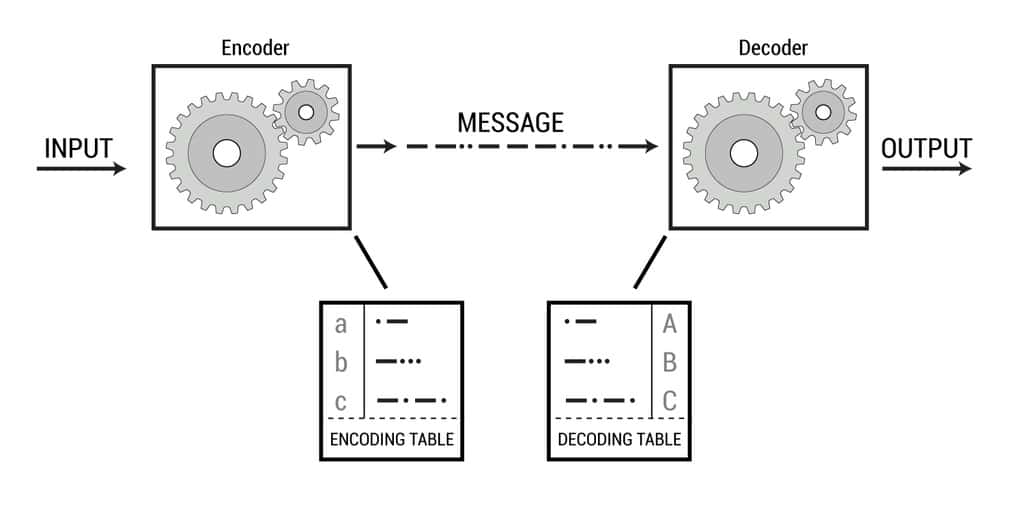 You text me on your phone. Your phone encodes your words into a message and sends them over a communication channel, and my phone decodes your message. The amount of information is the number of bits it takes to encode the message. The message can be degraded by noise.
For the guy who builds TVs, cell phones, etc., his #1 job is to combat the noise.
Everything I just said is simple reductionism. It is very powerful. What you cannot reduce to formula though (by definition) is the origin of the message itself, the “surprise” and originality of that message, the creation which requires will and intent. Its origin is by definition not algorithmic.
The heart of this question is nothing less than the mystery of consciousness – which no one to date has ever even been able to fully define, let alone explain.
All communication systems that we know the origin of are designed. This suggests that consciousness comes first in the universe. Consciousness first, matter second. Not the other way around. (If anyone solves the Evolution 2.0 Prize, and I hope they do, they’ll solve it by starting with consciousness and working from there. My 2 cents.)
You cannot create messages or communication by blind material processes, so far as anyone knows thus far. Information always starts with consciousness. Which is the thesis of my Evolution 2.0 book.
All of this is pretty simple stuff. It’s not rocket science. But it is kind of trippy, and it’s fractal. So people struggle to wrap their heads around it.
Well if you can wrap your head around it, you can see how, as Taleb says, it has implications for dozens of fields of study, including core philosophical questions like consciousness and free will. I recommend the book “In the Beginning was Information” by Werner Gitt because it offers the best philosophical treatment of this subject I’ve ever seen.
Information theory shows that words and language are the basis of all creative acts. They are also the basis of all replication and all memes. So having understood this I was doubly struck by John’s opening statement in his gospel:
1 In the beginning was the Word, and the Word was with God, and the Word was God. 2 He was with God in the beginning. 3 Through him all things were made; without him nothing was made that has been made.
“Word” is the Greek word Logos. It suggests the Evolution 2.0 Prize, an award for the mystery of how chemicals produced code, is a search for the original Logos in the physical world.
People have been debating the Trinity question since the beginning of the first century, and in fact longer than that, because in Genesis God says “Let US make man in OUR image.”
God is plural. The prophets and writers are emphatic about this.
This question – more a question than answers per se – is intrinsic to the Old and New Testaments. No matter what you say about it, or how you might politically frame it, the question itself is always staring you in the face no matter what you do. It’s only an issue of how various people have tried to answer it.
In John 14 Jesus says “But the Helper, the Holy Spirit, whom the Father will send in my name, he will teach you all things and bring to your remembrance all that I have said to you.”
Knowing that the Holy Spirit is the teacher and explainer of the WORD, I had an epiphany:
God the Father is analogous to encoder.
The Father is originator, the original intent; all mysteries are hidden in Him.
The Son is the expression of God, the WORD, the communication and expression of the intent.
The Spirit is the understanding of God, the decoding of the WORD and the effective communication of that intent.
Which means that on earth, all successful communication is a reflection of the nature of God: An idea, which is then expressed and communicated, then finally understood. All successful communication is a fractal expression of the nature of God.
This is the definition of love. Love is the desire for complete communication and complete knowing. Without degradation and without shame. The only way that is can ever be possible to say “GOD IS LOVE” (as in God=Love, an equivalency statement, not just a metaphor) is if God is plural; and if the origination, expression and understanding of God is in perfect, lossless agreement. No entropy.
So God, stated in terms that humans can understand, is three persons who are in total and absolute agreement. Total harmony. That is what it means to say “GOD IS LOVE.” This statement cannot be true unless there is some kind of Trinity.
Every instance of successful communication is an expression of the nature of God – whether it is lovers melding together in harmony or merely your cell phone successfully receiving a text message.
It suggests that an ultimate evolution is harmony and communication between all things. It suggests that the cosmos, however imperfectly, is reaching for and aspires to, love.
It’s because the thing that harmonizes the most people has unbreakable power. Which is true because…. God is love.
~
~
 Answer:
 Can Anybody Actually Win The Evolution 2.0 Prize?