


By Perry Marshall, Founder, ReversingCancer.org and Evolution 2.0
Your kidney used to be a great place to work.
Good morale. Long coffee breaks. Nice boss. But the place started stinking like a gym locker. Hours too long, breaks cut short, food is lousy. One of your kidney cells starts looking around and thinking: get me outta here.
Not getting enough oxygen. Feeling threatened. Choking on toxins. Stressed, scared, wants to leave. So it switches on its evolutionary “Swiss Army Knife” toolkit and starts re-engineering itself to survive.
A white blood cell comes swimming by. The kidney cell says, “HEY! Gimme a ride out of here and I’ll give you immortality. Let’s do a merger-acquisition.”
They fuse into one.
This organism is now a single cell, 100X bigger now, heading off into the bloodstream with an all-access pass to the human body, because half of it used to be an immune cell, and immune cells go anywhere they want.
It is not cancer… yet. This is Stage Negative One. But one day it will start spilling out cancer babies. And those babies will land somewhere far from your kidney and grow.
This is the story of cancer evolution.
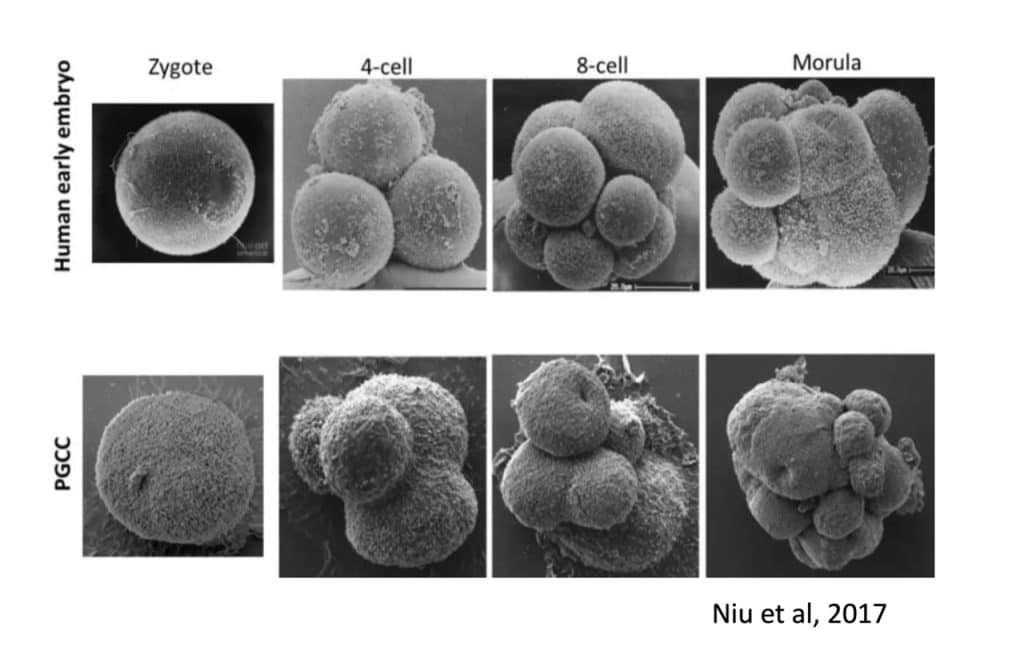
Top row: a human embryo – zygote, 4-cell, 8-cell, morula. Bottom row: a giant cancer cell running the very same stages. One is the start of a human; the other is Stage Negative One, the mother cell that gives birth to tumors.
Figure: Niu N, Mercado-Uribe I, Liu J, “Dedifferentiation into blastomere-like cancer stem cells via formation of polyploid giant cancer cells,” Oncogene (2017), DOI 10.1038/onc.2017.72. © 2017 Springer Nature.
Everybody Saw It. Nobody Believed It.
For more than 150 years, the doctors who study tumors under a microscope have sorted them into two bins.
Bin #1: Tumor still looks like the organ it came from. A liver tumor that still looks like liver. These are usually the friendly ones.
Bin #2: Tumor resembles nothing on earth. No structure, no resemblance to any organ, just a riot of cells with huge dark nuclei. These are the killers.
Nobody could explain why one cancer politely resembles its original tissue and the other looks like a monster from the swamp. We sequenced the genes. We spent 50 years and untold billions reading the genetic code of tumors, and we were still lost.
Sydney Brenner, who helped crack the genetic code and won a Nobel Prize, said, “Biological research is in crisis… we are drowning in a sea of data and thirsting for some theoretical framework.”
Those huge ugly cells? Pathologist Johannes Müller saw them under his microscope in 1838, when microscopes were first turned on tumors. He thought they were an important feature of cancer. Papers about giant cells popped up here and there ever since.
Yet for nearly two centuries, almost everybody decided they were garbage – dying cells, freaks, an accident on the way to nothing important.
What if the garbage was the main event?
Happy accident?
Jinsong Liu is a pathologist at MD Anderson, #1 cancer hospital in the world. For ten years he tried to turn normal human cells into cancer cells the official way – using cancer-causing genes – and he kept failing.
Then one day he and his postdoc were growing a batch of ovarian cancer cells. They choked them – starved them of oxygen until the cells swelled, stopped dividing, sprouted multiple nuclei, and went still. Dead, for all anybody could tell. Jinsong told the postdoc to throw the flask out.
The postdoc kept it.
A month later the “dead” cells had grown back. Cells that every textbook on earth swore could not divide had quietly come back to life and started a colony.
That is the kind of accident that ends a career or starts a revolution. Jinsong spent the next decade chasing it. What he found rewrites where cancer comes from.
YOU started as a giant cell
You began as a single cell. A fertilized egg, about ten times wider than an ordinary cell in your body.
Traditional textbooks taught us how one cell grows: it starts from one cell, then becomes two, two becomes four, all the same size. However, this is how this gigantic cell grows: one cell becomes two, two becomes four, four becomes eight, all the way to a ball of 32 cells – and here is the trick: each new cell is smaller than the last, and they all stay packed inside the original shell. The giant just keeps cutting itself into finer and finer pieces.
Look at that 32-cell ball the right way and it is not 32 cells at all. It is one giant cell with 32 nuclei inside a shell. Both are true at once – 32 little cells, and one giant cell with 32 nuclei, depending on how you look at it.
As the cells shrink, the nucleus fills more and more of the room inside. Crowd it in tight enough and it throws a switch. The parent’s genome gets rewritten into an embryo’s genome – flipping on the program that says build a new human being. The genes energize. The ball becomes an embryo. The embryo becomes you.
Jinsong calls this “the life code”. Not the genetic code – the genes were already there in the egg. The life code is the act of cramming more and more genome into less and less space, guided by the chemical cues your mom packed into the egg, until the building program catches fire.
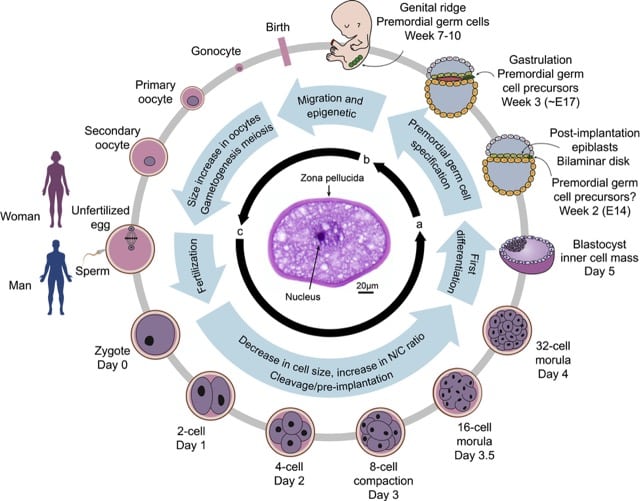
Fig. 1 from Jinsong Liu, “The ‘life code’: A theory that unifies the human life cycle and the origin of human tumors,” Seminars in Cancer Biology 60 (2020): 380–397. © 2019 the author. Reproduced under CC BY-NC-ND 4.0 (attribution required; non-commercial; no derivatives).
The embryo is a giant cell learning how to become a person.
Now watch what happens when the same machine switches on in a grown-up.
The Evil Twin
Your unhappy kidney cell – damaged, aged, choking, frightened. It turns off normal division and swells. It grows very large. It becomes a giant – exactly the way the egg is a giant. Your mom makes one of those giants every month – the egg. Most months, with no sperm, it simply dies.
Now it needs a trigger.
In an embryo, the trigger is the sperm. It arrives, and the egg begins to cleave.
In the tumor, says Jinsong, the stress itself plays the role of the sperm.
Low oxygen, toxins, inflammation, conflict, bad food – and yes, chemotherapy, and radiation – any one of them can walk up to that swollen, frightened cell and do exactly what the sperm does to the egg: pull the trigger.
Most cells in that spot simply die. But once in a while, one refuses to – and the way it fights to live is strange.
It starts making copies of its DNA library and hoarding them. Not two copies – the way a normal cell carries one set of instructions from your mother and one from your father. Four. Eight. Sixteen. 64 full sets, chaotically jammed in, stacked up inside one swollen cell.
Why would a cell hoard 64 copies of its own blueprints? Same reasons you back up a hard drive or keep spare parts in your garage.
Defense: if the originals get shredded – by toxins, by chemo, by radiation – there are backups, and the cell rides out the storm.
Offense: with stacks of spare copies it can take a few and tinker – scramble them, test new combinations, hunt for some trick that beats the next thing you throw at it – while the working copies keep the lights on. The extra DNA is insurance and a laboratory at the same time.
Biologists have a word for how many copies of the genome a cell carries: “ploidy”. A normal cell is diploid – two sets. This swollen monster is polyploid – many. A Polyploid Giant Cancer Cell (PGCC).
This giant is the seed many cancers grow from. Doctors number cancer Stage 1 through Stage 4, by how far a tumor has spread – but the PGCC comes before all of them, before there is any tumor to find. We call this Stage Negative One.
The stressed kidney cell plays the part of the egg. The stress plays the sperm. Pregnancy starts the moment the stress reaches a tipping point.
So what about the white blood cell from the start of our story, the merger? The immune cell brings the giant a propeller and a passport – the power to crawl and squeeze its way anywhere in the body, and the all-access pass to go there, because immune cells are allowed everywhere.
The giant cell does what an embryo does: Gives birth. Spills out daughter cells. Those daughters are the cancer.
Notice this is NOT a slow ladder of mutations climbing rung by rung over decades. Jinsong captured it on film. One stressed cell, one giant, and out come the babies.
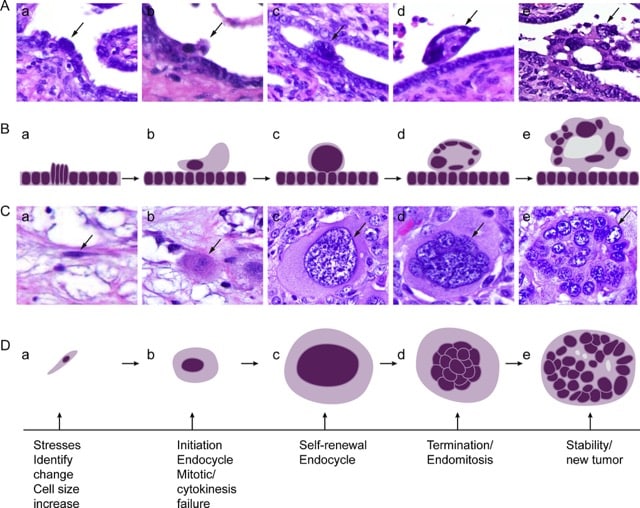
This is not a drawing. A normal cell becomes a giant, and the giant gives birth to cancer – photographed step by step under the microscope.
Fig. 3 from Jinsong Liu, “The ‘life code’: A theory that unifies the human life cycle and the origin of human tumors,” Seminars in Cancer Biology 60 (2020): 380–397. © 2019 the author. Reproduced under CC BY-NC-ND 4.0 (attribution required; non-commercial; no derivatives).
Good twin and evil twin. The good twin takes a giant cell and builds a baby. The evil twin takes a giant cell and builds a tumor.
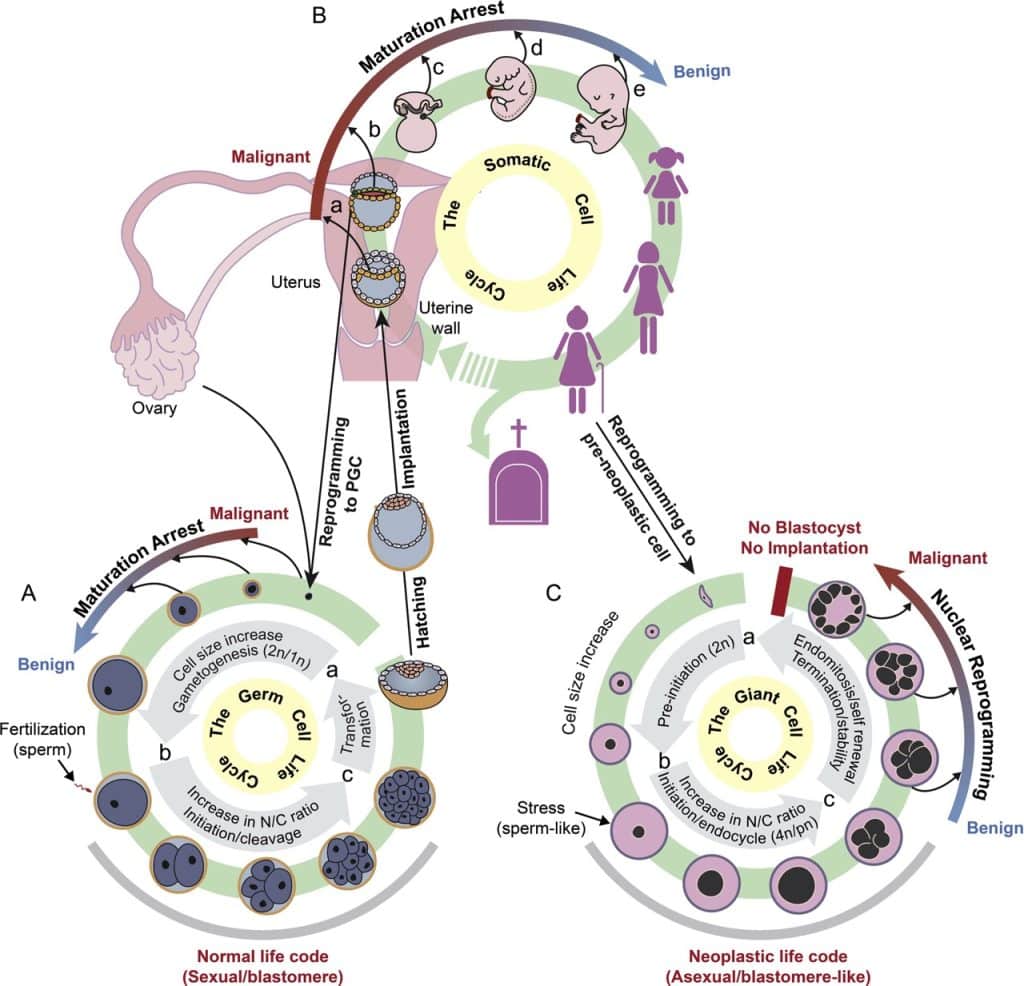
Jinsong Liu connects the dots between embryos and tumors. Bottom left is normal life: an egg, fertilized by a sperm, dividing down into an embryo. Bottom right is cancer: a stressed cell, triggered by the stress itself instead of a sperm, swelling into a giant and spilling out tumor cells. The wheel up top is the body’s own cells, where both stories play out. Two nearly identical machines, side by side – the main difference is what pulls the trigger.
Fig. 5 from Jinsong Liu, “The ‘life code’: A theory that unifies the human life cycle and the origin of human tumors,” Seminars in Cancer Biology 60 (2020): 380–397. © 2019 the author. Reproduced under CC BY-NC-ND 4.0 (attribution required; non-commercial; no derivatives).
Tumor Pregnancy
If the tumor really is running the build-a-baby program, then whatever halts a pregnancy ought to stop the tumor too. It does.
Jinsong calls the tumor a “somatic pregnancy” – a pregnancy in ordinary body tissue, with no sperm and no womb, just a stressed cell running the oldest program it has. And he points out that you can end it the way you end a pregnancy. The abortion drug, mifepristone, the same molecule that stops an embryo from implanting, has been shown in the lab to stall these giant cells. A clue, not yet a cure.
The match between the embryo and the tumor is so exact that the embryo’s off-switch is the tumor’s off-switch too.
Three under-rated scientists
This is where the cancer story walks straight into the biggest fight in modern biology.

The first under-rated scientist is James Shapiro. Shapiro is at the University of Chicago, and his concept of “Natural Genetic Engineering” has been overlooked for 40 years.
Shapiro has shown cells are not passive victims waiting around for random mutations. Cells actively cut, splice, and rewrite their own DNA, on purpose, under stress. Most biologists treat it as a footnote. Shapiro says it’s the very engine of evolution.
The giant cancer cell is natural genetic engineering caught in the act – a human cell, in a living patient, frantically rebuilding its own genome to evade capure. Shapiro encountered Jinsong’s work when we were planning the Cancer and Evolution Symposium (www.cancerevolution.org) in 2020. Shapiro lit up when he saw his signature discovery, Natural Genetic Engineering, suddenly making sense of every oncology case in the world.
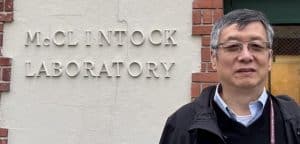
 The second is Barbara McClintock. In the 1940s, a woman nobody would listen to was growing corn and seeing that when she damaged its DNA, genes jumped around the chromosomes. When damaged code was missing, the cell copied code from one chromosome to another and repaired the damage.
The establishment thought she was confused. It took until 1983 for them to hand her a Nobel Prize and admit she had been right all along: stress reorganizes the genome. Everyone filed it under “interesting thing about corn.”
It was never about corn. The giant cancer cell reorganizes its genome under stress by exactly the rule McClintock found in her maize. Jinsong calls it “McClintock’s heredity.”
 The third is Lynn Margulis. Go back to the very first move in our story – the kidney cell and the white blood cell, merging into one. Margulis spent her career arguing, against a barrage of dogma and stern ridicule, that the great leaps in evolution did not come from slow mutations at all. They came from whole cells swallowing other cells and keeping them.
Macro evolution is accomplished quickly via huge leaps of cooperation. This is where mitochondria, the powerhouses in your own cells came from – they used to be free-living bacteria. Ditto with chloroplasts, which are blue-green algae living inside plant cells.
The textbooks call it symbiogenesis and stamp it “two billion years ago.” Safely in the past, nothing to see here.
It is not in the past. It already happened this afternoon, in a hospital near you, every time a stressed cell merges with another and floats off into someone’s blood.
You just witnessed evolution in real time – not years, but minutes
A cell under stress copies its DNA into stacks of spare sets. The early embryonic program wakes up. The genome reshuffles. Two cells fuse into one.
That is not a list of cancer mechanisms. That is the very toolbox of evolution itself – Shapiro’s self-engineering, McClintock’s jumping genes, Margulis’s mergers – the whole toolkit, running at breathtaking speed, in your sister-in-law’s breast tissue.
Ken Pienta at Johns Hopkins built a tiny glass maze he calls the cancer swamp, with a gradient of poison running across the top, and watches cancer cells crawl into the danger and turn into these giants. The harder you stress them, the more giants you get. It does not matter what the stress is. Smack them hard enough and they reach back into the oldest survival program life has – one Pienta traces all the way down to the earliest bacteria – and they execute.
This is why we lost the war against cancer. When you carpet-bomb a tumor with chemo and radiation, you are not just killing cells. You are nuking a village with napalm, killing 98% of the peasants… and the 2% you don’t kill drop their sticks and stones and start shooting missiles instead. You are pouring gasoline on the very fire you are trying to put out. (Chemotherapy sometimes triggers more cancers. Every oncologist knows this.)
Your sister-in-law’s numbers are looking great…. suddenly five months later she’s dead.
You cannot understand cancer until you understand evolution. And you cannot understand evolution until you understand cancer. They are the same phenomenon seen from opposite directions. For 100 years the creationists wouldn’t look at evolution because they thought it was the enemy. And the Darwinists wouldn’t acknowledge the engineering inside the cell because it didn’t sound random enough to suit their agenda. Between the two, they buried the unifying story that explains the 2nd deadliest disease in the world.
Once you see this, you cannot un-see it.
In 2017, in my book Evolution 2.0, I said, “Cancer is an evolutionary runaway train, and that train has powerful engines. Cancer is the result of a malfunctioning evolutionary Swiss Army Knife.”
That’s as far as I could carry it at the time. But then in 2020 I co-founded the Cancer and Evolution Working Group with James Shapiro, Henry Heng and Frank Laukien. It is now part of American Association of Cancer Research with 5300 members. In 2025 I co-founded a cancer early detection company with four scientists from Columbia University in NYC.
Today we know how to detect a Stage Negative One cancer cell within 18 days of appearing in the human body. We know how to sense what organ it came from. We know how to attach a protein to that cell and make a therapy target. Most importantly, we can ask questions like “Why is your kidney so miserable in the first place?” – before it’s too late.
Early detection at Stage Negative One… instead of napalm at Stage Four. The revolution has begun.
~
References:
Jinsong Liu, “The ‘life code’: A theory that unifies the human life cycle and the origin of human tumors,” Seminars in Cancer Biology 60 (2020): 380–397. DOI: 10.1016/j.semcancer.2019.09.005. Open access, CC BY-NC-ND 4.0. https://www.sciencedirect.com/science/article/pii/S1044579X19300537
Jinsong Liu’s presentation at the Cancer & Evolution Symposium
Ken Pienta’s presentation at the Cancer & Evolution Symposium
Meeting Report: 1st International Conference on Polyploid Giant Cancer Cells—Biology, Clinical Applications, and the Birth of a New Field in Cancer Research (February 2024, MD Anderson, Houston TX)
~
Download The First 3 Chapters of Evolution 2.0 For Free, Here – https://evo2.org/evolution/
Where Did Life And The Genetic Code Come From? Can The Answer Build Superior AI? The #1 Mystery In Science Now Has A $10 Million Prize. Learn More About It, Here – https://www.herox.com/evolution2.0