


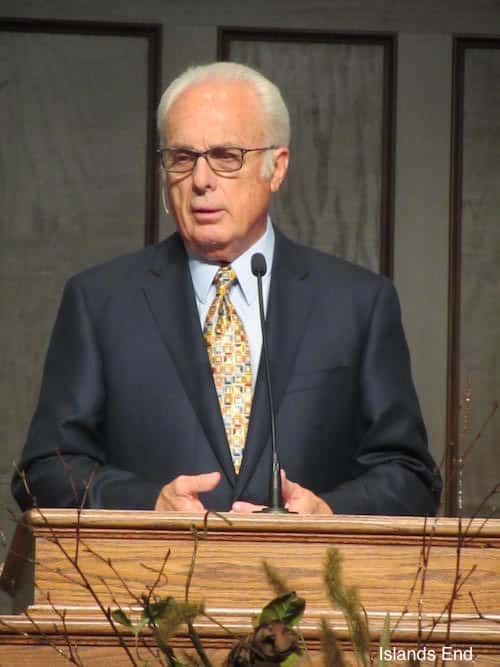
John MacArthur, ally of Young Earth Creation
I grew up in an ultra-conservative, 4 1/2 point Calvinist, expository Bible teaching church. When I was in high school, my church in Lincoln Nebraska brought in a special speaker, the Young Earth Creationist and Bible teacher John C. Whitcomb. He gave a series of talks about science and the Bible.
It was FASCINATING. Ten times more interesting than the usual Sunday Biblical exegesis. A six-part series, a multi-day, power packed tour de force of creation science.
Whitcomb delivered a scorching exposé of the fallacies of carbon dating; he described the worldwide flood; the Genesis account, the deterioration and de-evolution of the human genome; the tower of Babel.
He explained how Noah’s flood accounted for geological anomalies which secular scientists misconstrued as “millions of years;” and how the earth is actually 6,000 years old. He explained how we know that from the Biblical genealogies. I was captivated.
Whitcomb was a pivotal figure in the Young Earth Creation movement. He and his co-author Henry Morris created an entire field known as “Flood geology.” A weekend seminar similar to that one still appears at a church near you multiple times a year. My church growing up was very similar to John MacArthur’s. He’s pictured above.
When I was seven, I had a dinosaur book I wore out from total fascination. It described dinosaurs living 65 million years ago. My 2nd grade teacher taught me how to handle that:
“Just laugh at it.”
So I did.
Origins didn’t come up much in high school or college. Once I had a conversation about Jesus around the water cooler at work. I offered a pretty convincing case for the resurrection, and a co-worker admitted as much.
But he said, “There’s no way you’re going to convince me that all of humanity is the result of two naked people, an apple and a snake.” I didn’t have a comeback.
I professionally subscribed to a publication called Sensors Magazine. It struck me how technologies – especially sensors, from cameras to ultrasonics to devices most folks have never imagined – are greatly inspired by sensors in the human body and animal kingdom. As an engineer I intuitively sensed a tremendous level of design in nature.
I also knew there were a LOT of questions I couldn’t answer. I wasn’t exactly seeking opportunities to debate.
One day I heard up talk by astrophysicist Hugh Ross called “New Scientific Evidence for the God of the Bible” and it set my mind on fire. This guy explained how the Big Bang was first proposed by a Catholic priest in 1931, scorned for years, then reluctantly accepted in the mainstream. Why? Because evidence for a single discrete beginning 13.8 billion years ago had become overwhelming, despite secular bias against it.
He showed, verse by verse, how modern cosmology and the opening verses of Genesis match exceedingly well. All that was needed was a shift in perspective, a few very elegant assumptions.
So long as you assume a “day” is a period of time, and take the story as being told from an earthly vantage point (which is established in Genesis 1:2), it all fits – tit for tat. Ross described the extreme fine tuning required for gravity, the expansion rate of the big bang, forces, constants etc – physics facts Electrical Engineers are quite familiar with. Wow. That was a mind-blower.
Guess what – no conflict between mainstream cosmology and Genesis after all.
I sent Ross’s tape to a physics professor friend of mine. He wrote back with a rebuke: “David Hume dismantled the ‘design argument’ 200 years ago.”
His reply didn’t contain much actual substance, however. He did nothing to explain the fact that no plausible re-configuration of any of those interdependent constants would result in any kind of coherent universe. Nothing more than a hand-waving dismissal.
I plowed forward, happy to now have a general cosmology that matched the Biblical one – but on a much grander scale. Guess what, those dinosaurs really did live 65 million years ago and it’s not a problem.
The story I’ve told so far will make Old Earth Creationists quite happy – and Young Earth Creationists unhappy. The reason it makes YECs unhappy is… YEC is brittle. Any change to the story forces them to disassemble quite a number of theological shibboleths and re-assemble them.
Go down this road and you’ll soon find major Biblical engine parts scattered around on the shop floor. For awhile may not feel quite sure if they’re going to go back together.
This is anathema to a traditional evangelical. Especially where I came from. Our systematic theology was a vast spreadsheet of theological exact answers and precision-formed parts, carefully engineered and fine-tuned like a NASCAR drive train.
To a traditional evangelical, this comes down to an issue of authority. “Are you going to believe godless secular scientists? Or are you going to believe God’s word?” This is how Answers In Genesis frames the question. It’s either/or, black-and-white.
There’s little dance or interplay between science and theology. You take the plain sense literal reading of Genesis, you eschew those “liberals” who “compromise” God’s Holy Word.
Any apparent disagreement with science is obviously a science problem. Not a theology problem. Not an interpretation problem.
When I was in high school I had debates with my pal Pat, who belonged to a traditional strand of Church of Christ. COC interpreted not a few, but MANY things differently than my home team. I saw that as they rotated their theological Rubik’s cube, they matched some pieces much differently than we did. As I became familiar with other protestants and Catholics, I saw that the re-configurations of Christian theology can be almost endless.
The central pillars of Christianity are quite solid. It’s pretty hard to come up with anything much different from the Apostle’s Creed, for example, without butchering the Bible. But once you get to secondary and tertiary issues, there are many ways to work the puzzle.
I was a pastor’s kid. As Biblically educated as anybody’s likely to get short of seminary. And already by age 20 I viewed the 10-decimal precision and proclaimed certainty of reformed evangelical theology with a jaundiced eye.
I noticed that theologians fiddle with interpretations for their entire lives, and do clever sleight of hand with each other (with plenty of petty name calling, posturing, shaming and shunning) to win debates and protect egos. I knew too much about the Bible to crown one single, rigid, Ken Ham interpretation as king – or anybody else’s for that matter.
Don’t get me wrong, I embrace the inspiration and authority of the Bible. I believe in the lifelong pursuit of truth and discernment. But I believe the value and experience of twisting the Rubik’s cube itself is actually more important than the particular Rubik’s configuration your cube happens to land on today. Nuances of theology are squishy. That’s a fact.
I also think the capacity to dialogue with people who disagree with you, and still love them without losing your cool, is much closer to the “point” of Christianity than whatever doctrines we abstract from the stories and texts.
Also:
As an Electrical Engineer, I found some things in science are not squishy at all. Like the speed of light. It’s the “c” in Einstein’s “e=mc^2.” That “c” appears all over the place in physics. It’s in Maxwell’s equations, which define light’s essential behavior; “c” cements the relationship between electric fields and magnetism, and we can measure it with ten decimals of precision. 299,792,458 meters per second.
There is nothing remotely controversial about this in science. (Contrast this to Darwinism, for example, which has been plagued with endless problems and conflicting data for 150 years.)
The speed of light, so far as I know as an electrical engineer, is a constant in physics. Sure, light’s speed changes in a prism, but as a physical constant it does not budge. It doesn’t even shift with the speed of objects. As far as we can tell it’s an absolute barrier.
Q: If a star is 100 million light years away, when did that light leave the star?
A: 100 million years ago.
All kinds of YECs have tried to dodge that question and that answer. None have succeeded. If they were right, physics itself would be a complete mess. But it’s not. Physics works like a precision-built Swiss watch, thank you very much.
Therefore… in the alleged authority battle between science and the Bible… for me, speed of light won.
Once I began seriously considering this, I realized that if the Bible actually intended to say the universe is 6,000 years old, then it could not even be inspired by God.
The universe is old. Period.
But upon further study, I’m not convinced anything in the Bible contradicts that. Rather, YECs have been reading a young earth into scripture for 100 years.
Yes, you can explore whether the speed of light is changing, whether God made the universe to LOOK old even though it’s actually young. I invite you to research to your heart’s content. Personally I’ve been down those trails and I caution you that any of those positions will back you into a corner that you cannot get out of.
Our often-squishy theology needs to make room for verifiable facts. Like the speed of light.
Any honest apologist or thinking Christian surely has to admit that quality of evidence comes into play. The Bible is FULL of history-based truth claims (which is not the case with other religions, like Hinduism and Buddhism).
For example: the honest Christian should be able to say that IF someone really did produce the body of Jesus, if they proved that Jesus didn’t actually rise from the dead, then Christianity is therefore not true. And then we are truly “above all most to be pitied” as St. Paul said.
Is it not true that Christians criticize Mormons for believing in entire civilizations in South America that left nary a trace? For believing that American Indians are actually a lost tribe of Jews, even though DNA evidence contradicts this?
Is it not true that Christians criticize Jehovah’s Witnesses for predicting the end of the world multiple times, and being wrong?
So if Christianity is historical, shouldn’t it be falsifiable as well?
Why does YEC get a free pass in making up its own version of history, yet Mormonism doesn’t?
We should be willing to abandon Christianity if we find it’s not true. By the same token we can shout it from the rooftops if we find that it IS true. That’s the position the apostles took in the book of Acts.
And yes, we can and should use verifiable scientific facts to judge between competing theologies.
Oh, and by the way…. most people at this point would pile on a litany of other problems with YEC. Most articles like this one sport a list of 10 major problems or more.
I don’t need all those. I only need one. Speed of light. It’s exact, you can measure it in the comfort of your own home and you can do the math. Math doesn’t lie.
The other problems with YEC are more fuel for the fire.
We know the earth is old. If that’s true, what theological dominoes fall?
The first domino is the notion that there was no animal death before the fall. Nothing in the fossil record suggests a death-free world before man showed up.
THIS is the lynch pin of YEC. It’s not the word “Yom” (day) in Hebrew, it’s not something else. It’s the issue of death before the fall. Let me explain.
The central cornerstone of YEC is belief that 1) earth was a perfect paradise, 2) God could not make any world that was less than perfect and pristine, and 3) “Through one man sin entered the world, and death through sin” (Romans chapter five.) For YECs, that means ALL death, not just men, not just men’s spirits.
This holds YEC in place. It’s a theodicy (account of evil despite a perfect God) that many Christians are comfortable with. Throw that out and you have to start over with your theodicy. You’ll need a more complex picture of God.
If earth is old, if bears were eating salmon 50 million years ago, if alligators always had sharp incisors, then God fashioned an extremely inefficient universe where conflict was baked in from the word go.
Cancer and bacteria and weeds and parasites have been around as long as there have been plants and animals.
That, to the traditional Christian mind, is too much to stomach. (Though the same Christian seems to have no quibbles with various other cruelties, both in the past and future.)
My late colleague Michael Marshall asked, “Which is more dangerous? A world with pathogens like viruses and bacteria? Or a world where the 2nd most powerful being in the universe is a serial killer boiling with rage, salivating for an opportunity to devour everyone?”
Did you ever notice that in the Adam and Eve story, God doesn’t even warn them them about what’s coming, or who? He certainly doesn’t do what any normal parent would do.
Nevertheless God declared the world to be very good. Despite the fact that peril was built in to the picture before man ever showed up.
In Genesis 1:31, when God says “And God saw all that he had made and it was very good,” do you know what the Hebrew word for “Good” means in the original Hebrew?
It means “Good.”
It does not mean “Perfect.”
I can still label planet earth a “good” world. I cannot label it “perfect.” I don’t have to like all of it. I can still agree with God that it was good. Exuberant parents bring newborn babies into this good world with joy every single day.
The assertion that God would never make anything “imperfect” flies in the face of not only science, but Biblical theology. And good luck coming up with a coherent definition of “perfect” that aptly describes any created thing.
What did God say to Moses in Exodus 4? “Who gave human beings their mouths? Who makes them deaf or mute? Who gives them sight or makes them blind? Is it not I, the Lord? Now go; I will help you speak and will teach you what to say.”
This raises even more questions that I’m not going to answer in this article. Some of those are:
–Who was the first man? Who was Adam?
–Was Adam a Real Person?
–Was Noah’s flood global or local? How does known Middle Eastern history overlap with the Biblical story?
–Is “death” in the fall physical death, or something else? Does it apply to animals?
–How do you read Genesis 1 from an old-universe perspective?
–Was the Grand Canyon formed by the flood?
–What about evolution? Is evolution Biblical?
You can follow the links above for more on these questions. Meanwhile, basic facts of science which are now beyond reasonable doubt call YEC into question.
God wrote two books: the book of scripture, and the book of nature. I do not believe there is any conflict between the two. But our understanding of both will never cease evolving.
And that is why I am not a Young Earth Creationist.
Download The First 3 Chapters of Evolution 2.0 For Free, Here – https://evo2.org/evolution/Where Did Life And The Genetic Code Come From? Can The Answer Build Superior AI? The #1 Mystery In Science Now Has A $10 Million Prize. Learn More About It, Here – https://www.herox.com/evolution2.0
Jose Lopez,
Is this the “debate” that you had in mind?
https://m.youtube.com/watch?v=SuWAUnQN1HQ
If so, someone else already encouraged me to watch it, and I finished it ten days ago, even though it is rather lengthy. Just in case my guess is right, let me share one reaction.
At 1:53 in the video, Kaiser said that God created 24-hour days on Day 4, and I never heard him retract this idea later, even after it was pointed out that the Bible does not say this. Amazingly, this surprising claim was defended by a man whose education cost in the neighborhood of $100,000 with plenty of impressive items on his résumé. Ankerberg reviewed some of them in his introduction. But think of this. We want to identify the day of creation when the day-night cycle began, presumably, the very first 24-hour day whose creation Kaiser believed was delayed until Day 4. I think a preschooler could find the answer here: “God called the light ‘day,’ and the darkness he called ‘night.’ And there was evening, and there was morning—the first day” (Gen 1:5). So there you have it, settled per Genesis. I watched five men talking for hours without pointing to this verse as the answer, but it was this simple and easy to find and understand. I was reminded of the verse that says, “At that time Jesus, full of joy through the Holy Spirit, said, ‘I praise you, Father, Lord of heaven and earth, because you have hidden these things from the wise and learned, and revealed them to little children. Yes, Father, for this was your good pleasure’” (Luke 10:21).
I would like to say how much I have appreciated everyone’s comments on this, it has certainly helped me.
Jose, God said ‘let there be’ and then it goes on to say he ‘made’ or ‘created’ whatever it was he said let be. So whatever word was used seems irrelevant as either way it got done.
You say ‘But, to ignore basic, simple, elementary astronomical truths, such as how our universe came into existence…….well that’s just unfortunate’ I agree with Tom that ‘fallible human have to interpret physical evidence after making assumptions that may or may not be correct. Scientists change their minds and do not necessarily even agree among themselves. This should be a good reason to consider “the inerrant Word of God” to be your highest authority.’ therefore how can they be ‘truths’.
I don’t think we can ignore the fact that the days are marked by morning and evening and therefore should be taken as 24 hour periods. If God appeared to us today and told us the story in the same words, wouldn’t we assume he was meaning days as we know them. If he meant long ages wouldn’t he have said so.
God is not a ‘magician’ but he is a miracle worker, he doesn’t need a gigantic flashlight to speak light into being and Google is not the fountain of all truth. There are so many conflicting views that come from our own thoughts and ideas and theories that it is difficult to find the ‘truth’ so why not trust in “the inerrant Word of God” and seek to verify that.
Barry, researching to develop a consistent, Scripture-based world view requires more than a literal Biblical interpretation. Leaving out God’s astronomical record, including all the the scientific disciplines, does not justify a literal Biblical interpretation. And, of course, scientific research changes. That’s common sense. Astronomical research, for example, changes every day. So, well-disciplined scientists must change their conclusions if their to continue consistent research. It’s very simple.
Excuse me: they’re to continue
Jose, then if well-disciplined scientists keep changing their conclusions , how can we trust it to be ‘truth’.
I think I will just wait until they come to the conclusion that the ‘inerrant word of God’ is indeed inerrant.
Barry, with new technology, scientific research changes almost daily. In the case of astronomy, it’s no different. That does not mean the scientific disciplines are not trust worthy. It means as new research happens, our knowledge increases. That’s common sense.
Jose Lopez,
You can drop out of our discussion at any time, of course, whether you feel it is pointless or not. If your objective was to change my mind, and you feel frustrated because you failed to do this, it might help you to empathize with me if you imagine my trying to change your mind with unpersuasive arguments, but I gave up, complaining that the discussion was pointless. From my perspective, the big idea here is to help each other see important points that have been overlooked, but this exercise certainly is pointless if the points are simply ignored anyway, as if someone actually refuses to see them.
You brought up again your claim that stars were created on Day 1. Mike and Barry have already responded. I agree with them, but I have a little more to add, in case you are interested. Notice that Gen. 1:1 and 2:4 both state that the heavens and the earth were created, and our English translations reflect the corresponding Hebrew word (*bara*). Gen. 2:1 clarifies what “the heavens and the earth” mean by adding “and all the host of them” (KJV) or “in all their vast array” (NIV). How can the stars not be included there as a significant part of what God created? If this was not clear enough, consider Ps. 148:5, which says, “… he commanded, and they were created [same verb in Hebrew]” (KJV and NIV). Of course, we need to know to what “they” refers, and we find out by looking back at Ps. 148:1-4. Notice especially verse 3: “Praise ye him, sun and moon: praise him, all ye stars of light.” Those items are just what Genesis covers in the passage on Day 4. We have the same idea confirmed again in Is. 40:26.
The bottom line for me is that none of these verses contradict what Gen. 1:16 says about God making the sun, moon, and stars. This verse does not state that they were created, all right, but we can easily reconcile all of the relevant verses by concluding that God both made and created the sun, moon, and stars. One could still claim that God created them on Day 1, then made them on Day 4, but does this really make any sense? What is the difference between a star created but not yet made, and one both created and made? The only created thing mentioned in the passage on Day 1 is light. This light (necessary to start the day-night cycle) did not have to come from the sun, moon, stars, or a giant flashlight. After all, God is light (1John 1:5; Rev. 21:23), and he evidently knows how to make even raiment shine as “white as the light” (Matt. 17:2; Mark 9:3).
You can ignore all of this, if you want, because doing so may help you feel more comfortable with the position you have adopted, but if you really want to convince others that you have found the truth, I think you need to come up with a cogent, rational counterargument.
Tom, our planet can not have light without the sun, moon and stars. It’s very simple.
Mike Tisdell,
Thanks for your help enlightening Jose about the Hebrew verbs for making and creating. Thanks, too, for your reply yesterday morning to my February 28 (3:22 pm) comment. Your second paragraph there suggests that you misunderstood my position on “the addition of the infinitive absolute” in Gen. 2:17. Did I ever say that this “changes the meaning to that of a continuing action”? It would be tedious to rehash old comments, but I don’t recall ever proposing any such rule. I still think, as I did when we started this discussion, that the construction would at least allow continuing action as an alternative to punctiliar action, as reflected in the center reference column of the KJV. In particular, I think the use of the same construction in Gen. 2:16 reinforces this conclusion, considering the context. This continuing/punctiliar ambiguity may exist even without the infinitive absolute added. You are the expert on this.
We do not need to keep beating a dead horse, but I would be interested to know whether you are convinced that the Hebrew text of Gen. 2:17 demands an interpretation that makes God a liar, because Adam did not drop dead physically on the same day that he ate the forbidden fruit.
On your reply to Barry Wadhams (March 2 at 11:22 am), the differences in article usage that you discussed were not news to me. I remember reading an article about this where the author argued that the days were separated by long gaps of unspecified length, allowing plenty of time for evolution, but each day mentioned was just a single 24-hour day. I reject this idea, of course, because if this were a reasonable interpretation, it would make the Sabbath commands unenforceable.
On the positive side, I think the differences are there for purely literary or stylistic reasons that may be hard to nail down for sure. This may explain why translators often ignore them. As a practical matter, I think we are talking about a difference without a distinction. What comes before the sixth day? It would be the fifth day, of course, right? This would be true even if this very same day is also a fifth day, which is “one day” as well. Any interpretation that depends crucially on the differences you noted needs to be consistent with the references to the same days in Exodus, where they are called “six days” and held up as a model for the “six days” in an ordinary work week, both ending with one additional day for a Sabbath rest. I think this allows an interpretation where each day lasts exactly one thousand years, or any other unit of time of fixed length, but the law becomes unenforceable if the length of those “days” is flexible or unspecified, or if Day 7 has not yet been completed. At least, this is the way I see it. What do you think?
I tried to reply to your “Just curious” comment (March 2 at 8:09 pm), but when I submitted my comment, I never saw it show up as awaiting moderation, and when I tried to submit it again, it was rejected as a duplicate. It may still be in limbo somewhere. The Hebrew font I used might have messed something up. Anyway, to answer your question, if I understood it, I never really learned to read Hebrew well, but I did study Modern Hebrew at The University of Texas at Austin in the summer of 1974. It was two semesters of credit crammed into an intensive summer course taught by native speakers, but we did read a good part of Genesis 1 in class. I used that course to satisfy a requirement for a non-Indo-European language.
Jose Lopez,
Your claim is very simple, all right, maybe even too simple. Are you suggesting that mankind is wise and powerful enough to provide artificial lighting sufficient to illuminate the room where I now sit, without any light coming in from sun, moon, or stars, while God is wise and powerful enough to create the heavens and the earth out of nothing but is utterly incapable of figuring out a way to provide enough light to maintain the day-night cycle on our planet for Day 1, Day 2, and Day 3, unless he creates the sun, moon, and stars on Day 1, leaving him time for an extra day of rest on Day 4? Your claim seems incredible to me, but you can believe it yourself for as long as you please, of course. Count me out. I agree with Jeremiah. Nothing is too hard for God (Jer. 32:17).
Tom, what’s incredible is that young earth creationists have to find answers, such as God providing the light on day one because He hadn’t dropped in the sun, moon or stars until day four. Now, how would that look? He must be a magician, stopping every possible law of physics for the first three days of creation in order to show us His immense power…. because His Word says He’s light. That may sound Biblical. But, what about the fact that He said His fixed laws never change. Did He make an exception on the first three days? The astronomical record tells us the laws of physics, that govern our universe, have never stopped, or changed, since the beginning of time, space, matter and energy (Genesis 1:1). Tom, God’s fixed laws of physics have not changed since Genesis 1:1. Why? Because He said it. So, is He a liar? His word tells eight different times that He cannot lie or deceive us. It’s time for Christians to stop trying to debunk the scientific record of nature. That’s not Biblical inerrancy. Jesus Christ gave us two books: His Scripture and His record of nature. They both must be accounted for.
Just a philosophical implication of the cavalier use of “nothing is too hard for God.” Can God create a round circle or 4 sided triangle?
Hopefully not too off topic here, but I’ll oblige. There are plenty of things that God can’t do and you identified two of them. God can’t create square circles, 4-sided triangles, or rocks too heavy for Him to lift because He is a God of logic, which extends from His very nature. Creating such objects or situations are non-tasks that can’t be imagined in any possible universe so they’re just absurd. It isn’t a lack of power or knowledge, but that logical absurdities contradict God’s nature. When people say “nothing is to hard for God,” they’re excluding absurdities. I don’t think they’re being cavalier, just assuming everyone is including logically possible situations.
God also cannot sin for the same reason.
Gordon Sun, what is so “cavalier” about claiming that nothing is too hard for God? If a student needed help with his geometry homework, and you announced that none of his geometry problems were too hard for you, would it be fair to say that your announcement was cavalier? What would you say if he asked you to draw a 4-sided triangle? Would you draw an ordinary triangle and claim that just one of its three sides was actually two sides that overlap perfectly? Your challenge reflects a basic misunderstanding, which is explained well here.
https://www.gotquestions.org/God-rock-heavy-lift.html
Creating light on earth that does not shine from sun, moon, or stars is certainly not a logical impossibility. Even humans and fireflies can do this. Why not God?
Jose Lopez,
How would that light look? Since we did not receive Genesis as an illustrated history, one can only imagine the light created on Day 1, but at least one thing is clear from the text. It was sufficient to allow what looked like an evening and a morning on each of the days before Day 4.
You said, “[God] must be a magician, stopping every possible law of physics for the first three days of creation in order to show us His immense power….” Would you say that a firefly must use magic to shine light on the earth that does not shine from sun, moon, or stars? How immense does a bug’s power have to be to do this? I don’t get it. Can you name even one law of physics that has to be stopped to accomplish such a feat?
I think part of the problem here is that you are trying to prove a universal negative, and this can be really hard to do. This case is no exception. You said earlier, “Tom, our planet can not have light without the sun, moon and stars,” but I think what you really meant was that you cannot imagine how this could be possible, so you concluded that it therefore must not be possible. Please correct me if this is not the case. Otherwise, this looks to me like an ordinary argumentum ad ignorantiam, and it ought to be rejected as fallacious. I simply believe that God did what the writer of Genesis says he did, whether I can imagine how he did it or not.
God is certainly not a liar. If you believe that God cannot perform any miracle without suspending the laws of physics and also that he has told us that he never changed or suspended the laws of physics since Genesis 1:1, then I think it follows that God has never performed any miracles since Gen. 1:1. This makes no sense to me, but if you can defend your logic, please go ahead and try. Otherwise, let’s try to identify a flaw in it and straighten this out.
On finding answers, I have two questions for you. Even a child can read Genesis 1 and tell what God made or created on the different days. If you were to ask a child what God created on Day 7, he could easily answer that God made nothing on that day, because he was already finished creating stuff and ready to rest. If you asked a child what God made on Day 4, I think he would answer that God made the sun, moon, and stars on that day, but you would disagree, insisting that those things had already been made back on Day 1. From your perspective, how should the child answer the question about Day 4? If your answer is nothing at all, and this is actually the correct answer, then why doesn’t Ex. 20:11 say that in five days the Lord made the heaven and earth, the sea, and all that in them is, and rested the fourth and seventh days? This is not rocket science.
There really is no “scientific record of nature” revealing history that someone might try to debunk. Nature is not literally a book. If scientists consider it to be a book in some figurative sense, you have to know that they keep changing their mind about what is “written” in it and cannot agree among themselves what it says. What God has actually told us verbally in the Bible ought to be held up as our highest standard of truth. If these claims seem crazy to you, I think Jason Lisle may explain it well in his opening presentation during a debate with Hugh Ross. After you follow the link, please slide over to 26:14 for the start of Lisle’s part. It ends at 50:50, so it would take you less than 25 minutes to watch it.
https://www.youtube.com/watch?v=Lvnst9ffwEE
Tom, again I’ll say (in very simple terms) that our planet could not have been prepared for advanced human life without the light and gravity from the sun and the moon. We would not have the elements needed for advanced life had the stars not been there, as well. Also, I agree, God had made the sun, moon and stars. It does not say He created them. He used the word Bara, translated to create something brand new that’s never been there before, three times in the first chapter of Genesis. Day 4 was not one of them, and He did not use Bara and Asah (meaning to make) interchangeably, as young earth creationists claim. They’re two completely different words, and in a contextual sense, that’s huge. If you can’t see that contextual issue, then you have a comprehension problem. Ive said this before: this is an English language issue. It does not mean that this somehow negates God’s inerrant Word. That’s a common defense that’s derived from the young earth creationists camp. It’s very simple. So, how can this be correct? Astronomical research has already proven that this is how God did it. So, the miracle, amongst many God performed, is that on day four, God changed Earth’s atmosphere from translucent to transparent in order to prepare for God’s fifth day because the animals and later human lives need these things because of their biological clocks. It’s very simple.
Jose Lopez
How do you reconcile your position with Exodus 20:11 in which God “‘made’ heaven and earth, the sea, and all that in them [is]?” Your logic would imply that God “created” everything on day/age one and then fashioned them or “made” them to appear through out the next 5 day/ages. Also, it never states in Genesis 1 that God “created” (bara) the land animals. He “made” the land animals. So are we to conclude using the same pattern of “creating” the sun, moon, and stars originally and then “making” them to appear later that God “created” the land animals originally and then “made” them to appear on day 6?
Jose Lopez,
I wanted you to name at least one law of physics that God would have to violate to provide light on earth without sun, moon, or stars. No answer. Do we agree then that no violation was required?
I wanted you to explain why Day 4 did not count as a second day of rest. I think you answered this by proposing that “God changed Earth’s atmosphere from translucent to transparent,” which you categorized as a miracle. If this was a miracle, it should count as work done, but was it really a miracle?
You must have seen images of the whole earth taken from space. Have you ever seen one without any cloud? From any given vantage point and throughout history, the sky has frequently changed from cloudy or translucent to transparent and back again, right? If this takes a miracle of God each time, when did he ever finish his Day 4 work? If it never takes a miracle of God except on Day 4, what changed? Genesis says nothing about a change in the clarity of the atmosphere, so if the only work actually mentioned happened back on Day 1, I think you should conclude that Day 4 was also a day of rest, according to your theory, but skies naturally started to show patches of blue wherever sunlight burned through cloud cover, as is commonplace to this day.
I also wanted you to see Lisle’s presentation in the debate. Did you? If you did, do you have any comment on it?
You repeated your claim (first made in your February 26, 2018 at 6:51 pm comment) that “…our planet could not have been prepared for advanced human life without the light and gravity from the sun and the moon. … Astronomical research has already proven that this is how God did it.” Well, the part about God is a new extension of what you said earlier. Does any of the research actually prove that divine intervention was required?
Barry Wadhams and I pressed you to be specific about what astronomical research you had in mind, but the best you came up with for us was a vague reference to “basic information on the Big Bang or the Anthropic Principle” and a suggestion to check out “Hugh Ross’ Reasons To Believe for any information on astronomical research,” which suggests to me that you simply trusted Hugh Ross to do the thinking for you on this issue.
However, Gordon Sun tried to help you out by suggesting that you might be thinking of nucleosynthesis in stars as the way “metals” (elements heavier than helium) came into existence. Water has oxygen in it, one of the elements supposed to be created in stars, but if this is what you and Hugh Ross have in mind, how do you explain Gen. 1:2, which suggests that water existed even before light was created (Gen. 1:3) on Day 1? (If stars were created before light so that we can start with darkness over water, then we need stars that already produced oxygen but no light, right? Nonsense.)
More importantly, if we believe the very first verse in the Bible, why should we ever imagine that it might be so hard for God to create heavy elements in the beginning that he has to wait for them to be created naturally in stars millions or billions of years after the beginning? If this was the “work” for which God took credit, and it is supposed to have continued without interruption, did God ever rest from this “work”? I obviously need help understanding your logic. Does your theory even make sense to you? If it does, please explain it here. Otherwise, maybe you can ask Hugh Ross for help, if you got the idea from him in the first place.
You also repeated your claim (first made in your February 28, 2018 at 6:28 pm comment) that God “did not use Bara and Asah (meaning to make) interchangeably.” Well, you reworded your claim slightly this time. You had originally said, “… the Hebrew word Bara is tranlated to create something brand new that’s never been there before, and finally the Hebrew word Asah is translated something that was already made, or there. Young Earthers will tell you they mean the same thing, as it’s a way around the fact that they’re wrong, which many mean Old Earthers are correct. The truth is they’re two different words, which God uses in two, different, contextual meanings.”
You were challenged to defend this claim in earlier comments, some of which refer to passages where those two verbs do appear to be used interchangeably in the very same context, and this is true even if you confine your study to the Hebrew text, removing your “English language issue” as a factor. You can continue to refuse to move this discussion forward by addressing those challenges, of course, but otherwise, you can save yourself the trouble of simply repeating the claim. At least this approach is not going to change my mind. If you ever get serious about defending it, you may want to refer back to the comment by Mike Tisdell, who has served as our expert on Hebrew language (March 2, 2018 at 10:12 am), to the comment by Bill Furman earlier today, and to two comments by me (February 28, 2018 at 10:53 pm, final paragraph, and March 1, 2018 at 10:09 pm).
Absolutely, it was a miracle. There are many miraculous things that God performed during the history of our universe and our planet. I mean, we’re here. As far as Jason Lisle: He doesn’t represent my faith any more than his partner Ken Ham. They’re young earthers who are in same boat as you. Talking to you is like talking to them. Not much of a difference.
Jose, Tom believes in “virtual history” which means he doesn’t necessarily think that what is physically recorded in geology actually happened at all. Thus it’s not possible to discuss science because he can’t be pinned down on what’s virtual vs. what’s reality. Thus there is no possibility of common ground between us and that’s why I don’t engage with him anymore.
Jose Lopez,
You said, “Absolutely, it was a miracle,” without telling us what “it” was. Maybe it doesn’t matter. At least you made it clear that you believe, “There are many miraculous things that God performed during the history of our universe and our planet.” On this much, we agree. You evidently are unclear on what exactly God did miraculously during Creation Week and what was done through purely natural processes. I hope I did not press you too hard to settle this right away. You may need more time to decide the level of trust and credibility that alternative authorities deserve. I don’t want to rush you.
I encouraged you to listen to Jason Lisle because I thought he did a great job of explaining what I believe, not because I thought he might represent your faith. You are free to ignore him and anyone else, of course. An ad hominem argument is always an easy way to dodge the hard questions that might challenge your beliefs, but you should understand that this is no way to persuade others who want a good reason to change their mind. At this point, maybe going ad hominem or repeating your old claims is about the best you can do.
Perry tried to explain why he decided to stop engaging with me, but in the process, he revealed confusion that I ought to clarify. I believe that everything that “is physically recorded in geology actually happened,” but history is not “physically recorded in geology.” It is not literally like Genesis or an ordinary history book.
To understand what I mean, consider the leftover food that the disciples gathered after Jesus fed a multitude (John 6:1-15). Everything physically recorded in that food actually happened. It was real food, not virtual food, and the miracle that brought it into existence actually happened, all right. The problem is that the food was not a written record of its past or origin. People who witnessed the miracle could testify to its true history. Others could imagine a virtual history that would probably involve imaginary fishing trips and countless imaginary cycles of sowing and harvesting barley, not to mention imaginary natural work on food preparation and delivery, even though none of this actually happened.
It is the same story with geological evidence. What experts actually see and measure is quite real, not virtual, but the story they tentatively propose based on their study and presuppositions may or may not have actually happened. If their story is wrong, they cannot blame the physical evidence for their mistake or honestly say that God fooled them with it. They ought to take full responsibility for their own story and its underlying assumptions. Not everyone who sees the same evidence will tell the same story about it. If multiple stories are proposed, and only one of them is true, then it would make no sense to say that God fooled only some of the storytellers with this physical evidence. The ones who got the story wrong fooled themselves.
Virtual history is just a history based on physical evidence, not testimony, but the events covered in the speculative history never actually happened. I have to put into this category any historical event that is supposed to have taken place before the date of Creation according to correct biblical chronology. It is true that I can’t be pinned down on what parts of a history really happened if they are based on geological evidence and dated this side of Creation. In some cases, there may be little doubt about what happened, but the cause or date of the event is uncertain.
When Perry says, “Thus it’s not possible to discuss science,” I believe he is actually confusing science with history. If we are talking about the kind of science that supports advances in our modern technology, this is not controversial, and we can discuss this without a problem. On the other hand, if he is talking about what scientists do while wearing their historian hat, we are actually talking about history, and if this is based on a study of physical evidence interpreted under the no-miracle presupposition, which only one of us grants, then this difference will indeed frustrate us in any discussion of this kind of history.
We should still be able to discuss history as recorded in the Bible, but Perry has evidently decided not to discuss this with me either, for his own reasons. Personally, I have no problem with opening or reopening a dialog on the proper interpretation of the early chapters of Genesis.
If we are done with our discussion here, I wish you all the best and thank you for your patience.
Tom, I believe in the Father, His Son, and my Savior, Jesus Christ and His Holy Spirit. I believe that Jesus Christ was here before He created only one universe more than 13 billion years ago and life as we know it. I believe He put His laws of science into motion since the beginning of time that He created. I believe He walked on our planet as a human being, He was crucified, took my sins, rose from the dead and ascended into Heaven right next to the Biblical God. I believe His universe has order, and He’ll determine when it’s time to bring it all to an end when His seventh day comes to an end. He’ll create, again: A perfect world with different laws of physics and no evil. Anything less than that, I’m out. It’s been a pleasure conversing with you.
I appreciated your book. I listened to the audio version. I am curious of what other evidence and counter points have you researched about your conclusion that the universe is old. Distant star light is certainly a big issue for reconciling a yec view with the evidence presented with reality. But there are known issues within our own solar system that cuase problems for the 4.3 b old star nebula formation theory. For instance why does Pluto look so young? How did our moon form scientifically?
James,
I don’t know about Pluto; as for the moon, this resource might be useful to you:
https://shop.reasons.org/product/466/if-we-had-no-moon
When my brother Bryan and I were tussling about this issue when he was losing his faith, very early on we discussed the age of the earth. For me, I knew that speed of light is a problem, and I quickly verified that it had not been adequately addressed by the YEC community. But there were other considerations.
One of my rules was: “Ignore no verifiable fact.” One of my criteria for verifying such facts was, you shouldn’t have to possess a very specific religious belief in order to embrace a proposed scientific fact.
So for example let’s take traditional Darwinism. There are people of every religious or irreligious view you can imagine who seriously question major assumptions of Neo-Darwinism – including a lot of atheists. Criticism of Darwinism is by no means limited to Christians or a particular sect of Christians, and a lot of this lends itself to further scientific investigation and my book Evolution 2.0 goes into that.
What about the age of the earth then?
Bryan and I wondered: are there geologists or astronomers who are Hindu or Buddhist or agnostic or atheist, who think the earth and universe are young?
What I particularly paid attention to was: People who are in a profession which has no “dog in the hunt” with regards to old vs. young earth, yet whose assumptions about the earth affect their performance in their job. Like guys who drill for oil, or people who launch space ships.
How hard do you have to look in the oil & gas industry to find an oil drilling guy who thinks the earth is young? Or how about people in mining industry who are digging for say uranium, which has radioactive decay, which can be directly tied to time lines?
You have to look really hard to find such people – in fact I haven’t really encountered any in 14 years of this effort. The consensus among almost everyone is that the earth is very old and people who espouse that view offer exquisitely detailed and for the most part very consistent findings that support that.
You can contrast this with something like the resurrection of Jesus. This is a very detailed historical problem and tons of ink has been spilled on it. Yes, it’s true that for the most part only Christians believe he rose from the dead. But: is there an alternative view of what happened to Jesus that has wide acceptance?
No there isn’t. There’s a 100 different little theories, all of which have significant problems. None of those views has attained any real consensus, and if you talk to a Jesus skeptic you will often get an inconsistent mishmash of all kinds of incompatible parts of those theories about what really happened.
But the only view which has gained acceptance by a large number of people is the conclusion that Jesus did rise from the dead. It’s sensible and parsimonious – all you have to do is accept the possibility that a miracle could have occurred.
Here’s a comment from a die-hard atheist which reinforces this:
“I think it is rational to both accept and reject the resurrection. I think there are strong historical arguments for the resurrection (a lá William Lane Craig), but I also think there are good reasons to reject such arguments. I realize this may sound like a cop-out to some, but I think it is quite reasonable, especially when the issue of prior probability is taken into consideration.” -Jeffrey Jay Lowder, The Historicity of Jesus’ Resurrection, 1995 (Infidels.org)
Young Earth theories did not do well when considered under these criteria. I did not find YEC evidence to be convincing. For the most part I found that those who believed in a young earth were pre-biased with a very particular interpretation of the Bible. Rather, many of them felt a young earth was absolutely vital to the integrity of Christianity. Many of them said that an old earth with death undercut the entire theology of the gospel. (I did not agree with that by the way.)
I also found that even most Christians did not believe this, and I found that YEC was mostly restricted to the United States and countries where lots of US missionaries have gone abroad.
Part of my process also was putting my views in front of thousands of people (on this website for example, or on what was for quite some time the largest atheist website, Infidels) and inviting them to hammer on them as hard as they could. Everything in Evolution 2.0 has been hammered HARD by thousands of skeptics. It’s withstood the artillery fire extremely well. YEC didn’t fare as well, though, so I changed my views.
Thank you for taking time to reply. I enjoy talking about thelogy and science and could literally do it all day. What I was getting at with my previous comment is that there are issues with dating our universe, solar system, and earth over 4 billion years. I threw out the moon and pluto as quick examples that came to my head. The leading current theory of how our solar system formed is that our sun, star, formed and other large masses, our planets began to form as well over several billion years ago. But Pluto looks really young, there is no plausible theory for the formation of such large gas giants such as Uranus and Neptune so far from the sun. Based on the nebula theory of our star system formation, they would and should not exist, but they do. Now, this does mean automatically that “God just created them and He must have done it not so long ago.” But some of the issues do in fact go away when you allow one to accept that all the planets formed the same time as our sun 4.3 billion years ago. Nebula theory says all the planets should be rotating the same way. Uranus rotation is quite different.
As for spiral shaped galaxies, they should not look as they do if they were billions of years old.
As for your “go to” response for why yec cannot be true, distant star light. Keep in mind, as I’m sure you know, light year is a measure of distance not time. The universe expansion rate, inflation, and or relativity could all be possible ways to reconcile distant star light with yec. Inflation as you know is the band aid to reconcile the big bang theory with the even microwave radiation across the universe. So they assume inflation must have happened in the beginning. Also if a star is 1 billion light years from us, it is safe to say that it did not take 1 billion years for the light to be visible to us since the universe is continually expanding. While most yec proponents will reluctantly admit that the expansion rate of the universe is not enough to convert billions of light years into a few thousand years, combine that with inflated inflation, maybe. Interested to hear your thoughts
I am not an expert on the formation of the planets by any means. But I am HIGHLY skeptical, on the face of it, that there is no coherent explanation for how the planets formed. I bet a few Google searches would turn up fairly coherent models, and I personally don’t recall anyone else bringing up this issue.
The inflation problem does not, as you point out, solve the basic problem of stars and distance and time. The nearest galaxy is Andromeda which is 2.5 million light years away. This has nothing to do with inflation. Thus I have never been able to see any way of scientifically concluding that the universe is young. We may have problems interpreting the first minutes or years or even the first billion years of the universe, but as far as I can possibly tell all of it is at least billions of years old. I don’t know of anyone outside of the YEC crowd who seriously disputes that.
Amen, bro.
And yes you’re right it’s distance not time, but the speed of light is an absolute constant. And not only that it is a KEY constant that permeates the laws of physics. It is all over the place.
If the speed of light was changing it would make a complete mess of physics. But physics such as it is is incredibly precise and reliable. It wouldn’t be if the speed of light were changing. Thus I challenge anyone who tries to play games with the speed of light, especially because they for various reasons wish to interpret “yom” as 24 hours. There’s a lot more wiggle room in “yom” than there is in the speed of light, as I see it.
I might be missing something here, but your reply seemed to inply that I was supposing the speed of light could change. I didn’t say that or mean to say that. I did say that inflation, the very band aid that deep time big bang supporters assert, could be a solution for reconciling distant star light with a yec world view. So unless I misunderstand the connection with the speed of light and inflation, I was wondering why your reply only dealt with speed of light. If inflation should not be considered to reconcile a theory or world view, than why do deep time big bang theory supporters use it to reconcile the visible evidence with the big bang theory? I also mentioned relativity in my previous comment and no reply given on that either.
A star is 100 million light years away.
You can see it.
Therefore the light left the star 100 million light years ago.
Therefore the universe is old.
Therefore YEC cannot be correct.
Sorry left out the word “not” in does not automatically mean that God just created it…
James McKenzie,
In a recent comment (dated May 4, 2018, at 8:14 pm), Perry explained an approach to verifying facts that I might have misunderstood, but it seems to me to be logically flawed. It may combine the argumentum ad populum and ad hominem fallacies. A possible claim could truly be a fact even if no one currently embraces it as fact. By the same token, an actual claim could be false even if almost everyone embraces it as fact. Besides this, the religious beliefs of a person who claims to know the age of the earth, for example, should be totally irrelevant if the goal is to evaluate the accuracy of the age he proposes. If anything in this paragraph is controversial, please explain.
It seems clear enough that Perry believes that the age of the earth can be reliably discovered through a study of currently available geological evidence interpreted under the no-miracle presupposition (also known as methodological materialism), and if the result happens to exceed by far the age revealed through a study of biblical chronology, then harmonization requires the Bible to be reinterpreted to fit what atheists believe to be the correct age. I think he applies the same principle to the age of the universe, but in this case, it is astronomical evidence that really matters. One can simply ignore the claim in Gen. 1:1 that God created the heavens and the earth “in the beginning” (singular, not in two separate beginnings billions of years apart).
Perry’s speed of light argument has nothing to do with the age of the earth. Geologists evidently rely mostly on some form of radiometric dating when they propose an age of the earth. I think Perry considers his speed of light argument to be conclusive proof that the universe is billions of years old, but I advise considering especially one key assumption involved in his logic. It is the no-miracle presupposition mentioned above. If in fact God created stars miraculously on Day 4 only a few thousand years ago, the presupposition is invalid, and any line of reasoning that requires it may well be misleading at best if not totally false.
If we are interested in our origins, then we have to deal with questions of history. The age of the universe is just one of those questions. There are at least two radically different approaches to finding answers. One is to believe what is revealed in Genesis and other biblical passages. Another is to trust modern experts to interpret currently available physical clues under their no-miracle presupposition and propose an alternative story, one that needs to be recognized as both speculative and tentative. It will forever be subject to revision as more is learned through this approach.
I prefer the biblical approach, perhaps supplemented with speculation based on physical clues and consistent with what has been divinely revealed in the Bible. I think Perry may prefer the secular or atheistic approach more exclusively. I know he believes in miracles, but in the case of origins, he may feel that any appeal to a miracle would be rejected by skeptics as a God-of-the-gaps argument, and he may also worry that this could be a stumbling block that hinders evangelism.
As I see it, a God-of-the-gaps argument is possible only if one adopts the physical clues approach to learning about history. The idea is that one is supposed to try to explain everything through a study of the clues, but if anything cannot be easily explained this way, one saves himself a lot of hard work by resorting to the all-too-easy explanation that God did it miraculously. The acceptable way to handle this is to say that there must be a purely godless explanation, but for now, an unsolved mystery calls for further research. If we reject the whole secular approach, there is no “gap” in knowledge to figure in a God-of-the-gaps argument. One simply believes that God did whatever the Bible says he did. Any “gap” in the biblical narrative is merely an invitation to speculation consistent with what has been revealed.
To apply this to Perry’s speed of light argument, I think a Bible-believing Christian can say that it would take a miracle for God to allow us to observe today astronomical objects reckoned to be billions of light-years away, even though he created them only a few thousand years ago, but we believe in a miracle-working God for whom nothing is impossible. This leaves us without any physical explanation for how God did this, all right, at least none that might be considered acceptable to an atheist or anyone else who rejects any explanation that appeals to a miracle of God, but so what? If this situation means that we have to reject what God revealed through Genesis, do we extend this rationale and reject any claim about a miraculous resurrection as well? How far do we carry this? I say forget it. We don’t have to carry it anywhere at all. Stars are no exception. What do you think?
The fundamental problem with your premise is that you are using the science of the program to explain the science of the hardware running the program. That statement may not make sense without an explanation. If I create a software program that fully simulates a living environment then obviously there are going to be laws that govern how that simulated world operates. If the program also generates an artificial intelligence inside of the program to study the simulation itself, the entity may come to the conclusion that there are fundamental laws of the universe in which he inhabits. His first problem is he doesn’t yet realize he is actually a construct of a computer program, so his conclusion that there are laws that govern his universe, while true, is not entirely true. The laws he is referring to are simply the ways in which the program regulates his simulation. There may be a physics engine that describes how physics works in his simulation. There may be an engine that governs biology. Another that handles chemistry. But in reality, this is all just code the hardware is executing as a sequence of command instructions. You use the speed of light to dismiss young earth creationism. I do not subscribe that the earth has an age of 6000 years old–only that the 4.5 billion year old earth has only been around for 6000 years. It’s a distinction that makes perfect sense to a computer, because computers do this *all the time*.
When the computer runs the simulation I have programmed, it does not spend 13.4 billion years waiting for starlight to travel along its path to light up the planet in which the entity exists. It simply renders that light along its calculated path(in all directions obviously) so that the simulation can start without taking 13.4 billion years to run.
But a computer simulation doesn’t just do this to photons traveling across the universe. It also does this to fossil records if I want a decent backstory rather than a bland and boring empty world. It also has a geological record that never happened, though it certainly looks like it did and it looks like it took many hundreds of millions of years to progress.
And as absurd as this might sound, the real problem is we actively utilize this feature everyday in our daily lives. Every email, every news article, every video on youtube, every piece of information presented to us is fully rendered instantaneously to us on our digital devices in near 0 time even though the production of that data may have taken its authors hours, days, weeks, months or even years to make. The age of that data is reflected in the outcome, but definitely not in its rendering upon our systems. So while it may be difficult for people to swallow at first, we need to understand that it is happening all around us every single day.
Yes the bible is the inspired word of God, never the less the writers could only write within the boundaries of the knowledge of the day.Have a look at the Hebrew version of the Earth, the Sun, the Moon, Heaven and Hell.