
Defining Life: The day I realized I was growing up

“Defining Life: A Conversation” by Levin and Kofman

My favorite prof at the University of Nebraska was an English professor, Robert Knoll. Every single class he taught was a revelation. He was one of the most cherished professors on campus. His classes were always full and I would always leave his provocative lectures feeling my mind had been expanded.
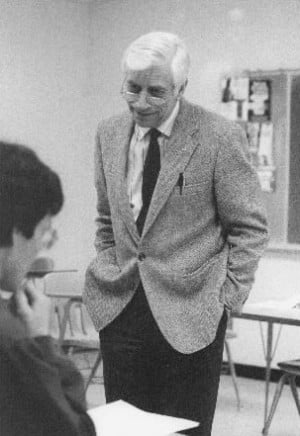
One day Dr. Knoll said, “Kids in their teens and 20s are drawn to subjects like chemistry, math, physics and engineering because they have a need for exact answers. But as you mature, you become more comfortable with grey areas and ambiguity. The older you get, the less need you have for exact answers.

“When you get into your 40’s and 50’s you’re much more comfortable with politics and imperfect human beings. So… if you want to spend the rest of your life looking for exact answers, you can go to Indian Hills Community Church.”

Hey wait a minute! that was the church I grew up in!

I felt like Professor Knoll had smacked me in the face with a 2×4. I meandered to my classes for the rest of the day in a daze.

Suddenly, several hours later I realized:

“Hey, wait a minute… I don’t even go to that church anymore! I left.”

“Why did I leave?”

“I left because the exact answers were so excruciatingly exact I couldn’t stand it anymore.”

I suddenly realized:

“Hey wait a minute… that means even though I’m only 20, I AM growing up. Just like he said.”

I no longer felt like I’d been whacked in the head with a 2×4. Dr. Knoll had certified my rite of passage.

Mike Levin wrote two papers recently. For both, he asked 68 scientists including me to define life. The definition of life is famously fraught, because nobody can adequately pin it down to words or any kind of formula.
 
The first paper analyzes everyone’s answers and plots them on a grid. For the 2nd paper, he started a very long email thread with all of us. We discussed our opinions and impressions. He culled that thread down into a piece which was just published today in the Journal of Biological Sciences.
 
The story I just told is included in this paper, near the end, on page 36. I go on to say:
 
The science profession itself is in a similar place. The mathematicians began disabusing themselves of their Supreme Confidence in Exact Answers after Gödel’s incompleteness theorems shattered the absolute certainty of mathematics. 90 years have gone by, yet science is only now starting to get the memo.
 
We’ve been in the grip of reductionism since Newton and even Einstein’s work did not manage to change it. I think it will take the New Biology to drive the nail in the coffin.
 
This also means the “soft sciences” are more sophisticated than the “hard sciences”. They demand more maturity. It means biology is a soft science not a hard science. It means physics envy is misplaced.
 
I say all this as an electrical engineer whose most comforting sense of “what is absolutely true” in the world came from the fact that I could model a circuit on a computer, and when I built it, it behaved exactly as the model predicted. That is true of many dead things, but it’s not true of alive things. Only those who are truly alive can accept this.
 
~
 
I think this is a great paper. I hope you will read it. I also think it signals several shifts.
 
First, this topic is so famously contentious that in years past it would have been difficult for a conversation like this to be this cordial and civil. There was never a hint of rancor in any of the email threads.
 
Secondly, we really are at a transition in the history of science. The steel claw of reductionism is loosening its grip, and conversations are becoming more fluid.
 
And I think science culture itself has become more receptive to ideas it was once allergic to, and this is making science a better place to work.

Props to Michael Levin for not only being one of the most imaginative and prolific researchers alive today, but also for being one of the very few individuals who could pull something like this together.

~

Read “Defining Life: A Conversation” in Journal of Biological Sciences. 

~


Download The First 3 Chapters of Evolution 2.0 For Free, Here – https://evo2.org/evolution/

Where Did Life And The Genetic Code Come From? Can The Answer Build Superior AI? The #1 Mystery In Science Now Has A $10 Million Prize. Learn More About It, Here – https://www.herox.com/evolution2.0

Leave a Reply (Check to see if the EV2 chatbot can answer your question)

You must use your real first and last name. Anonymity is not allowed.
Your email address will not be published.
Required fields are marked *