


Atheist PZ Myers Debates Perry Marshall
Darwinism vs. Evolution 2.0 on “Unbelievable?”


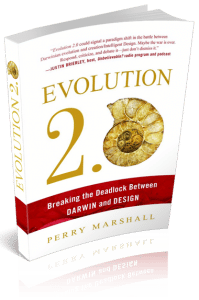
Get 3 Free Chapters of “Evolution 2.0”.
|
|
Listen to the show on Unbelievable’s Website Get the MP3 Get the Podcast of Unbelievable? Via RSS or Via Itunes Host Justin Brierley: Welcome to Unbelievable, the show that aims to get you thinking. Today we’re asking the question “Is it time to upgrade to evolution 2.0?” Perry Marshall is an author, speaker, engineer, and world-renowned business consultant. So why has he written a book on evolution? Well, in Evolution 2.0 Perry claims to have found a way to break the so-called deadlock between Darwin and Design. The book includes information on how organisms re-engineer their genetic destiny in real time. It talks about the amazing systems that living things use to redesign themselves, how every cell is armed with machinery for editing its own DNA, and much more. And Perry’s even offering a public award for anyone who can answer the greatest question in all biology, he says, ‘Where does genetic information come from?’ We’re going to meet Perry in a moment’s time. But opposite him on the show today is PZ Myers. Well-known as an atheist biologist, who’s not afraid to speak his mind on his popular blog Pharyngula. He regularly critiques the Intelligent Design community and has denounced Perry in the past too, though Perry doesn’t claim to be Intelligent Design. And we’ll get to that a little later. He’s had a chance to look at Perry’s new book and is going to be addressing Perry’s claims, so welcome both PZ and Perry to today’s program. Perry, let’s start with you. This book is sort of the journey of ten years, more or less. Do you want to tell us about that journey, and why you, in the end, became dissatisfied with both Intelligent Design and Darwinist camps in this debate? Perry Marshall: This started when my younger brother, who has a master’s degree in theology, was a missionary in China, and in the space of 4 years became almost an atheist. We’re very close, and there were emails and emails back and forth for a couple years, and one day I’m in China visiting him. We’re sitting on this bus, and we’re having this argument number three hundred and twelve, and this has been going on a trajectory, and he’s very smart. I just was feeling like I was losing ground, and I found myself grabbing for science. And I said “Bryan, look at the hand at the end of your arm. You don’t think this is a long series of accidents that produced this do you?” “Well, actually yes I do.” And he kind of pushed back with a Neo-Darwinist view of things. And I knew two things: I knew yes I did have my engineer’s intuition about this. On the other hand, I knew, without him even telling me, that most biologists would be more inclined to agree with him than me. I knew I didn’t know. I have an electrical engineering degree. I knew that there are things in engineering and in science that are powerfully counter-intuitive. And I knew I didn’t know. But what I did know was that engineering and science are a lot less ambiguous than theology. (Laughing) PZ might agree. And I said ‘you know what, I’ve got the same question Bryan has. I’m going to let science settle this for me.’ And I went down the rabbit hole. I’m an obsessive person and I bought probably 200 books. I started reading scientific papers, and I said I’m going to get to the bottom of this, I’m going to find the truth of this. And I think it’s probably going to inform where I go in the faith department. For a while I just floundered helplessly. I would listen to both sides and all I could decide was: I’m not going to ignore any verifiable fact. And I’m not just going to learn “my side” or whatever the party line might be. I’m not even sure what it would have been anyway. I’m just going to take all the information and try to touch the bottom of the swimming pool at some point. It was very unsettling at first. The waves would toss back and forth. Both sides kind of made sense and both sides didn’t. There was a point where I first touched the bottom of the swimming pool and it was recognizing that: because I had written an Ethernet book in 2002 for a major professional society called the ISA which was for process engineers, I knew how 1s and 0s work, I knew how code works, and I came to realize that all of the math, and all of the principles of code, apply to DNA. Now DNA is code. Cells are more than code, but at the very minimum the principles of communication applied to the cell, and now I could begin to break this apart. And I realized: evolution is a software engineering question. At least I can make a substantial amount of headway starting with that. And I found a tremendous body of literature connecting genomics to communication theory. And there are journals on bioinformatics. Then things began to make sense. Now to fast forward the story quite a bit more, so we can get into this discussion. I realized that error correction and error detection were absolutely critical to any kind of communication process and any kind of DNA replication. Yet the Darwinian view was that random copying errors, among other things like population genetics and gene flow and things like that, were major drivers of evolution. And that it was inevitable that copying errors and things like that would inevitably produce new structures, new organs, new features; natural selection would select them, and that you would have constant improvement just naturally with time. But everything I knew about software said software doesn’t work that way. And having written an Ethernet book, copying errors never – for all practical purposes – they never help. So I had a giant discovery moment when – let me just say that for a while, I’m looking at evolution, I find lots and lots of anecdotal evidence that there is evolution. I don’t think the creationists are right on this. I don’t think this is all fake. However the mechanisms they’re telling me about don’t make sense mathematically and engineering-wise. And then I discovered the work of Barbara McClintock. And her story is: She kind of approached problems like a hacker. She was hacking corn plants in 1944 using varying measures of radiation. And she damaged a chromosome of a plant. And the plant threw her a curveball; it did something she totally did not expect. And if I might use an analogy, what she had done was she had ripped a page out of a novel. So if you could imagine ripping a page out of a novel, giving it to one of your friends who’s a writer: “I want you to fill in the missing page by reading what’s before it and after it and use words and sentences that are already in the novel and make it all make sense.” And this is essentially what the plant did. She called this transposition. Certain genes were moving around and changing the expression. Host: It kind of re-wrote itself. It sorted of repaired itself at some level. Perry: Yes, the cell repaired it; it rewrote its own code. She presented this at a symposium. Half the people there laughed at her. And the other half were angry. They were like ‘who does this women think she is, suggesting that plants can re-engineer their own genetics?’ And they didn’t accept i |
|
|
Barbara McClintock discovered Transposition, which changes expression of genes by moving Mobile Genetic Elements in your DNA. This is similar to the way English changes when we re-arrange words.
If you transpose the sentence “you did have coffee this morning” to “did you have coffee this morning,” you change it from a statement to a question.
|
Well in 1983 she won the Nobel Prize for discovering transposition. And I believe that what she really had done was she was one of the very first scientists to observe evolution actually happening in real time and understand genetically what happened. Host: Obviously this is just scratching the surface, which you delve a lot deeper into in the book. But essentially what I take away from this is you develop this view which you say is simply bringing to the surface all this science that’s already out there, but essentially not talked about much in the public sphere. That essentially there’s a sort of, for want of a better word, intelligence in the cell. There’s a purposiveness in what the cell does, it’s not just a case of, as you say, random mutations naturally selected over a long period of time. There’s a sense in which the cell is doing a lot more than we ever gave it credit for, in that sense |
|
|
Symbiogenesis a cell merger-acquisition. A chloroplast is algae inside a plant cell. Epigenetics switches genes on and off in real time. Ohno’s Hypothesis says genome duplications formed vertebrates in hybrids. Horizontal Gene Transfer exchanges DNA between cells.
The Intelligent Design community talks about “Irreducible Complexity” – systems that don’t work unless all the parts are in place. But McClintock proved cells perform sophisticated, irreducibly complex operations in minutes. She talks about rapid new species via hybrids for example. So unlike what Darwinists say, evolution isn’t always gradual. Isn’t fast evolution in live experiments a lot more intriguing than saying it’s impossible?
|
Perry: Yes, they are most emphatically non-random. They’re anti-random, in fact, I would say. So now evolution began to really make sense. And Barbara McClintock was only the tip of the iceberg. Then there was the work of Lynn Margulis on symbiogenesis. There was Ohno’s 2R Hypothesis. There was Epigenetics. And Horizontal Gene Transfer. And when taken together, these mechanisms actually explain what’s going on, and you can observe them in real time. And I thought this is so much more interesting than what the Intelligent Design guys are talking about, and this is so much more interesting than the traditional Darwinists are talking about! Why isn’t anyone talking…? Host: Well we needed to take some time to explain where the book came from and the central thesis behind it, so we can begin this conversation now with PZ. PZ, you’ve run into Perry’s work before. You’ve not been very complimentary about it. So what’s your take on Perry? Do you think he’s just recycling Intelligent Design perspectives? What’s your take? |
|
|
If I were in PZ’s position of defending an outdated theory against an outsider, I would also pat the guy on the head and accuse him of not really understanding what’s going on.
But PZ shows poor understanding of Transposition. He makes false statements like “there was absolutely nothing in McClintock’s work that argues against the importance of chance in this business.”
Don’t take my word for it. Read or watch McClintock’s Nobel Lecture. Notice near the end when she talks about rapid “punctuated evolution.” You don’t need to know the stages of cell division to ask: Does anything she’s talking about sound “random”? Is PZ accurately representing her work?
Fact Check: Transposition is when the cell moves a defined cassette of coding sequences and plugs it into a new location. [The “cassette” link shows transposition cassettes in experiments with zebrafish]
Transposition is not just inserting unspecified DNA sequences. Transpositions are by their very structure non-random, and would be even if there were no pattern to where insertions occur.
There almost always is some pattern to the insertions. Yeast retrotransposons insert either >95% upstream of transcription start sites (Tf1, Ty1-Ty4) or >95% into silent chromatin (Ty5).
Contrary to what PZ said, McClintock’s work is explicitly about cells engineering solutions! That is her point. The name of McClintock’s 1983 Nobel Prize speech was “The Significance of Responses of the Genome to Challenge.”
From the first paragraph of her Nobel speech (emphasis mine):
“It was necessary to subject the genome repeatedly to the same challenge in order to observe and appreciate the nature of the changes it induces… In contrast to such “shocks” for which the genome is unprepared, are those a genome must face repeatedly, and for which it is prepared to respond in a programmed manner.
“Examples are the “heat shock” responses in eukaryotic organisms, and the “SOS” responses in bacteria. Each of these initiates a highly programmed sequence of events within the cell that serves to cushion the effects of the shock. Some sensing mechanism must be present in these instances to alert the cell to imminent danger, and to set in motion the orderly sequence of events that will mitigate this danger.”
All her examples (SOS etc.) trigger transposition.
PZ doesn’t appear knowledgeable about McClintock’s work. Her findings perplex Darwinists because Darwinism has no grid for cells re-engineering themselves… but that’s exactly what they do in experiments.
The real problem here is not that PZ misrepresents transposition. The real problem is: Any time you declare “it’s random,” you hit a scientific brick wall. There is no more order or structure to discover. “Randomness” kills curiosity and prevents scientists from doing their jobs. It becomes a self-fulfilling prophecy.
The only way a scientist can discover anything is to NOT assume randomness, but assume there’s a pattern. That’s what McClintock did and it’s why she won the Nobel Prize.
PZ is correct in describing biological systems as “Fault tolerant.” Tolerance to faults is by definition non-random. Cells are fault tolerant because are able to protect and modify their DNA in pursuit of those goals. Notice PZ says “cells hate…” because they do.
|
PZ Myers: Well, he’s trying to put a new twist on it, but he’s getting it all wrong. You know for instance when he’s – what I thought was very telling, it’s also telling in the book – he’s a software person, he’s an electrical engineer, and he’s trying to impose his perspective on biology. So he says ‘ok, biology doesn’t make any sense when I look at it as the way software works’. Instead of saying well maybe my analogy is totally off base and wrong, he says what we’ve got here is a situation where the biology does not conform to his expectations of how it will work. And yeah biology is far more fault-tolerant than electrical engineering. You can’t directly compare it to software or code or anything like that because it’s got a lot more complications going on with it. But on top of that in his book what he tends to do is throw out science buzz words like ‘transposition’ and the transposition discussion is a good example of this. He throws them out, but he doesn’t really understand them. He’s got McClintock totally wrong. McClintock’s work, which was marvelous work, and yeah it was not initially accepted because it was difficult stuff. If you read her papers, she’s got an amazing mind, it’s really complicated, really difficult things to understand, and that’s largely why it wasn’t immediately accepted. But she was very convincing because she brought the data to bear. But all of her work was on something called genetic instability, ok? It’s not about cells engineering solutions. For instance, the stuff on bridge break fusion that Perry mentions. That’s about random chance breakage of chromosomes that have exposed ends. They tend to re-fuse and then when mitosis and meiosis occurs they break. And they break in random places. Not in designed, engineered, planned places. But in an entirely random way which means that the progeny of that cell will exhibit greater genetic variation than the parent. There was absolutely nothing in McClintock’s work that argues against the importance of chance in this business. Host: Can we maybe start to open up that area, before we progress onto any more. Just from the point of view, you’re saying, PZ, base: the analogy is all wrong–Perry’s come to this as an engineer, well this isn’t computer engineering that we’re talking about, this is biology. Very different thing. Different types of tolerances, different kind of thing going on. And then you’ve obviously got specific criticisms about how he’s interpreted that particular work that he spoke about. Ok, the obvious question that PZ has aired here: Perry is an engineer, so why, no matter how good he may be at engineering, is he writing a book on evolution? You aren’t a qualified scientist in that sense, and a lot of people will probably throw your claims out the window just on that basis alone. Why do you believe an engineer does have the right to throw his hat into this ring? Perry: We build models in science. And all scientific descriptions are models. All scientific descriptions are analogies. If I drop a steel ingot off the building onto the ground I can use calculus to calculate its trajectory. But the calculus is not a steel ingot and its gonna have a margin of error. The question at hand is: do the models of information theory apply in biology to the rearrangement of code? And we have huge bodies of literature going back to the 60s that say: Yes it does. Host: That DNA is an information code. It is not simply like an information code. It is an information code. Perry: Yes, and I would certainly acknowledge that it is more than a computer program, but it is not less than a computer program. And the rules of information, entropy and all of that work. Now PZ said biological systems are much more fault tolerant. The reason they’re more fault tolerant is because they have layers and layers of error detection and error correction. So when radiation damaged the chromosomes, the plant repaired the chromosomes non-randomly. So, yes, the damage was random, but the repair was not. Host: PZ, why do you think he’s got this research so wrong exactly, can you explain? PZ: I have no idea, that’s very bizarre, because what’s going on in McClintock’s models are that chromosome ends are broken, and they tend to fuse back together. Cells hate single stranded DNA hanging out there. So what they’ll do is the two broken ends will stick together. Then when the cell divides and they have to separate, they will break in some random position on the chromosome. |
|
|
PZ says: “The only repair mechanism here is that it doesn’t tolerate dangling ends”
Transposition does far more than repair dangling ends! Transposition is one part of a very sophisticated programmed response to dozens of kinds of external threats like heat, DNA damage and starvation. Cells re-arrange DNA in highly organized ways.
|
The only repair mechanism here is that it doesn’t tolerate dangling ends ok? It fuses dangling ends together. But the actual repair is in essence randomly damaging to the ends of those chromosomes. McClintock also studied transposons, transposition, which is basically where there’s an enzyme that copies out a piece of DNA and then inserts it into some random other spot in the genome. It’s a well-understood phenomenon; it’s actually used in a lot of biotechnology techniques. And that again is also a random process. Often what happens when you have a transposition is that it inserts that copied sequence into a place that’s damaging to the cell, or shifts regulation, or in many cases will be in a totally neutral place and does nothing at all. Host: Perry? Perry: There are two problems with what PZ said. One is that error correction in this case is just repairing broken ends. And the latest Nobel Prize discusses three layers of error correction, which result in a copying error rate of less than one in a billion base pairs. And the correction of the errors is explicitly non-random. Transposition is also non-random because if you get a book on transposition, it shows that transposable elements tend to land in specific places and specific patterns. If you read McClintock’s work on this, what’s going on is explicitly non-random. Now PZ’s claim that it’s random is not mathematically provable. And what I found was that in every instance when I started chasing things down I would find a pattern, rather than evidence of randomness. Host: What Perry sees as patterns, do you just see as… I don’t know, what do you see it as PZ if it’s not a pattern and some kind of purposiveness within a cell? PZ: Well, of course it’s a pattern, but it’s a random pattern. Patterns can be random. So when McClintock describes the patterns of irradiation and corn, for instance, that are induced by these breakage models of the chromosome, what she was actually seeing is variation in the structure and the color of the tissues that was random. That was driven by random processes. It’s hard to argue that there was a scheme or a plan behind them. Because we understand the mechanisms for how this was generated. And we can see exactly how it happens, and it doesn’t seem to involve any kind of design elements. There’s no engineer inside the corn plant deciding where things go. Host: Okay, you believe that there is some kind of an engineering principle going on. I don’t know if you would hazard to guess how that happens but as far as you can see, Perry, you observe it happening in all that you can tell? Perry: I predict that there is a mathematical model or matrix that is dictating what is going on. And that that is a testable hypothesis. PZ’s assertion that it’s random is not a testable hypothesis, because it’s not even possible to prove that it is random. So, PZ, my question for you is how do you know that it’s random and where is your proof? PZ: So, in biology, randomness is an operational property. What you do is you do the experiment, make predictions about the results you’ll get. And what you typically see in these kinds of experiments is that you can’t predict where the mutation will occur. For instance, if you’re inducing mutations, you can just predict that it will occur with some frequency. And you do many repetitions of the experiment, and you can get a nice distribution of where mutations occur in each event, you can plot these out. And you can see that they’re actually fairly random in what they do. That’s all we care about is that there’s a process we can use to determine whether a particular event was predetermined by other prior consequences or whether it seems to be arbitrary. And in this case when we look at things like transposons, when we look at bridge breakage fusion models. What we see is random variation in an operational sense. Perry: So, PZ, I believe that you are imposing your view of things onto something and making a statement that you can’t scientifically prove. It’s mathematically impossible to prove that it’s random, so you’re making an assertion that can’t be confirmed. Now I’ll give you an example of a way that you could confirm that evolutionary events are random, and they are the very popular fruit fly experiments and radiation experiments that have been done since the early 1900s. If your assertion was correct those experiments would have produced some consistent percentage of fruit flies or moths or bacteria that were better, had better organs. But in fact those experiments didn’t make better fruit flies. The best they ever achieved was getting the organism to activate its error correction systems; again, which were study of the recent Nobel prize. But those experiments were very disappointing. Now if you were right, I believe those experiments would have been successful. But those experiments failed to do what the experimenters wanted them to do. Instead what they did was they achieved, they discovered which parts of the genome caused birth defects when damaged. Which then told the scientists which parts of the genome build certain structures. Host: Quick response from you PZ, and then we’ll go to break and continue this discussion. PZ: He was cutting in and out there so I didn’t quite get it all, but I got the gist of it. Here’s the thing, when we do these experiments what we do see is improvement of the organism. For instance, I work on zebrafish, and I work on a highly inbred strain of zebrafish, and what we find is over time strains of organisms raised in the laboratory become progressively better at living in the laboratory. Which may mean they are less adaptable, less able to live in the wild. But it’s a routine thing that we see all the time. And under the understanding of ‘better’ as used by evolutionary biologists they fit the criterion. They get better and better at living in their environment all the time. Perry: So, PZ, you are taking for granted that this happened randomly, and communication theory indicates there’s no way that those adaptations were random. And my contention is that cells sensing hundreds of inputs from the environment make alterations to gene expression, epigenetics, maybe there’s horizontal gene transfer, there could be all kinds of things. In the case of your zebrafish, I would think that it’s probably more along the lines of epigenetics and transposition types of events, and this is why the improvements are observed. It doesn’t just happen with random inputs, it happens because the organism is responding to an input. Host: Somewhat technical debate today, and we like to do the technical debate sometimes, and two excellent guests to join me for it. We’re asking today: is it time to upgrade to Evolution 2.0? That’s the title of Perry Marshall’s new book. He claims to have found a way to break the deadlock between Darwin and design. It’s all about capability of the cell to organize itself, to reorganize itself. There’s something rather special about the cell. It’s not all random mutations acting on natural selection says Perry. Well, PZ disagrees. PZ Myers is our atheist guest on the line from the States. [break, reintroductions]Host: …Obviously what we’re hearing here from Perry, PZ, is as far as he can tell what you describe as randomness, the typical Darwinian-evolutionary model can just as easily, and more easily in Perry’s view, be described as this very purposed response to environment and stimuli and so on. And when we do try and do the experiments where we kind of influence that ourselves, and try to introduce mutations and so on, it rarely if ever produces beneficial mutations and so on. So yeah feel free to respond and we’ll move things on in the conversation. |
|
|
Transposition, Epigenetics and Horizontal Gene Transfer are not magic incantations that explain things. They are well-documented, non-controversial systems that organisms use to change their DNA. These systems operate in everyday life.
The only magic incantation in this conversation is the word “random.” When anyone says an evolution event happened because of a “random mutation,” that statement is indistinguishable from magic and equally unscientific. This is because randomness is unprovable and the event cannot be reproduced.
In real life, systems never evolve randomly. Automobiles don’t, computers don’t, chemical plants don’t, and neither do fruit flies or cells. Randomness is just another word for “magic.” Transposition events are not random. Over 75,000 scientific papers show that they are highly structured and obey rules.
A scientist’s job is to discover patterns. Not deny them. PZ is advocating an anti scientific position… and then trying to shame me for explaining McClintock’s work to the public. Nothing about MClintock’s work was the discovery of “random processes.” In the conclusion of her Nobel Prize speech, she says:
“In addition to modifying gene action, these elements can restructure the genome at various levels, from small changes involving a few nucleotides, to gross modifications involving large segments of chromosomes, such as duplications, deficiencies, inversions, and other more complex reorganizations.”
So when PZ says “It’s hard to argue that there was a scheme or a plan behind them” he’s pretending 50 years of molecular biology never happened. The eminent scientist Lynne Margulis said in her book Acquiring Genomes:
“Many ways to induce mutations are known but none lead to new organisms. Mutation accumulation does not lead to new species or even to new organs or new tissues… Even professional evolutionary biologists are hard put to find mutations, experimentally induced or spontaneous, that lead in a positive way to evolutionary change.”
|
PZ: So what’s frustrating about talking to Perry here is he keeps throwing out these words as if they’re magic incantations that explain things. So for instance when he was talking about my zebrafish and how they get better at living in a laboratory environment over years. He says ‘transposition’ and I’m sitting here wondering what the heck is he talking about. Transposition is a very specific genetic and molecular phenomenon. You don’t simply say “transposition” as if solves everything because it doesn’t. Transposition is another mechanism that causes random mutations in the genome. So in a sense he’s right yeah we get random variations in individual zebrafish that are then selected for by their presence in the lab environment that leaves the next generation, the survivors, being better able to live in a lab environment. But as far as directedness, there’s absolutely no evidence for that. There have been many experiments done with transposons and flies and other organisms. They do have specific sequences they like to zoom in on, but those sequences are common throughout the genome. So you can’t simply say that there’s some kind of directedness. There’s no purpose. In fact the whole argument rests on the fact that he is proposing this amazing mechanism in which there is purposeful modification of the cell by the cell, and he’s the one with no evidence for that. We’ve got decades worth of evidence in biology supporting the idea of random genetic change. Perry: PZ, none of your evidence supports random genetic change because there’s no way to prove randomness in mathematics. Now what we can do is we can say ‘does this fit certain patterns’ and you said it tends to conform to specific sequences. You know transposons don’t just jump to anywhere. There are certain places that they are more likely to go to than others. There is a definite pattern. It’s kind of like if you read the newspaper the letter E is going to appear 13% of the time and the letter Z is going to appear about 0.1% of the time. And we see a similar statistical profile in genetics where you see specific gene sequences specific percentages of the time, and if it was actually random you would not get these–they’re called, ergodic patterns–which is, for example the letter U almost always follows the letter Q in the English language. That’s an ergodic pattern. There are ergodic patterns all over biology and they specifically and directly contradict your claims of randomness.
|
|
|
There is no way to prove that any specific sequence of symbols is random. I’m not ignoring the evidence; PZ is.
Darwinists assume random mutations cause evolution. This is impossible to prove. There is no evidence this is true.
Fact Check: “Code” in biology is not a metaphor. “Information, transcription, translation, code, redundancy, synonymous, messenger, editing, and proofreading are all appropriate terms in biology. They take their meaning from information theory (Shannon, 1948) and are not synonyms, metaphors, or analogies.” (Hubert P. Yockey, Information Theory, Evolution, and the Origin of Life, Cambridge University Press, 2005)
|
Host: You’re groaning, PZ. Why are you groaning? PZ: Because he’s ignoring all the evidence. Yeah you’ve got a metaphor and you are shackled to this metaphor of a computer code or a language or whatever. It’s invalid here. That when we do real biological experiments we can make predications about the results based on chance. And they work, they actually work. So for example a really simple kind of experiment that I do with students every year is we are doing mapping experiments. We’re mapping genes in the genome. This is a process in which you encourage recombination. You do breeding experiments, and you get random recombination of pieces of chromosomes, and what that means if two genes are really close together there’s a low chance there will be a recombination event between them. |
|
|
Fact Check: PZ’s example of homologous recombination is also a non-random process (it requires DNA sequence complementarity) and is subject to control by the cell. See for example:
Brick, K., F. Smagulova, et al. (2012). “Genetic recombination is directed away from functional genomic elements in mice.” Nature 485(7400): 642-645.
|
If two genes are far apart there’s a greater chance that there will be a recombination event between them. Just because of the physical properties of the chromosome. We can do this and what we see is that it works. That every time we can do mapping of genes, we can tell which genes are closer to other genes by looking at recombination frequency. So this is a case where we’re using the predications of chance events in the genome to map out the structures there. Furthermore, when these same animals, these same organisms, are taken and subjected to a molecular gnome analysis, for instance we sequence the entire DNA strand what we find is that proportionally we’re largely correct. Yeah that chance events do a really good job of mapping out the distribution location of genes on a chromosome. Perry: But the breakage points are not random. You’re moving genes around, and the genes are staying intact or sections of the genes are staying in tact, they’re not just breaking anywhere. |
|
|
When PZ says, “let’s not confuse this with a uniform random distribution… there are places that are hot spots for breakage” he’s just contradicted himself. A “hot spot” is a place where mutations happen more frequently. That by definition is non-random!
To a Darwinist, anything we don’t understand gets swept under a big giant rug called “randomness” or else “natural selection.” It’s abdication. PZ is just moving the operation of randomness from one level to another.
|
PZ: No they can… let’s not confuse this with a uniform random distribution. It’s not a uniform random distribution. There are places that are hot spots for breakage. But when you look at this, yes, you do get cases where it breaks in the middle of a gene, and you get a recombination event that bridges right at the point of a gene. You get them in the energetic region, but those are larger so you’re more likely to get them there. Uh, that’s the point of the experiment is that when genes are far apart you get many more recombination events between them… Host: Now, as a layman, coming in here between two people who obviously disagree, and I’m not following every aspect of this debate, but if I could try to boil it down as I often try to… You’re saying on the one hand, PZ, when you get these events going on in the cell, at the genetic level, when you look at what’s happening when a cell’s repairing itself or whatever it’s doing, it’s doing it on the basis of statistical probabilities, will play their part. Something will happen, but you can see that it’s happening because of the physics of the thing, and the way it all plays out. Perry’s contention, on the other hand, is that no there’s something really purposive going on here that, in some way, the cell itself is exhibiting almost a desire let’s say to repair itself, rather than it just being the random events that, when all added together, do create something that ultimately helps the next generation to improve and all the rest of it. I’ve probably not described that brilliantly. PZ: No, actually, I think that’s a good point to make. Yes, you would expect that if there was intent that this cell would be trying to optimize its condition, trying to select for, and without selection, just doing it by itself, designing and engineering a better solution. But the thing is when we do those kinds of experiments what we’re typically comparing is deleterious and wild-type alleles. So we’ve got an allele that’s actually deleterious to the organism and we’re looking for a recombination event with a healthy allele. And so what will happen is that by the distance separating them, they will sort out into some organism that will get two deleterious alleles, others will get a healthy one and a deleterious one and others will get two healthy alleles. One prediction is if this was a purposeful event, you ought to get more with the double healthy combination, right? And what we find… Host: So, it just looks like what you would exactly expect, from your point of view? PZ: Right, what we find is the distribution of the deleterious traits and the distribution of the healthy ones are dictated by chance, not by the well being of the poor fly that’s going to inherit them. Host: Ok, what’s your response to that Perry? Perry: There’s a video, it’s on the Evolution 2.0 Facebook page at the moment where the University of Redding damaged a gene related to the tail of a bacterial flagellum. So the flagellum didn’t have a tail, and they came back after the weekend and the organism had repaired some gene and now had a tail. Now, we see this over and over and over again when we look at genetic repair. That the cell is constantly trying to maintain the integrity of the genome, and, again, the latest Nobel Prize is specifically about the error correction. There are three layers of error detection and correction. The cell is militantly defending itself again random errors. To give an analogy that listeners would understand – PZ, please tell me if I’m misquoting you – is suggesting that if this were a newspaper article, the words and phrases could get broken up in all kinds of unspecific, statistically random places and rearranged, and sometimes they’re helpful. I’m saying they’re actually obeying the rules of a grammar, and the words are moving around intact, or subsets of words like words with two parts. |
|
|
|
Host: There’s an editor somewhere in the background making sure that you don’t just end up with a scrambled article in some way. I’d like to move this to the bigger picture, because I’m obviously not going to get you guys to agree on these specifics about these genomes and so on. One thing you make the suggestion of in the book is the Junk DNA debate that’s been going on for the last few years. You believe this is an example of the way in which your thesis is being born out in some way. Perry: Yes. Craig Venter was asked not too long ago: “What is your opinion about junk DNA?” And he said a lot of arrogant people have prematurely announced that 90% of our DNA is junk, and he’s not willing to jump to that hasty conclusion. I think that’s a very hasty conclusion. Nature is not nearly that wasteful. PZ says a lot of interesting things about junk DNA. He says ‘junk gibberish with occasional bits of translated code that convert to proteins with regulatory elements’. PZ, your view of the genome as this kind of junkyard – I think it’s completely wrong. I think time will prove that wrong. I think it’s an anti-scientific position to take. Host: Hmmm, throwing down the gauntlet there. PZ, explain briefly what junk DNA is, and why you think it is a good indicator of why evolution is, in that sense, a random process… PZ: Well, yeah junk DNA–it’s a complicated term. There’s lots of things that are called junk DNA that are not junk DNA. But roughly 90% of the human genome has no purpose along the lines of assisting us in our life, ok it has no functional role, no functional human role, although it may it have some selfish genome roles to play. I have to throw the gauntlet back because, yes, I read Perry’s section on junk DNA. It was disgracefully dishonest. This is simply awful what he says here. I’ll just quote it from page 273: It says: …ENCODE’s finding were unambiguous. At least 80% of our DNA is active and necessary. If you deleted it, our bodies would fail. Our children or grandchildren would be missing something critical that they need to survive. |
|
|
RETRACTION: PZ is right. Encode’s findings were not nearly as strong as my statement in the Evolution 2.0 book. My statement was misleading so I retract it.
“At least 80% of our DNA is active and necessary. If you deleted it, our bodies would fail” was MY opinion and not ENCODE’s findings.
I still predict that this is true, even though ENCODE’s findings don’t yet support it. ENCODE has found that over 80% of the genome is transcribed in a tissue-specific manner.
I estimate at least 80% of our DNA is active and necessary. I believe it would take 100+ years of experiments with real humans to reach a definitive answer.
Do you know a pregnant couple who is willing to delete 80% of their child’s “Junk DNA”? If so, let us know.
One thing we do know about the non-coding regions of DNA is they contain sections of retroviruses.
In mammalian placentas there is a membrane one cell thick called the syncytium. It mediates transfer of waste and nutrients between mother and child.
Genome research indicates that the instructions to build the syncytium first came from code in the envelope gene of the HERV-W human endogenous retrovirus.
Also, so far as we can tell, different versions of the syncytium were constructed in mammals three different times from entirely different viruses. (Reference: Virolution by Frank Ryan.)
|
PZ: That’s a complete lie. I will say that right up front. Not even ENCODE, and I have a lot of disagreements with ENCODE, I don’t think they did a good job, but not even ENCODE would agree with that. That’s simply not something that they determined at all. At the ENCODE experiments, they defined function as simply binding any other protein in the cell. It’s the loosest possible definition of function. They have done no experiments to determine whether those elements are active or necessary. And they definitely have not done any experiments in which they have deleted some of the junk DNA to see if it has an effect. So to make that claim, this is very characteristic of his book, is that he makes this sweeping, strange arguments that are informed more by his prejudices than they are by actually evaluating the facts appropriately. Another thing he says “the burden of proof that junk DNA is truly junk is on them until they understand everything and explain every nuance of the genome’s operation in precise detail until they can build a cell from scratch. Their job is not done.” That is also false because most of the junk DNA we actually know what it does. For instance there are transposes that are part of the junk DNA that have no function for the cell. There are reverse transcriptases that are relics of past viral infections. A lot of the junk DNA we have categorized, we know exactly what it does and it does not contribute to the well being of the organism. Host: It’s kind of historic, hence the name Junk DNA that played a role at one point in our evolutionary history but no longer does, and, for you, is yet another reason to show why this – why the idea and purpose of this is – PZ: Well, yes, and we actually know what it does. You know if you find a sequence – there are sequences called LINES or transcriptases, and we know exactly what they are, we know what their enzyme does. It copies RNA back into DNA, which is not a function that our bodies use, but viruses do. Host: Let’s allow Perry to pick up this gauntlet again in order to throw it back across the line. [PZ: A little bit of gauntlet slapping.] Yeah absolutely, and I expected no less.
|
|
|
So far as I can find, the most DNA that has been deleted from a mouse with no discernible effect is 1-3%. Do you think extrapolating a 1 to 3% experiment to “90% junk” might be a bit of a reach? I welcome anyone with a better Junk DNA deletion example than the mouse experiment. Did it have “absolutely no effect?” The article says:
“Knowles cautions that the study doesn’t prove that non-coding DNA has no function. “Those mice were alive, that’s what we know about them,” she says. “We don’t know if they have abnormalities that we don’t test for.”
“David Haussler of the University of California, Santa Cruz, who has investigated why genetic regions are conserved, says that Rubin’s study gives no hint that the deleted DNA has a function. But he also believes that non-coding regions may have an effect too subtle to be picked up in the tests to far.
“Survival in the laboratory for a generation or two is not the same as successful competition in the wild for millions of years,” he argues. “Darwinian selection is a tougher test.”
|
Perry: So, PZ, has anyone deleted this junk DNA and seen what you get? PZ: Why, yes, there have been experiments where large structures of DNA have been deleted from organisms such as mice. And most of that has absolutely no effect. Perry: So I should predict that if you run the experiment 10 or 20 or 50 generations you will find that does get used. It is necessary, it is helpful and useful. I think it’s extremely premature to say that it’s junk. And if you can’t build an organism from scratch… Again, I go to what Craig Venter said, he engineered a synthetic genome, and injected into a cell, and got it to work. And if you did this on a grander scale, and you let the experiments run long enough, I think you would find there’s a whole bunch of stuff in there that’s not junk. And one of the reasons I believe this is true, the human genome is only 750 megabytes; it’s about the size of a CD. Considering that 750 megabytes contains most of the instructions for building human, body yet Mac OS takes about seven CDs and Windows takes 20. First of all I’m really impressed that the job gets done in 750. What you’re saying the job is actually being done in 75. Which is just flat out extraordinary. I don’t think you can get that much good code in 75 megabytes. And if you can it’s the best code I’ve ever seen and so I think it’s really premature… |
|
|
PZ might have a leg to stand on if bioinformatics was not such a successful discipline… or if DNA did not have so many strong parallels to computer information.
Excerpt from Evolution 2.0: DNA, like many human-made codes, also has redundancy (326), error correction (312), checksums (316), linguistic structure (403, 520), and codes layered inside of codes (675).
The nucleus of a cell stores data with a million times the density of our best hard drives. The genome stores an incredible amount of functional information into a very tiny amount of space.
So I predict that the 90% of DNA we don’t yet understand is not junk. The amount of so-called “Junk DNA” will fall every year until the term is abandoned entirely.
20 years from now, nobody is going to be defending the Junk DNA theory anymore.
About Metaphors: “DNA is a lot like software” is a metaphor. “DNA is code” is not a metaphor, because DNA by definition contains the genetic code.
|
PZ: You don’t see that this metaphor is totally self-defeating? You’re trying to compare the human genome to information in code on a CD, and you’re pointing out that it’s really really tiny. Even if we count all the junk DNA as functional it’s still really really tiny. Doesn’t that tell you right there that maybe you’re making an inappropriate comparison, that you’re dead wrong on trying to shoehorn the information in a cell into your rather naïve conception of digital information from an electrical information from an electrical engineer’s standpoint? Perry: Well I don’t think that all of the information for building a human body is in the genome. I think it does reside in other places in the cell. But it’s a remarkably small instruction set that builds a remarkably sophisticated machine. Again we’re using metaphors. Host: PZ’s fundamental objection though is that you’re using—you’ve come at this as an electrical engineer, a software engineer, so you’re seeing the biological processes with that set of filters and PZ says it’s not the same discipline—you’ve got the wrong analogy. I’m interested to hear from you, Perry, why you think this is an absolutely valid analogy for biological systems. Perry: Well, two reasons, Craig Venter, is not just a software engineer, he’s a biology engineer, and he’s very good at it. And he says this is premature, and he’s got a lot of credibility with me. And secondly it’s because bioinformatics is such a rapidly advancing field, as is Systems Biology, that when somebody violates a basic mathematical principle—mainly information entropy, and I know that in all of the other analogous systems, what he’s saying would never work—then I question his model. All I’m saying is what’s going on here is non-random, and the non-random hypothesis is more consistent with the spirit of science than the randomness. Because as soon as you say ‘random’ inquiry stops, then there’s not further dissecting what’s going on. There’s a pattern here. Host: PZ? |
|
|
This is not about Electrical Engineering or even software. This is about the fact that the math (“random” is a mathematical term after all) doesn’t work. And if the math doesn’t work, it’s a bad theory. No matter what. If you’re going to build a scientific model of anything, the math has to work.
Good-old-boys clubs always get offended when outsiders show up and raise the game. The taxi companies are very upset about Uber. But customers like Uber because taxis give them a lousy, over-priced experience and Uber gives them an affordable, pleasant experience.
|
PZ: Yeah I would love to hear Perry question his own model because he’s not doing that. Over and over again what you do is you tell me ‘well from my perspective as an electrical engineer this doesn’t work, it can’t work’ and I’m telling you yeah but biology does work, so maybe your perspective is wrong. Maybe you’re coming at this from an invalid angle. Yet you just come back and insist on applying these fallacious ideas about electrical engineering to biology. It’s like we’re in a constant circle here where you refuse to consider the possibility that you’re wrong. I also have to point out one other thing and that is every time I get in an argument with a creationist they fall back on this appeal to authority. Craig Venter is a smart guy, and he’s really good at what he does, but he’s not an evolutionary biologist in any sense of the word. |
|
|
In engineering, the standard for claiming you understand something is: You can build it, and it works. Venter builds stuff that works. I won’t believe anybody’s Junk DNA hypothesis until they can demonstrate experimentally that the Junk DNA really is unnecessary.
I find an astounding lack of curiosity about how things actually work among Darwinists. They are too often content with hand-waving explanations that have no substance.
I also find the same tendency among creationists. If natural processes can bring about evolutionary events, wouldn’t you want to know about it?
|
He does not do evolution. He does brute force molecular biology. And so to argue that because Craig Venter is unfamiliar with the evolutionary arguments against his interpretation does not hold any water with me at all. Perry: It’s the brute force molecular biology that I respect. Because he has to build a functional cell, and he doesn’t really concern himself with where it came from. Your junk DNA theory comes from where you think it came from, or how you think it got there, and I believe you’re wrong. And the proof is in the pudding. If you can build a successful cell then you must know something about the genomics. And I think he knows. [break] |
|
|
|
Host: As we come back from break… Perry, you’re a bit of a person who likes to throw challenges and gauntlets as we’ve already experienced in the program. One of the things you’ve offered is a prize for someone who can solve this riddle in a naturalistic way. Do you just want to explain what this Evolution 2.0 Prize is? Perry: Yes, the genetic code is one of those central discoveries of all modern science, and when I began to understand: encoding, decoding, copying, all of that, everything began to make sense. And what I observed was that all of the other codes that we know the origin of are designed. We of course don’t know where DNA came from, and we don’t know of any codes that aren’t designed that fit the definition of a code. So early on I was going around and I thought ‘I’ve got a really awesome God of the gaps argument.’ But I shifted my position, because I got in this discussion with my brother and he’s like “So, Perry, what do you expect scientists to do? Say ‘OK, God did it’ and then go out to lunch? I mean come on.” He had a point! When you shift from ideological concerns to doing the practical work of science… you know that all science can do is peel the onion another layer and another layer and another layer. Maybe this is solvable. And we should understand where codes and where information come from. I heard Richard Dawkins say the origin of life was a ‘happy chemical accident’ and I was appalled at what an unscientific answer that was. And so I decided to put together a technology prize. So with a considerable effort, forming a company, forming a private equity investment group, right now were offering 3 million dollars if someone can produce a patentable process that generates codes without cheating. And I think this would be a very valuable thing to achieve. Host: And would that effectively disprove at some level your view that the cell is doing it itself or what would be the purpose, I suppose. Perry: I think it might tell us something about deeper principles in the universe that what we haven’t yet discovered, that might explain a lot about what goes on in biology. Biological organisms are really amazing I’m sure Mr. Myers would agree with that, they are amazing. And I think there are some bigger pieces of mystery that we are missing. |
|
|
The investors who are backing the Evolution 2.0 prize are serious. If this problem is solvable, then they want it solved, and they want to own the patent. If somebody solves this, they’ll get a LOT more recognition than just money. This will be one of the ten most important science discoveries of the 21st century. And yes, they’ll get the money
|
Host: What do you think about Perry’s prize, PZ? PZ: Oh, I think it’s a sham. Host: You’re not going to put your hat in the ring, and try and win this 3 million dollars? PZ: No, because there’s no way he’s going to give the prize to anybody. |
|
|
This is exhibit “A” of “begging the question: Assuming the very thing you’re supposed to prove… then offering it as proof.
Maybe the origin of DNA is a miracle. Or maybe it’s purely natural. But we can’t be sure it’s natural because there’s not yet any proof for how it got here.
PZ, where is your proof that it “spontaneously emerged”? How is this a scientific theory?
|
If I were to say OK I’ve got one for you it’s called DNA and genetics and biology. There is no designer behind it. It’s a code that spontaneously emerged and has evolved over 3 billion years–he’s not going to accept it, he’s going to say it’s not going to count. Host: Well, I guess that’s what he’s saying—this is precisely a code which, in every other instance where we have a code of similar kind, we know it’s been designed, engineered and so on; why would we assume that this is the only counter example to that—I suppose is Perry’s point. PZ: Well, one good reason is that the code evolved when there were no humans around. Humans are really good at generating codes and signaling and all that kind of stuff. But this is a case where we weren’t around 3 billion years ago, so we’re off the hook on that one. But I would say the bias goes the other way. Perry has said specifically that all codes are created by a conscious mind. This is not demonstrated, this has not been shown. What’s far more interesting is that naturalistic processes can generate something as complex as a cell. So just to assert that all codes are created by a conscious mind… Host: Is that an assertion on your part Perry? Perry: It’s a misquotation. All codes we know the origin of are designed. And, PZ, you said it spontaneously emerged. Could you please give us evidence through a repeatable scientific process that confirms your assertion? PZ: First of all let me just say that was not a misquote. It’s on page 192 of your book where you say “all codes are created by a conscious mind, there is no natural process known to science that creates coded information.” Perry: That was the way I originally stated it in 2005. And then you’ll see as you turn the page that I updated it a little bit to my current stance. PZ: Which is no difference from your original stance. Perry: …that all codes that we know the origin of are designed. PZ: Ok, let’s get back to your original question—how do we know that these are a product of natural processes? It’s because we’ve got historical information, so we can’t repeat history of course, if would be nice if we could, but we can’t. But we’ve got historical information about when these code originated, and it was at a time when the earth was an oxygen-free hell, and so there weren’t our kinds of intelligences around at that time. It also rose entirely in single celled organisms. So unless you’re going to argue that those single celled organisms were intelligent, that shows that no it had to be a natural process that generated them. Perry: So you’re assuming that it was a natural process, but you can’t reproduce the event. And we don’t know that much about it. PZ: Can you? Are you going to simply assert that it was magic? Or that it was a god who appeared or whatever that just did it with the wave of his wand? Perry: I’m trying to get away from magic, which is why I’m offering a prize for somebody that can actually produce an experiment. Rather than make an assertion. Host: We’ve gotten to the God question, which I did want to get to eventually, because what are you saying I suppose, Perry? If you’re right and PZ is wrong let’s say, and that really there is this extraordinary ability in cells that most of science has not woken up to, the fact of that means it’s not random, that there’s this kind of purposive directiveness to the way that organisms change over time that’s built in from the first seed I suppose, the first DNA molecule that appeared — it was all there ready to roll. Are you saying we can only actually at present explain that as the product of a conscious mind? And by that we’re probably going to be talking about something a bit like God I suppose. Perry: Currently that would be the inference. But I am reluctant to make God of the gaps arguments and pronouncements. What I would really like to see is somebody to make real progress on this issue. Because my theological views don’t hinge on God magically creating a cell. Maybe there is a principle that we have not discovered, that gets you from matter to information and to cells. And if that exists, we sure should find out what it is. And if it’s a scientific theory, it’s repeatable, it’s based on principles. PZ is not giving us any principles. He’s asking for a free diplomatic pass of immunity, if you will. And I’m saying really there’s very little we know about origin of life that currently qualifies as science. And let’s improve that. That is what I’m saying. I don’t believe in pitting theology against science. I’ll tell you what I’ll ask for a diplomatic pass of immunity is: I believe God created a universe that is orderly and structured and discoverable and directional; and all the rest is discoverable because evolution makes the universe an open book. So my bias is to believe that we can uncover the mysteries, but there is, at minimum, a principle that’s being ignored here. And I’m very serious about finding it. This is not a joke. Host: Alright, what do you have to say to that, PZ? PZ: Well, a couple things. I would recommend that he read Princeton’s Nick Lane’s recent books on the subject. Currently what a lot of people are pursuing is this metabolism first model of the origin of life where it’s not a matter of code, it’s a matter of chemistry. And that seems to be really successful. I would also point out that we do have a lot of information about the origin of these things. There have been a number of studies for instance where we do comparative genomics, and we ask ‘ok what’s in common with every creature on earth’, and we can thereby work back and figure out what the early gene set was. And doing that we can determine something very specific about what genes were present in early organisms, what kind of environment they lived in, what kinds of chemistry they had to do to survive. What we see is again a pattern of common decent derived from these ancestral organisms that implies, of course it doesn’t prove, but it implies that if we keep going back we’ll get simpler and simpler, and we can figure out what those early organisms were. And that is a productive scientific approach rather than saying ‘it can’t happen, that all codes are created by a conscious mind therefore there was no natural process that could generate those’. If we’re scientists, we’re looking for natural processes, that’s what real scientists are doing. We’re not sitting around writing books based on electrical engineering to impose their views on a discipline totally inappropriate to that perspective. Host: So, I don’t think you’re going to get a good review from PZ on Amazon, Perry, but if someone is teetering on the edge of getting hold of your book, what reason could you give them to pick it up? |
|
| Jerry Coyne’s and Richard Dawkins’ books give good anecdotal evidence for evolution itself. They teach you nearly nothing about how it works.
Much of what they do say about how evolution works is awful. They largely omit and downplay epigenetics, transposition, symbiogenesis etc. They offer very little in terms of real-time evolution experiments. They are peddling a model that is 30+ years out of date. Bill Nye’s book is very nicely written but it’s essentially for sixth graders. It’s just as outdated as Coynes’ and Dawkins’. The evolution book by “the science guy” contains almost no science education at all. I’m surprised because Bill Nye is a mechanical engineer. I expect better work from an engineer. Engineers tend to like Evolution 2.0. It’s often the first explanation of evolution they’ve heard that makes sense. |
Perry: When I started reading evolution books, I was… ‘disappointed’ would be a mild word… at the lack of rigor that I found in popular books by Richard Dawkins, Bill Nye, Jerry Coyne, people like that. They told you very little of any real substance about how the evolutionary process happens. They told you what happened, but they didn’t tell you how. As I went down the rabbit hole and discovered things like horizontal gene transfer and symbiogenesis, I found this extraordinary experimental evolution which many people were strangely silent about, and this tells that story. I said: This story needs to be told! People can come to philosophical conclusions on their own. But they at least need to know what these experiments achieved. Host: I’m glad for PZ taking up the challenge, at the very least, to come and debate it with you. Because I think there’s loads of people who simply wouldn’t take that up in the first place. But thank you, PZ, for being on the line to us. If you want to find out more about PZ – pharyngula.com or look him up on Google. Same for Perry: https://www.evo2.org/evolution for more on Evolution 2.0. Please post your comments and questions below. All comments must be civil and include your REAL first name and last name. All others will be deleted. |

Podcast: Play in new window | Download
Subscribe: RSS
Download The First 3 Chapters of Evolution 2.0 For Free, Here – https://evo2.org/evolution/Where Did Life And The Genetic Code Come From? Can The Answer Build Superior AI? The #1 Mystery In Science Now Has A $10 Million Prize. Learn More About It, Here – https://www.herox.com/evolution2.0
Perry, I found an interesting video debate between Dr. Fuz Rana and Dr. PZ Myers on You Tube. Starting at about the 1:27 mark on the video there is a dialogue between the debaters. I am going to condense the comments somewhat for the blog. Anyone can go to the debate on You Tube by Reasons to Believe and get the full content of what was said. I think the comments of Dr. Myers also have application to your debate with him. I am writing this post in a friendly manner. It is intended to simply reflect the truth of what I heard during the debate and my comments about what I heard. It helps to illustrate why I think it is illogical to believe that a naturalistic evolutionary process could produce a good reasonably functional and reliable mind. Dr. Myers seems to agree with me on that point.
Dr. Rana asked Dr. Myers, ” If our minds are indeed the product of evolutionary history, how can we be certain that anything we observe about the universe or reason about the universe is actually true? …… Evolution is essentially producing minds that promote our survivability, not necessarily the discovery of or recognition of truth. It is even conceivable that we could actually identify false positives if those false positives actually promote survivability.” Dr. Rana goes on to mention Darwin’s doubt about the reliability of his mind if it evolved from a monkey’s mind. After that he asks Dr. Myers a question. “How would you address the origin of our truth seeking capacity from an evolutionary perspective?”
Dr Myers responds, “I actually agree with that. One of the other hats that I wear is that of a neuroscientist. One of the things that is absolutely true is that our minds are unreliable. Memory is unreliable. We often make logical fallacies. Dr. Myers then points to his head and says the following. “These are not, strictly speaking, truth generating computational machines. They are survival machines.” He goes on to say, ” That explains religion. It is an illogical product of our minds. And that because we thought of it doesn’t make it true. But then you might ask, how do you know anything is true? That’s why we have science. That’s the whole purpose of science – to get beyond the limitations of our mind and have a disciplined, coherent mechanism for collecting data, transmitting it to other people and interpreting it. What we do is always provisional. That we can change everything just by new discovery and that means it’s not a change in the universe, it’s a change in how our minds perceive it. This has been the case for centuries.”
The first thing that struck me as illogical about Dr. Myers remarks was his absolute truth claim. He claims minds are unreliable yet he is able to know with certainty that what he is saying is absolutely true – that minds are unreliable. He also later said that the mind is a survival not a truth generating machine. How can a survival machine (his mind) generate absolute truth? The other point he made was that the purpose of science was to get beyond the limitation of the mind. Don’t scientists have to use their minds and memory to both develop scientific experiments and then interpret the results of those experiments? If mind and memory are not reliable scientists cannot possibly design, perform and interpret scientific experiments accurately. I have a great deal of difficulty following his logic.
I don’t want to misrepresent the position of Dr. Myers, but he seems to be saying that he thinks his mind and memory are basically or fundamentally unreliable. He actually did say that minds and memory are unreliable. I assume he is including his own mind in that statement. I have to at least admire the consistency of Dr. Myers with his stated belief in naturalistic evolution. If naturalistic brain evolution started with zero intelligence on the early Earth, and filtered the process through the mind of some primitive primate common ancestor that was dumber than a chimpanzee, I wouldn’t expect a reliable mind or memory to develop either. On the other hand I think you (Perry) and Dr. Rana both think you have basically reliable minds and memory. Sure, you may occasionally get something wrong, but basically you think your mind and memory function well.
The point I would like to make is that a debate is not a scientific experiment. It is a conversational discussion using the mind and memory. The discussion of science may be involved, but the debate itself is not a controlled scientific experiment. If Dr. Myers believes his mind and memory are basically unreliable unless empirical science is involved (which he has to interpret with an unreliable mind) how does he expect to win any debate with someone who thinks their mind functions reasonably well. It seems to me that he has two options. One is that he could concede it is more likely that a person who believes his mind and memory are reliable is more likely to win a debate than a person who believes he has an unreliable mind and memory. The other option would be for him to concede that he did not believe either his or his debate opponents mind or memory were reliable. In that case the debates would not be very helpful. Neither side could be confident of providing good, accurate, truthful debate information. It would also be a confession by Dr. Myers that he himself had not provided accurate, truthful information during the debate since he couldn’t rely on his mind or memory to provide said information. In my opinion, It is a no win situation for Dr. Myers.
You are right. Atheism is full of all kinds of conundrums like this. You actually find that it’s a “tell” – like a signal that someone is lying when playing poker. Atheists talk about “reason and logic” and almost every time they do it, they are disguising the fact that they are making a completely emotional judgment about something. Their very next sentence will usually be an assertion like “Of course we know a perfect god would never allow tsunamis” which is a theological statement (!) made by a person who claims to not believe in theology, which is motivated by emotion not grounded in logic. They can never seem to explain how they “know” this or why they’re not practicing theology when in fact they’re doing just that.
In every atheist argument there is a circular logic. For example “natural selection” is problematic because it is a tautology. (This is a very well known problem, widely discussed in philosophy.) The fittest survive because the ones that survive are fit. It is a means of appearing to explain something without actually explaining anything at all. It’s like if someone asked you to explain why the Broncos won the super bowl and the only answer you could get was “playoffs.”
Meyers asserts that McClintock never claimed it was non-random?
Here’s what she wrote herself in 1950.
” There can be no question that these “spontaneous translocations” are nonrandom with respect to the location of the breaks and fusions.”
http://www.pnas.org/content/36/6/344.full
PZ dramatically misrepresents McClintock.
He apparently misrepresents a lot of what others say.
Not only that, but his behavior is even offensive to self-respecting atheists.
http://www.michaelnugent.com/2015/07/28/pz-myers-little-shop-of-hatred/
Behavior like PZ’s is epidemic in the atheist community.
Maybe ENCODE didn’t show how essential “junk” DNA is, but other studies have.
Here’s just one e.g.,
http://www.frontlinegenomics.com/news/1918/genomic-activation-during-embryo-development-mapped/
“These methods allowed the authors to explore how some genes interact with ‘junk DNA’, non-coding regions of the genome that are known to have a key role in regulating gene expression. Their results show that interaction between the newly-identified genes and the ‘junk DNA’ was essential to the start of embryonic development. “
Myers downplays the significance of ENCODE, and completely ignores findings like those above. Technically ENCODE by itself didn’t address the details of how important the “junk” really is, but in conjunction with other studies that DO show that, it is powerful confirmation that Myers is the one who is wrong.
Hi Perry, I thought you’d find this evidence of vegetarian T-Rex’s and most other carnvivorous dinosaurs being herbivores interesting:
http://gizmodo.com/5715569/most-carnivorous-dinosaurs-were-actually-vegetarian
http://www.pnas.org/content/108/1/232.abstract
I’ve no particular dog in the fight at this time, but I do have children, and I figure I better get some answers. I have experienced the supernatural in ways that are undeniable, if not recreatable (when you’re dealing with a Person, you can’t expect them to conform to a scientific experiment like a constant force might). So I know God moves and exists.
I could see a system where at least some of the predators were vegetarian before the fall. After all, in the end, the Lion lays down with the Lamb. I suppose we’ll all eat strictly for recreation too (which will be Awesome).
I think it’s no accident that Jesus refers to us as branches, and he is the vine. While we were meant to be immortal, our immortality rested on residing and subsisting and living in a particular manner, and if that balance was upset (say… removing the fruit from the tree of eternal life), we would begin to degrade.
Some things that need clarification from what Myers said. I’ll quote him where applicable:
1) “But the actual repair is in essence randomly DAMAGING to the ends of those chromosomes.”
Is that true, Perry ? Does it even make sense to speak of a damaging repair job ?
2) “Often what happens when you have a transposition is that it inserts that copied sequence into a place that’s damaging to the cell, or shifts regulation, or in many cases will be in a totally neutral place and does nothing at all.”
Again, is this true ?
3) “Yeah that chance events do a really good job of mapping out the distribution location of genes on a chromosome.”
Was Myers speaking of reproductive genetics or just random mutations occurring on an individual’s genome while NOT trying to reproduce ?
Here’s my take on it:
I think Perry should have made it much more clear to Myers from the very beginning that he is talking about two distinct things in Evolution 2.0:
1) non-random built-in genetic engineering mechanisms within the cell;
2) possibly random permutations of genes as a result of the aforementioned non-random mechanisms.
Basically, it is entirely possible to have a random shuffling of genes provided that this is how the non-random algorithm is written, to specifically shuffle genes in a random fashion. The design argument should not come from looking for directional mutations but from observing that there is a non-random mechanism that produces massive numbers of random mutations in a very short time span, as opposed to the former Darwinian view where the genome would just wait for the lucky mutation to happen every one million years.
Secondly, just having transpositions damaging the cell, or shifting regulation, or in many cases being in a totally neutral place and doing nothing at all does absolutely nothing to disprove that the mechanism which triggered the transposition is non-random. The mechanism is the cause and the shuffling is the effect. One may be non-random and the other random. Maybe that’s just how it’s supposed to be at that level of scale. Maybe nature has no other way to ensure quick adaptation other than by triggering a massive number of random mutations through a non-random mechanism within the cell, “hoping” that at least one such recombination would be the lucky new formula. Maybe covering all possible use cases to make each mutation strictly directional would have taken much more natural programming on the part of the designer. If you’re in a dark room and you know danger is coming from whichever direction and you’re given a machine gun with enough ammo, shooting in every direction will ensure that you kill your enemy even without knowing the precise trajectory that it’s coming through for you. Maybe that’s just how adaptations work, too, not through directional mutations but thorough an enormous number of random gene combinations that ensure all possibilities are being covered by at least one specimen which will get to live on to tell the story. But these mutations are being triggered by a non-random mechanism and THAT’s what should have been better pointed out to Myers.
Myers kept speaking of how obviously random genome mapping seems to be when breeding animals. Well, there is no reason why nature would make breeding directional, so of course genome mapping will be random in that context (mutations do not favor one trait over another, that’s the job of natural selection). And what kind of random was he talking about anyway ? Not a uniform distribution randomness, as he himself admitted to. There can be randomness in non-randomness and here’s how: you can write a software that generates stories in the English language. The software generator will be non-random, designed by the developer but the stories it produces will be entirely random. Random and yet keeping with the grammar, syntax and vocabulary of English. Perhaps the better term would be degrees of freedom rather than randomness. But they would still have to follow the rules of the English language. There is no was an instruction book can remain just that if you abolish the language when changing content.
So this is where I think Myers got this wrong, he clutched at randomness in the shuffling of genes but completely disregarded evidence to the non-randomness of whatever causes randomness.
Q: Does it even make sense to speak of a damaging repair job ?
A: No.
~
2) “Often what happens when you have a transposition is that it inserts that copied sequence into a place that’s damaging to the cell, or shifts regulation, or in many cases will be in a totally neutral place and does nothing at all.”
Again, is this true ?
Answer:
“Shifts regulation” is what the cell is trying to do.
“Totally neutral place” – Any time you have a code and you make drastic modifications and they have little or no effect, it’s because the code is switched off. When hybrids merge and double the # of chromosomes, many times very large amounts of code are epigenetically switched off. But then the organism starts re-arranging stuff and later switches that code on.
I’m sure there are times when transposition is damaging. However if transpositions were random, they would be damaging 99.9% of the time. The fact that transposition is often “benign” indicates there’s a lot more going on here than PZ wants to admit.
!
3) “Yeah that chance events do a really good job of mapping out the distribution location of genes on a chromosome.”
Was Myers speaking of reproductive genetics or just random mutations occurring on an individual’s genome while NOT trying to reproduce ?
I think he’s talking about the latter. But nothing about transposition is what you would expect from purely chance events. Transposons go from certain places to certain places. There are recognizable start and end points. Otherwise you wouldn’t be able to make sense of any of it.
PZ is just engaging in “randomness inflation” where whatever he or we CURRENTLY don’t understand is shrugged off as “random,” which is nothing more than very convenient excuse to stop doing your job as a scientist (and look for rules, order and structure) and still sound credible to the average guy.
~
He read my book and I made myself VERY clear in the book. However he seemed unable to comprehend what Barbara McClintock was saying; I can’t imagine that he would really want to understand what I was saying, much less be charitable towards it.
When YOU talk about random shuffling of genes, the idea you are trying to express is in a sense exactly what happens in normal mendelian genetics. It’s what gives us the surprise uniqueness of all our children etc. However this has nothing to do with “random mutations” as evolutionists speak of them.
I believe there is an algorithm and some aspects of it are probably random but algorithm by definition means rules not pure randomness.
If you have any kind of code which you can randomly change, and it does something different, yet it still actually works, that’s a pretty special piece of code.
Myers totally tried to have his cake and eat it too with his use of randomness. “Randomness is a pattern,” he said. No it’s not. Look it up, it’s absence of a pattern.
Hi Perry,
I don’t know if we’ve met. Obviously you know my last name…and may have heard of me. A few brief thoughts and feel free to contact me offline for further discussion.
1) As a science/tech guy myself, I love where you are going with this. Period.
2) My wife has a background in biology… way more than me. Taught h.s. science way back… We’ve been finding a lot of rather interesting papers lately. One (I need to look it up) summarizes how most of the underlying assumptions of evolutionary biology have been DISproven in the last few decades. She found it quite shocking.
2) I have noted for some time that the information content of DNA is a very important concept… I encourage you to stand your ground on this. Information science ABSOLUTELY applies to biology. I’ve found it helpful, at least with those willing to learn, to talk about how we measure information content (ie smallest-possible program.) It makes it easy to understand, for example, that duplicating a chromosome does not double the information content… it only adds one bit — if that bit wasn’t already there. Etc.
3) Your encoder/decoder “code” observation is of vital importance. And while apparently there wasn’t time in the above debate, you absolutely had PZ nailed on this. You’re not asking for someone to repeat the development of DNA. Just a code. Any code. (I did work on early hard drive codes way back, so I have more than a little understanding of this. You can search for an ooold article I wrote on RLL.)
4) With respect to time and scripture, there’s a wonderfully fresh approach, fully Biblical AND scientific. An atheist (now no longer 😉 ) scientist was studying the Big Bang from a relativistic perspective and asked a simple question: given time dilation and all the other factors involved in an Einstinian universe… how old is the Universe from an outside observer’s perspective? She was shocked by the answer. I think you’ll find this quite engaging. https://sixdayscience.com/six-days-2/
I’m working on some other, but related, stuff…. gotta run!
Pete
Pete,
Thanks for the comments. Thanks for the link, it’s fantastic! It’s at least 99% compatible with the appendix in Evolution 2.0, “Genesis 2.0.” I had never seen this before, MUCH appreciated!
Perry
The answer is nothing other than the will of God in the work force may simply be
His human creation after creation will be complete in the manufacture and control of a not perfect
The only way this is the will of God
Perry’s book is outstanding. I’ve now read it three times. Keep getting more and more out each time. “2.0” gives a way to avoid the end game problem inherent with the ID approach; ultimately ID tends to fall back on exactly where science can determine a mechanism for any event or structure. Maybe the “Third Way” approach of which 2.0 is a manifestation, will find itself also having to come “pros ton theon”….face to face with God…at the place of exactly HOW God did it…that is by using discoverable mechanisms that God used to create. All the way back to origin of life creation; not only new systems and body parts. Good work Perry. (Except for the easily explained Whale/pelvis/leg nonsense)….fabulous book. (I want to see what you saw at the Whale Museum in Boston…feet and legs so clear to you…can’t find anything close to the bones looking like that anywhere. Give me a source for picture…seeing is believing; however, the Neo Ds actually have been known to make up stuff ….hard to believe that huh?)
I was just at the natural history museum in St Petersburg Russia and the whales there, just like many other specimens, have a small set of bones suspended near the back of the animal. If you look at the attached picture closely you can see clearly:
http://evo2.org/wp-content/uploads/2016/09/RUS_3668.jpg
Not sure what you are implying with that. Perhaps you could be more specific? (Nice photo, btw.)
Here’s a good talk on whale “evolution.”
http://edinburghcreationgroup.org/video/32
I don’t agree with everything on that site, but they do have a number of quite interesting and informative videos.
Please use your real full name from now on.
Excerpt from “Evolution 2.0” —
This whale had a tiny set of legs, folded up near the back of its body, disconnected from the rest of its skeleton and suspended in the flesh—remnants of an earlier ancestor having been some other type of mammal.
If animals have body parts and extra hardware they don’t need, where did that leave me and my engineer’s intuitions about living things?
A human engineer, if designing a whale from scratch, would leave out the feet entirely rather than include very small feet tucked inside the whale’s body.
I pondered whale feet from an engineer’s point of view. I asked myself, “What would it have to take for the whale’s DNA to still hang on to those legs, but make them so much smaller?”
There was something very, very interesting about this. The whale’s entire leg assembly was shrunken down, apparently to scale. The legs on each side were symmetrical and it looked like all the parts necessary to function were still there. Just smaller.
It was like someone twisted the “Size of Legs” dial from “10” down to “1”!
That in itself is a very tricky engineering problem. How do you hang on to most of the instructions, but change some of the directions to make the legs smaller?
If this had been a computer program, rewriting that program to build smaller legs would be no trivial task. I thought of the welders and robotic assembly lines at the Ford plant on the South Side of Chicago. What would it take for those robots to start making a tiny little spare tire, instead of a regular-sized one, and install it in the trunk?
Everything would have to scale down in proportion—the rims, tires, nuts, and bolts—which meant a lot of precision programming. Now that I thought about it, shrinking the legs and retaining them was remark- able all by itself.
The genome didn’t just delete lines of code and make the legs dis- appear entirely. It looked as though the adaptive program was trying to hang on to valuable inventory. It seemed almost…conservative. As though it knew it might need those legs some time in the future, and so resisted deleting them. Who knows? Maybe those bones still serve some unseen function now.
An evolutionary algorithm that could hang on to those legs, com- pressing them to occupy minimal space and resources…that seemed anything but purposeless and accidental. Did an adaptive program pos- sess a kind of intelligence of its own?
Now I was really intrigued. I decided to investigate the idea of seem- ingly unnecessary parts further.
I listened to Perry and PZ’s debate with great interest. In my humble opinion they both miss important pri of the evolutionary process. Bearing in mind that there is no cell biology in all of evolution theory (an unfortunate accident given the centrality of cell biology in all of Biology), the formation of the first cell from the primordium demarcated life and non-life. Evolution is the mechanism by which that construct has remained viable for 4.5 billion years or so, employing homeostasis as its way of monitoring the environment to decide whether to remain static or change. Furthermore, the First Principles of Physiology have been adhered to by biology from the first instantation of life to this very moment. It is both the ontology and transcendence of evolution that are missing from the debate.
John,
Thanks for this. I would love for you to unpack this more at some point.
I would just love PZ to answer this: How many positive changes (mutations) have taken place since the very first life? 7? 12? Perhaps over 50 beneficial mutations?
Now, I don’t want to embarrass myself, so I won’t ask you to ramble on endlessly, but could you just tell me your top 10 scientifically verified beneficial mutations? Just 10.
Also: the repairs that are taking place when recombinations take place. These are happening randomly, according to PZ, as all mutations have a random element to them. So, if you wanted to create something like a cell, would you eliminate the smartest people you know, since you know they are the furthest away from how the cell was produced to begin with?
Is it possible that the utilization of intelligence is actually a hindrance to comprehending that which non-intelligence formulates so brilliantly and inadvertently?
I made an interesting observation.
All Perry’s referrals to the 2015 Nobel Chemistry Prize were ignored by PZ.
Read the release notes at the following link:
https://www.nobelprize.org/nobel_prizes/chemistry/laureates/2015/press.html
Compare it with the JCVI’s synthetic cell. compare it especially with the 7 % “preservation of genome information” coding of the minimal cell.
9perry refer to it on this blog
:https://evo2.org/simple-simplest-cell/
or ‘Google Minimal cell J Craig Venter Institute ‘
It will explain PZ ‘s reluctance to respond to the minimal cell.
Remember enzymes are highly specific catalysts. The genome preserving enzymes were most probably present of the beginning of DNA synthesis otherwise life life would have been impossible.
The DNA molecule is not stable enough to allow the evolution of the the genome preserving genes to develop on an unstable code carrier like DNA (DNA with the genome preserving genes).
If the enzymes necessary for the genome preserving evolved on replicating molecules that proceeded DNA, run into the problem of enzyme specificity . These enzymes are specific for DNA. Any view that they evolved on other replication code carriers, is a view that acknowledge that evolution does have foreknowledge. Evolution that with foreknowledge that Dna would be an excellent replicationg code carrier that unfortunately will need protection against it instability .
The other alternative the code the code proceeded the the origin of life.
Pz’s argument that the code code is an indication of a code that originated spontaneously without design is not scientifically supported.
As we humans are intelligent in creating symbols, signals, and encryption, so this feature came from the soul that carries a high level of that knowledge, which belongs to God.